Haplogroup J1a2a1a2d2b2b2c4d

– 5 min read


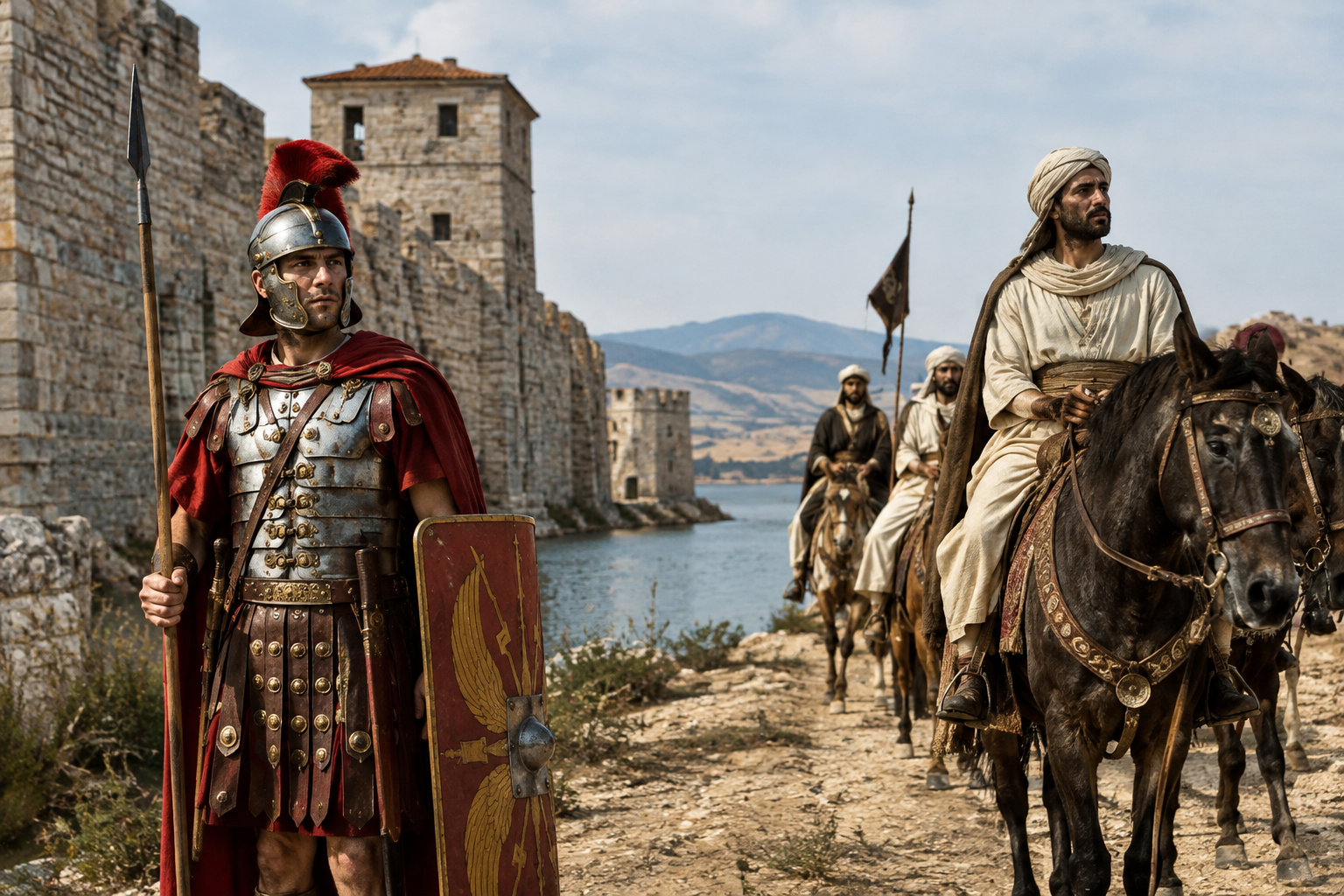
At Mursa in Roman-era Croatia, one ancient man dated to around AD 200, identified as I26749, carries an intriguingly specific paternal line in modern reporting: J1a2a1a2d2b2b2c4d. On its own, that string of letters and numbers is not a biography. But placed in its archaeological setting, it becomes a small but vivid clue to the sort of world Mursa was: a frontier city on the Danube where empire, movement, and ancestry rarely stayed neatly in one place.
The value of this haplogroup is not that it tells us everything about the man from Mursa. Y-DNA follows one direct paternal line only, not a person's whole ancestry or identity. What makes this branch interesting here is that it appears again in a very different setting: syr005, dated to around AD 717 at Tell Qarassa in medieval Syria under the Umayyad Caliphate. That is a striking pair of anchor points - Roman Pannonia and early Islamic Syria - and it invites a properly careful historical question: what sort of paternal line turns up in both an imperial Balkan city and the southern Levant across five centuries?
Mursa, near modern Osijek, stood in one of the most connected zones of the Roman world. This was not Rome itself, but a major place nonetheless: a settlement tied to roads, river traffic, military logistics, and the constant movement of people through the Danube provinces. A Y-line such as J1a2a1a2d2b2b2c4d appearing here should not be read as exotic in a theatrical sense. Roman frontier towns were full of people whose family histories had come from elsewhere in the empire, sometimes generations earlier, sometimes very recently.
The point is not that we can name I26749's father's fatherland. We cannot. The point is that the Roman Empire created settings in which eastern Mediterranean and Near Eastern paternal lines could become part of local urban populations far from their earlier centers of frequency. Research on Roman-period population change has repeatedly shown that imperial cities and military zones were often genetically mixed in ways older nationalist histories never expected. A broad ancient DNA study of the Roman world and its neighboring regions can be found here.
Mursa matters for another reason too. Croatia, and the wider Balkans, often preserve long local continuities on the maternal side alongside more visibly shifting paternal patterns through later prehistory and history. That makes a Roman-period J-line especially interesting: not because it represents "the" Balkans, but because it shows how urban and imperial history could layer new paternal branches into an already complicated regional population.
J1a2a1a2d2b2b2c4d is a very narrow terminal-style label within the wider haplogroup J1. That wider parent branch has a long and complicated history across parts of the Near East and neighboring regions. But one of the easiest mistakes in popular DNA writing is to take the entire deep history of J1 and paste it onto a much smaller downstream branch. We should not do that here.
What the present evidence supports is much more modest and much more useful. This particular lineage is associated, in the records provided here, with men found in two historically connected zones: the Roman Balkans and Umayyad Syria. That does not prove a single migration event, still less a named tribe, dynasty, or ethnic label. It does suggest that this paternal line belonged to the broad human traffic linking the eastern Mediterranean, the Levant, and imperial borderlands over a long stretch of late antiquity and the early medieval period.
The second key individual, syr005, comes from Tell Qarassa in Syria and is dated to around AD 717, squarely in the Umayyad period. Here the same haplogroup branch is no longer turning up in a Roman frontier city but in the southern Levantine world itself, in a region deeply shaped by older Roman and Byzantine rule and then by the political transformation of the early Islamic caliphate.
This is exactly the sort of context in which a J1 sub-branch makes historical sense without any need for melodrama. Syria in the 7th and 8th centuries was neither isolated nor simple. It was a land of cities, villages, military routes, agricultural districts, monasteries, markets, and administrative centers, with populations shaped by centuries of mobility before the Umayyads and continued movement under them. A paternal lineage found there might be locally longstanding, recently arrived, or part of older circulations across the Levant and beyond; archaeology and genome-wide context matter far more than the Y-line alone.
An ancient DNA study focused on Tell Qarassa and the region's burials is available here. Even without over-reading any single lineage, the site's value is clear: it places this branch in a historically grounded Syrian context rather than leaving it floating as an abstract modern DNA label.
J1 and Arabian historical context
Put the two samples together and the geography becomes the story. Mursa and Tell Qarassa are not random dots. They belong to worlds tied together first by Roman imperial structures and later by the transformations of late antiquity and the early Islamic centuries. Troops, merchants, administrators, craftsmen, pilgrims, captives, settlers, and their descendants moved across these zones for hundreds of years.
That is why J1a2a1a2d2b2b2c4d is best understood here not as the marker of one famous people, but as evidence for connectivity. In the Roman case, the branch appears in a provincial urban setting on the empire's northern edge. In the Syrian case, it appears in a region much closer to the broader Near Eastern heartlands where parts of haplogroup J1 have long histories. The combination hints that this paternal line, or closely related lines, could travel with the ordinary mechanics of empire and post-imperial society rather than through one dramatic event.
There is a useful comparison here with other work on Roman provincial mixing and eastern Mediterranean influence. Readers interested in how such ancestry could spread far from its older centers may want to look at Roman Iberia and its long genetic afterlife.
Two ancient samples are not a dynasty, not a census, and not a map of the whole haplogroup. But they are enough to make one important point. Ancient DNA becomes most interesting when it rescues lineages from the vague language of "Middle Eastern" or "Mediterranean" and places them in actual historical settings. Here, that means one man in Roman Mursa and another in Umayyad Syria.
Those contexts are very different, and that difference matters. One belongs to a Balkan city shaped by Roman power on the Danube frontier; the other to a Syrian landscape under early Islamic rule. The recurrence of the same fine-grained paternal branch across those settings suggests persistence across political upheaval and geographic spread across connected regions. It is a reminder that paternal lines can outlast empires while passing through them.
Croatia's shifting paternal lineages
If you belong to J1a2a1a2d2b2b2c4d, the strongest supported picture is not a tidy badge of ethnicity but a historical range. This branch is attested in an imperial Roman context in Croatia and in an Umayyad-period context in Syria, which places it firmly within the human networks that linked the Balkans, the Levant, and the wider eastern Mediterranean. That is already a rich historical clue. It suggests a paternal line at home in the connected worlds of antiquity and late antiquity, where cities, armies, trade, and family life carried ancestry farther than old textbooks once imagined.






Comments