Haplogroup J1a2a1a2d2b2b2c2a

– 6 min read


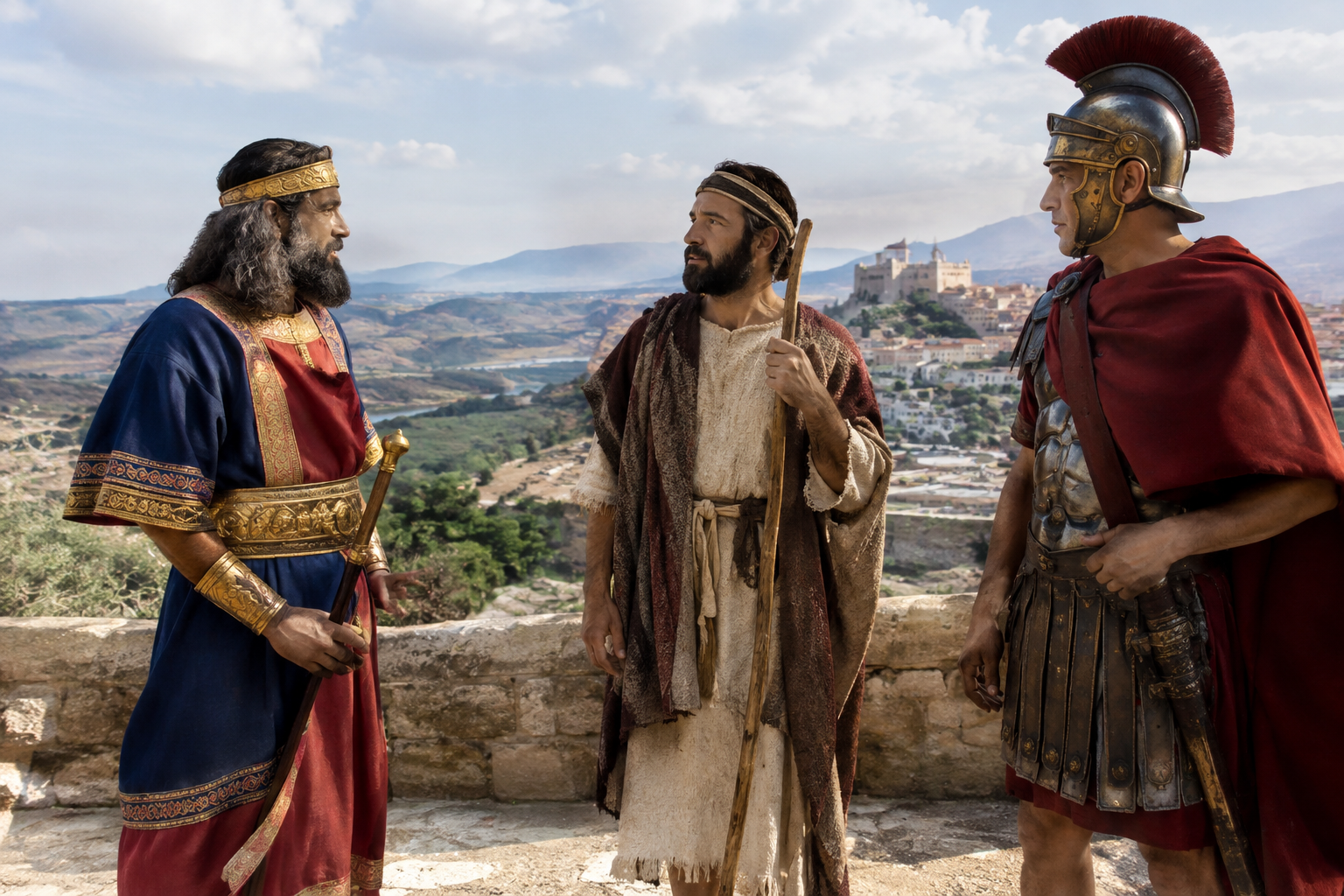
Some Y-chromosome lineages are easy to discuss because they come wrapped in familiar European royal surnames or dramatic steppe migrations. Haplogroup J1a2a1a2d2b2b2c2a is interesting for almost the opposite reason. Its story points us toward the ancient Levant and the wider Near East, into the world of Bronze Age courts, early Israelite communities, and the astonishing human traffic of the Roman Mediterranean. It reminds us that paternal ancestry is not only about kings and conquests, but about long-lived male lines that can appear in very different historical settings over more than a thousand years.
As ever with Y-DNA, a note of caution matters. A Y-chromosome haplogroup traces just one direct paternal line: father to father to father. It does not represent a person's whole ancestry, culture, faith, or identity. And with a subclade this specific, we must be especially careful not to pour the entire history of broad haplogroup J1 into one narrow branch as though nothing changed along the way. Still, ancient DNA now gives us a set of valuable glimpses into where related paternal lines were found, and those glimpses are historically rich indeed.
Broadly speaking, J1 belongs to a larger Y-chromosome family long associated in the scientific literature with parts of the Near East. That much is well established. What is harder, and more interesting, is working out how particular downstream branches were distributed in antiquity. Very specific lineages such as J1a2a1a2d2b2b2c2a are usually reconstructed not from sweeping generalisations but from the slow accumulation of ancient samples, regional studies, and careful phylogenetic comparison.
For that reason, it is safest to place this lineage in a historical setting rather than pretend we can write its entire prehistory in neat arrows across a map. The evidence supplied here points most strongly to the Levant and eastern Mediterranean world: from Bronze Age Alalakh to Iron Age Megiddo and then onward into Roman Italy. That is already a revealing pattern. It suggests that related paternal lines were present in societies tied together by trade, war, temple networks, dynastic politics, and imperial movement long before modern nations existed.
Explore How Ancient DNA Rewrites History
The most vivid way into this haplogroup's history is through the ancient individuals themselves. They are not props in a genetic morality tale. They were real men who lived in sharply different political and cultural worlds.
The earliest of the three is ALA002, described as an Amorite Nobleman Alalakh, dated to 1443 BC. Alalakh, in the Amuq Valley of what is now southern Turkey, was a Bronze Age city deeply entangled with the politics of Syria and the Levant. This was a courtly world of palaces, scribes, diplomacy, and regional elites. A paternal line related to our haplogroup appearing here is a useful reminder that the Bronze Age Near East was not a collection of isolated biblical place-names, but a connected zone of elite households and mobile populations.
Then comes I4517, an Early Israelite Megiddo individual dated to 1020 BC. Megiddo is one of those sites where archaeology keeps colliding with memory. Strategically placed in northern Israel, it sat astride routes linking Egypt, the Levantine coast, inland Syria, and beyond. To find a related paternal lineage here in the early Iron Age does not prove ethnic labels in any simple sense, but it does place this branch within the male-line landscape of a region where local continuity, political change, and new identities were all unfolding at once.
The third sample, R835, from Imperial Rome Cluana Ancona and dated to 165 AD, shifts the scene dramatically. We are now in Roman Italy, on the Adriatic side, in a world where soldiers, merchants, freedmen, administrators, pilgrims, and slaves moved around the empire in great numbers. If a related paternal line turns up in this context, one obvious historical question follows: was this evidence of long-standing eastern Mediterranean mobility into Italy, or of families already established there for generations? Ancient DNA often cannot answer that on its own, but it frames the question beautifully.
Discover Eastern Mediterranean DNA in Rome
If we stand back from those three finds, a pattern begins to emerge. This is not the pattern of one tribe marching intact across continents. That old habit of storytelling rarely survives contact with real data. What we see instead is a paternal lineage appearing in the orbit of major Near Eastern and Mediterranean systems: Bronze Age palace society, Iron Age Levantine settlement, and Roman imperial circulation.
That makes historical sense. The Levant was never a cul-de-sac. It was a corridor. Armies passed through it, merchants profited in it, empires taxed it, priests sanctified it, and families endured within it. A lineage associated with this region could easily have persisted locally in some branches while other branches travelled through military service, trade, enslavement, marriage, or migration. The Roman evidence from Cluana Ancona fits that wider Mediterranean story rather well.
Readers interested in the broader archaeology of population change in this zone may also want to compare this picture with work from Mesopotamia and neighbouring regions, where ancient DNA is steadily filling in the human detail behind familiar historical labels.
Explore Bronze and Iron Age Mesopotamian DNA
The historical association supplied alongside this haplogroup is not a conventional noble house with a tidy medieval castle. Instead, it points to something older and in some ways more powerful: Kohanim and the Temple Mount in Jerusalem. That immediately changes the register of the story. We are not dealing simply with aristocratic residence, but with sacred office, inherited religious identity, and one of the most symbolically charged places on earth.
In Jewish tradition, the Temple Mount was the site of the First Temple of Solomon and the later Second Temple, rebuilt after the Babylonian exile and enlarged under Herod before its destruction by the Romans in 70 CE. For Christians, it stood at the heart of the Jerusalem of the New Testament. For Muslims, it became one of the holiest places in Islam with the Umayyad construction of the Dome of the Rock and al-Aqsa Mosque, and with the site's connection to the Isra and Mi'raj. Across Byzantine, early Islamic, Crusader, Ayyubid, Mamluk, Ottoman, British, Jordanian, and Israeli rule, the platform remained a place where sovereignty, memory, and sanctity were never far apart.
Why does this matter for a Y-DNA article? Because paternal lineages often intersect with traditions of inherited status, office, or group identity. In the case of Kohanim, there has long been public interest in whether priestly descent traditions might preserve detectable paternal patterns. But this is exactly where one must keep a cool head. A historical or cultural association with Kohanim does not automatically prove that every bearer of a related haplogroup is priestly, Jewish, or descended from a specific biblical line. Nor does the existence of priestly descent traditions allow us to leap from an ancient sample in Megiddo or Alalakh to a named historical pedigree.
What we can say is that the geography fits a world in which paternal continuity mattered deeply, and in which male descent lines could carry social and religious significance across many centuries. In that sense, the Temple Mount is less a "castle" than an ancestral stronghold of memory: a place where lineage, ritual, and history have been argued over with extraordinary intensity.
Read About Hereditary Sacred Lineages
So what does J1a2a1a2d2b2b2c2a reveal? First, it points toward a paternal history rooted in the Near Eastern and Levantine world rather than in some late, purely medieval pedigree. Second, the ancient samples show that related male lines were present in contexts ranging from Bronze Age elite society to early Iron Age Levantine communities and the mobile population of Roman Italy. Third, the Jerusalem connection reminds us that paternal ancestry can be historically meaningful not only in dynastic politics but also in religious institutions and collective memory.
But there are limits. Shared haplogroups do not prove close kinship. They do not assign ethnicity. They do not certify descent from Solomon, Aaron, an Amorite prince, or a Roman official. Ancient DNA gives us context, comparison, and sometimes striking continuity across time. Genealogy gives us named individuals and documentary lines. The two can illuminate one another, but they are not the same thing.
That, really, is the fascination of a lineage like this one. It sits at the crossroads of archaeology, scripture, empire, and identity. Not a neat story, perhaps. A better one than neat.
If your Y-DNA places you near haplogroup J1a2a1a2d2b2b2c2a, MyTrueAncestry can help you explore how your direct paternal line compares with ancient individuals such as ALA002, I4517, and R835, and with the wider populations of the ancient Levant and Mediterranean. Those matches do not by themselves prove direct descent or membership in a priestly or noble lineage, but they can open an unusually vivid window onto your deep ancestry.






Comments