Haplogroup J1a2a1a1

– 5 min read


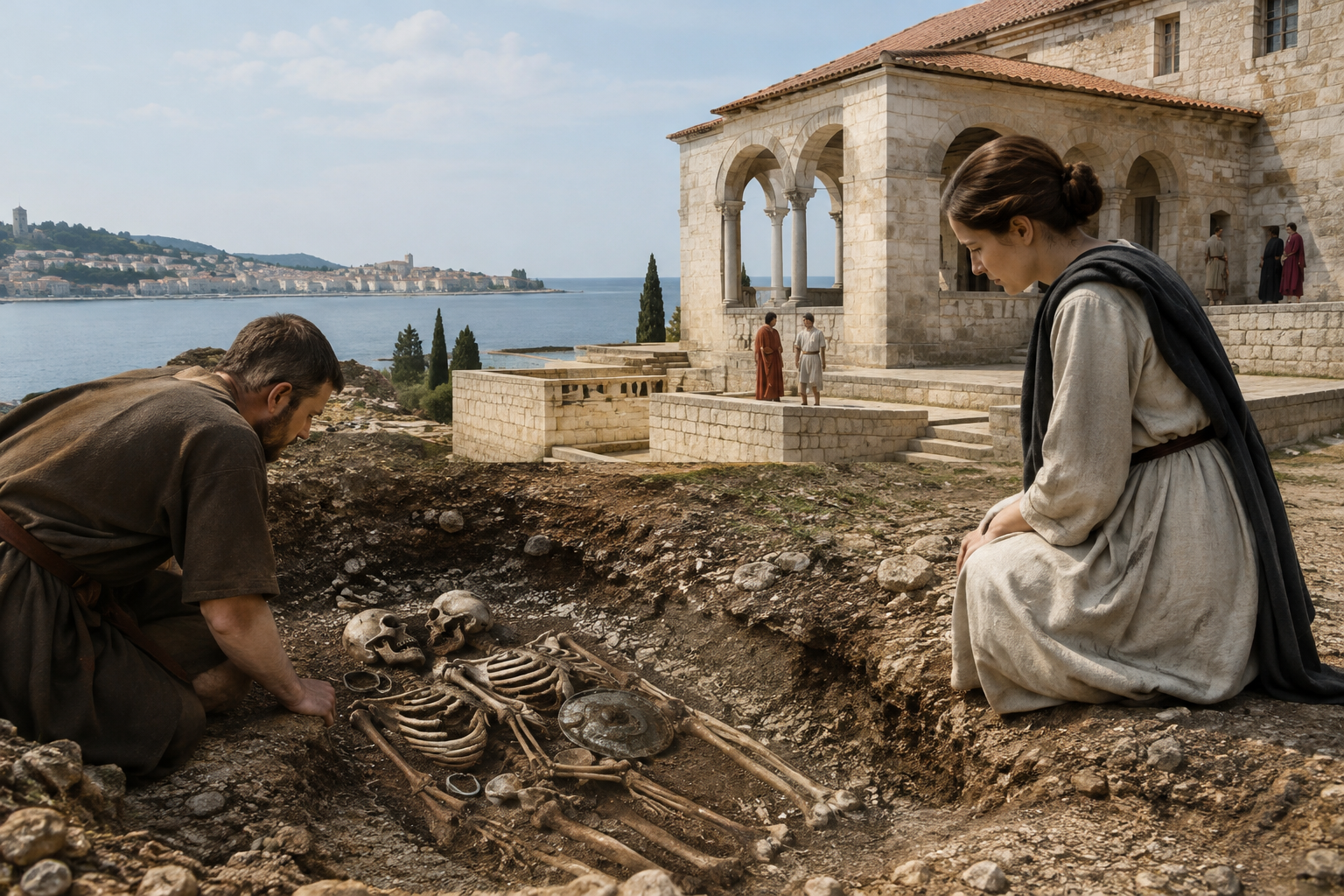
At Wels in Austria, the ancient Roman town of Ovilava produced a grave that catches the eye precisely because it does not fit a simple textbook picture of "Roman" or "Germanic." One of the men from a double burial dated to around AD 350, sample G12_01, has been associated here with the Y-DNA haplogroup J1a2a1a1. That matters not because a single lineage can tell us everything about identity, but because it places a paternal line often discussed in wider Near Eastern and Mediterranean contexts inside a late Roman frontier world usually imagined in much blunter ethnic categories.
A second clue comes from the eastern Adriatic. At Hvar, in Croatia, a Late Imperial Roman burial from the Radošević Palace site, sample I33889, dated around AD 400, is also linked here with J1a2a1a1. Two samples are not a population in miniature. Still, taken together, they give us something far more interesting than a neat origin story: they show this paternal branch turning up in the mixed, mobile, post-classical landscapes of the late Roman world.
J1a2a1a1 is a narrow paternal branch within the wider haplogroup J1. Y-DNA follows one direct male line only - father to son to son - so it is best understood as a thread, not the whole fabric of a person's ancestry. That is especially important in late antiquity, when individuals could belong politically to the Roman Empire, live culturally in mixed communities, and still carry paternal ancestry with a much deeper geographic history.
It would be careless to project the entire history of haplogroup J1 onto this smaller branch without sample-specific evidence. What the ancient finds do support is more modest and more useful: J1a2a1a1, or a very close reported association with it, appears in late Roman and frontier-adjacent settings in central Europe and the Adriatic. In other words, this is a lineage present within the human traffic of the empire's final centuries.
Roman Ovilava, modern Wels, sat in Noricum on a key corridor linking the Danube frontier to the Alpine and Italian worlds. By the 4th century AD it was part of a nervous imperial landscape, where soldiers, merchants, administrators, local families, and incomers all moved through the same towns and cemeteries. The double burial containing G12_01, described as an Imperial Roman Ovilava Germanic grave, belongs to exactly that unsettled environment.
The label "Germanic" in such contexts needs handling with care. Archaeology may indicate affiliations in burial custom or material culture, but that is not the same as proving language, self-identity, or biological homogeneity. A paternal lineage like J1a2a1a1 appearing in such a grave is therefore historically valuable: it underlines how little sense it makes to imagine late Roman frontier populations as sealed ethnic boxes.
Research on central European burials of this broad period has increasingly stressed continuity, contact, and local complexity rather than simple replacement narratives. A study connected with the region's archaeology can be found here, and it sits within a wider shift in scholarship toward seeing border provinces as social crossroads rather than neat dividing lines.
That makes G12_01 especially suggestive. Not because he can be turned into a mascot for a migration route, and not because one Y-chromosome defines a community, but because his grave sits in a place where Roman administration and non-Roman affiliations overlapped. J1a2a1a1 here is evidence of participation in that overlap.
The Croatian sample I33889, from the Late Imperial Roman site at Radošević Palace on Hvar, shifts the story southward to the Adriatic. Hvar was not an isolated island outpost. In Roman times the eastern Adriatic was knitted into networks of maritime movement, military logistics, local elite life, and exchange with the Balkans, Italy, and the eastern Mediterranean.
Around AD 400, those networks were still functioning, even as imperial power was changing shape. The appearance of J1a2a1a1 in this setting is therefore not some exotic bolt from the blue. It fits a world in which lineages, goods, languages, and loyalties circulated through ports and provincial towns, often leaving only fragmentary traces in the burial record.
The Hvar material is part of a broader discussion about long-term biological continuity and change in Croatia, where maternal and paternal patterns do not always move in lockstep. One related MyTrueAncestry discussion is worth seeing alongside this case:
Croatia's Shifting Paternal Lines
And for the specific site context, the Hvar burial ground has already been explored as a window onto Dalmatia's Roman-period population history:
Austria and Hvar are not the same landscape, and the two men need not have shared any recent paternal kinship. Yet they belong to the same larger historical moment: the 4th- to early 5th-century Roman world, when provinces were still connected but increasingly unstable, and when ancestry in almost any cemetery could be more mixed than older historical labels allowed.
That is the real interest of J1a2a1a1 here. It appears not in one isolated corner but in two different late Roman settings - one inland and frontier-facing, the other Adriatic and maritime. Neither sample proves where the branch first arose, nor does either let us assign a fixed ethnic identity. What they do show is that this paternal line was present among people living through the empire's last great age of mobility.
This is also where ancient DNA has done some of its best corrective work. For generations, historians and archaeologists often had to rely on cemetery style, imported goods, and later written labels such as Roman, Goth, or Germanic. Genetics does not replace those categories, but it complicates them in productive ways. A burial can look local and still reflect long-distance ancestry; a person in a "barbarian" context can carry a lineage familiar from Mediterranean discussions; a Roman provincial community can be far more cosmopolitan than its modern map position suggests.
For readers interested in how this wider late antique mixing looks elsewhere in Europe, one useful comparison is the growing evidence from Gothic-period communities:
Mixed-Origins Gothic Communities
Because the evidence here is sample-based and limited, caution is part of the story, not an obstacle to it. We should not pretend that two ancient men define the full range of J1a2a1a1 in antiquity, and we should not silently assume that every reported assignment reaches the same technical depth of Y-chromosome resolution. But even with those caveats, the pattern is historically meaningful.
Both G12_01 and I33889 sit in regions where Roman power connected very different peoples. One belongs to the Danubian-Alpine sphere, one to the Adriatic. Together they suggest that if you carry J1a2a1a1 today, one plausible part of your paternal past may lie not in a single tribe or kingdom, but in the dense human networks of late antiquity - military, provincial, maritime, and mobile.
A broader archaeological discussion linked to these late Roman and post-Roman transitions is available through this research reference, which reflects the current scholarly interest in how ancient DNA reshapes our view of communities once described in far simpler terms.
The most distinctive thing about J1a2a1a1, on the evidence here, is not an ancient royal claim or a tidy homeland narrative. It is its appearance in two different late Roman settings that were shaped by movement, contact, and mixed local histories. For someone researching this paternal line today, that is a useful and rather Roman lesson: your Y-DNA may preserve one direct male thread, but the world that carried it forward was already crowded with many ancestries, identities, and routes across Europe.






Comments