Haplogroup I2a1b2a2b2a
– 5 min read


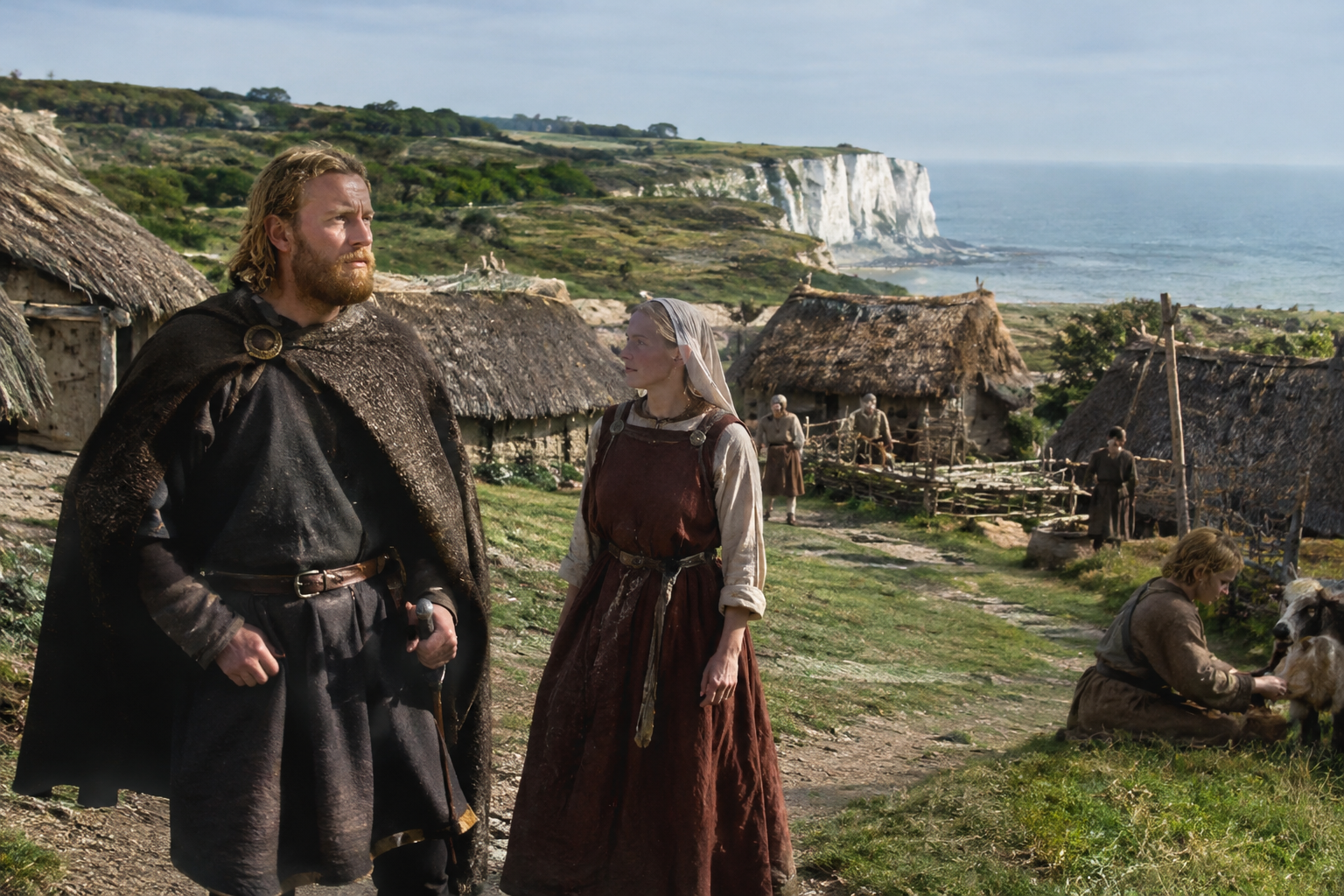
At Buckland near Dover, one early Anglo-Saxon burial has become a useful signpost for a much larger paternal history. The individual catalogued as BUK024, dated to around AD 400, belongs to the early centuries when eastern Kent was being reshaped by movements across the Channel, local survival after Roman rule, and the making of new communities in post-Roman Britain. In MyTrueAncestry's haplogroup framework, this man is associated with I2a1b2a2b2a.
That may sound forbiddingly technical, but the historical point is simpler. Y-DNA follows one direct paternal line only: father to son to son. So BUK024 does not stand for all the ancestry of early Anglo-Saxon England, nor for all the people buried at Buckland. What he does offer is a sharply focused glimpse of one male lineage present in a formative early medieval cemetery at the edge of Britain and the North Sea world.
Dover was never an isolated corner. In Roman times it was a major gateway facing the Continent, and in the centuries after imperial administration collapsed, Kent remained one of the most exposed and connected parts of Britain. That is what makes Buckland so interesting: a burial ground in precisely the region where archaeologists and historians have long asked how much continuity there was from late Roman populations, and how much came with incoming groups from across the North Sea.
BUK024 sits within that debate. The sample's dating to the early Anglo-Saxon period places him close to the beginning of the political and cultural world that would later be called English. A genetic study of this broader transformation, linked to the ancient population of early medieval England, is available here: https://www.researchgate.net/publication/363736520_The_Anglo-Saxon_migration_and_the_formation_of_the_early_English_gene_pool. Without pretending that one cemetery solves everything, Buckland belongs to exactly the kind of evidence that has changed the argument from guesswork to testable population history.
For generations, scholars argued over whether Anglo-Saxon England was built mostly by migration, mostly by cultural change, or by some mixture of both. Ancient DNA has made the picture both clearer and more complicated. In eastern and southern England, many early medieval burials do show substantial continental North Sea ancestry, but not in a neat one-for-one replacement. Cemeteries often contain people with varied backgrounds, reminding us that burial rite, language, politics, and paternal lineage are not the same thing.
The branch name matters because it places BUK024 inside the wider haplogroup I2, one of the long-established paternal lineages of Europe. But the article's lineage, I2a1b2a2b2a, is a much narrower twig on that larger tree. It should not automatically inherit every sweeping story told about haplogroup I2 as a whole, still less every tale about Mesolithic foragers or every region where I2 appears today.
What can be said responsibly is that this branch's appearance in an early Anglo-Saxon burial in Kent shows that such paternal lines were part of the male population circulating around the southern North Sea in late antiquity and the early Middle Ages. That is already historically valuable. It reminds us that the genetic formation of early England was not built from a single dominant Y-line, but from multiple male ancestries moving through related cultural zones.
One of the useful disciplines of archaeogenetics is learning not to overread a label. If a man is buried in an early Anglo-Saxon cemetery, that tells us about his archaeological and social setting. If his Y-DNA falls within I2a1b2a2b2a, that tells us about one paternal line. Neither fact, by itself, gives us his language, legal status, or a complete ethnic identity.
Kent is often treated in early medieval history as though it were self-evidently "Anglo-Saxon", but the archaeology is more interesting than that. It was a frontier region in the old Roman sense and a contact zone in the post-Roman one: facing Gaul, open to maritime travel, and densely involved in exchange. A lineage such as I2a1b2a2b2a appearing here is therefore historically plausible in more than one way. It could belong to family lines already circulating in the wider North Sea world before settlement in Britain, or to lineages moving through mixed communities where local and continental ancestry were already blending.
This is where a single sample becomes valuable not because it speaks alone, but because it joins a pattern. Early medieval England, especially in the southeast, repeatedly turns out to have been peopled by communities with both mobility and complexity. Kent was not simply receiving anonymous "tribes". It was hosting households, kin groups, retainers, and newcomers of varied ancestry who became part of new local societies.
Roman and early medieval Britain
The location of Buckland at Dover sharpens that point. Dover had been one of Roman Britain's key ports, and post-Roman communities did not suddenly forget the sea routes. When early medieval burials appear in such a landscape, we are looking at people living amid inherited infrastructure, remembered connections, and fresh crossings. That does not mean every man at Buckland was a first-generation migrant. It does mean the cemetery belonged to a world where movement across the Channel was normal enough to leave a clear genetic imprint.
There is a temptation, when confronted with a very precise haplogroup label, to imagine a grand chain of descent stretching cleanly from one ancient grave to a modern tester. Real history is not so tidy. Yet BUK024 matters precisely because he is securely anchored in place and period: Buckland, Dover, early Anglo-Saxon England, around AD 400. That gives I2a1b2a2b2a an archaeological foothold in one of the best known historical transitions in northwestern Europe.
It also helps correct a common misunderstanding about early medieval Britain. The emergence of English kingdoms was not simply a matter of uniform invaders overwhelming a passive landscape. Ancient cemeteries keep showing something more human and more untidy: migration, local continuity, intermarriage, and the creation of new identities on the ground. A paternal lineage like this one belonged within that process.
In other words, BUK024 is interesting not because he can be turned into a mascot for a whole people, but because he resists that simplification. His lineage sits in a cemetery associated with the early Anglo-Saxon period, in a region famous for contact with the Continent, and in a time when old Roman provincial identities were giving way to something new.
Germanic languages and genomics
If your own Y-DNA falls under I2a1b2a2b2a, the Buckland evidence does not prove descent from BUK024, or from Kent specifically. What it does provide is something more solid than fantasy genealogy: this paternal branch was present in an early Anglo-Saxon burial community in southeastern England during the centuries when post-Roman Britain was being remade. That places the lineage in a historically vivid setting shaped by Channel mobility, settlement, and the formation of early English society.
For family historians, that is a useful kind of anchor. It suggests that this branch belongs comfortably within the paternal diversity of the North Sea and early medieval English world, where lineages, languages, and loyalties were still being assembled in real time.






Comments