Haplogroup I2a1b2a1
– 5 min read


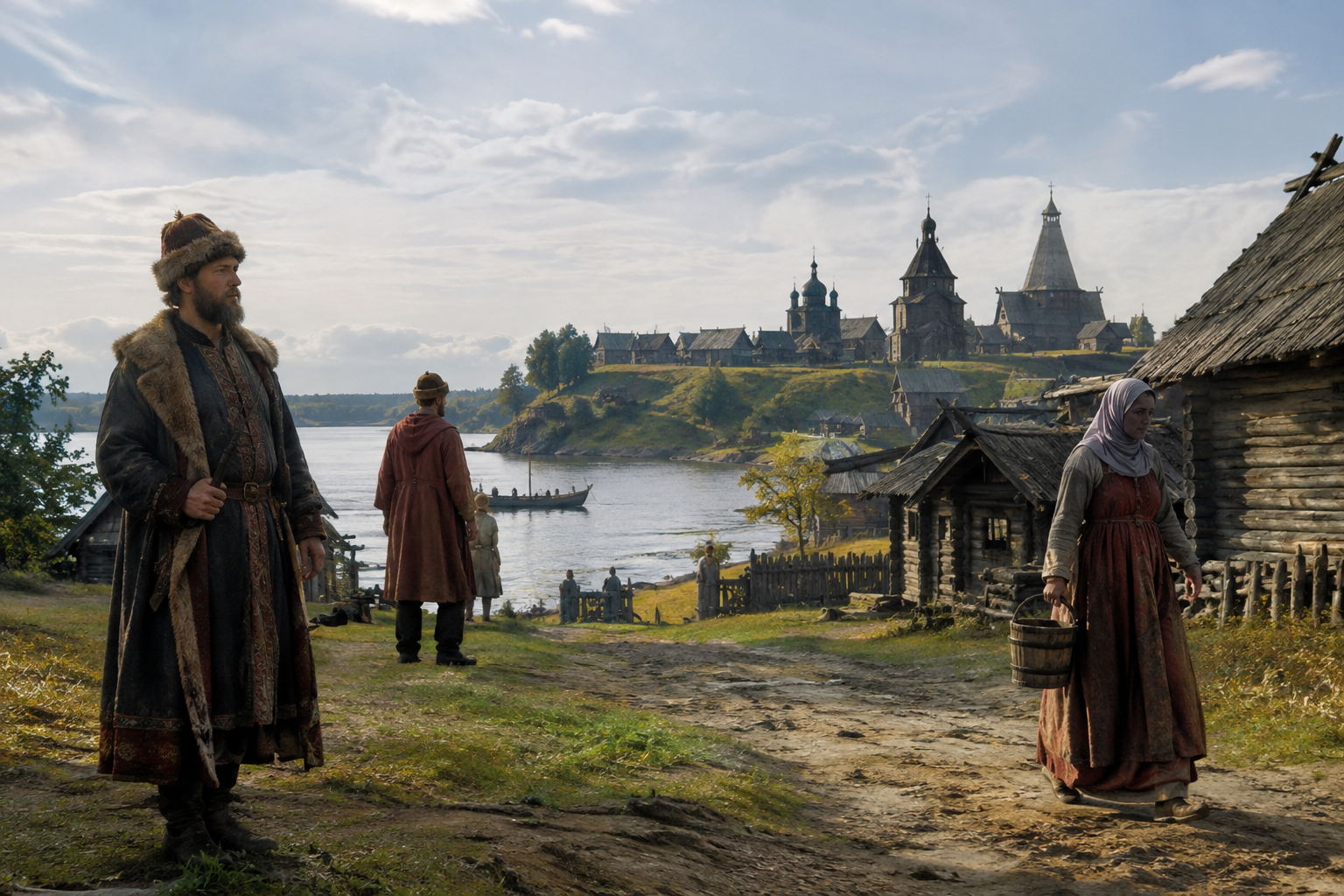
At Gorokhovets in medieval Russia, one ancient man offers a small but telling window onto the Y-DNA haplogroup I2a1b2a1. The sample, identified as GOS001 and dated to around 1200 AD, comes from a period when the towns and river routes of northeastern Rus' were tied into trade, warfare, Christianization, and constant regional negotiation. With only a single named individual in view, the attraction is not spectacle but precision: one paternal line, fixed to one place and one historical horizon.
That matters because Y-DNA does something quite specific. It traces a direct paternal line only, not a person's whole ancestry, language, or identity. In the case of I2a1b2a1, the ancient evidence supplied here is modest, but it is still valuable: it places this lineage in the lived world of medieval Rus', not as an abstraction on a tree diagram, but as the lineage of an actual man from Gorokhovets.
Gorokhovets lies east of Moscow on the Klyazma River, in a landscape that became increasingly important in the high medieval centuries. By about 1200 AD, this was a frontier no longer in the raw sense of untouched land, but in the political sense: a zone shaped by princely competition, church building, river traffic, and the expansion of Slavic-speaking societies into areas that had long seen interaction with Finno-Ugric populations.
Sample GOS001 belongs to that complicated world. A man carrying I2a1b2a1 in this setting reminds us that medieval Rus' populations were not genetically uniform blocks marching neatly in from one direction. They were communities formed over centuries of movement, mixture, local continuity, and assimilation. One paternal lineage in one burial cannot stand for the whole town, of course, but it can anchor the haplogroup in a real historical setting.
The most important point with a lineage like I2a1b2a1 is scale. Haplogroup I is an old European Y-chromosome family, and its branch I2 has a deep history in Europe. But a narrower label such as I2a1b2a1 is not interchangeable with the whole of I2, still less with every ancient movement ever associated with I2 lineages. The narrower the branch, the more careful we must be.
So the Gorokhovets sample is best read conservatively. It shows that a man associated with this branch was present in medieval Russia around 1200 AD. It does not by itself prove where the branch first formed, which language its earlier carriers spoke, or whether it arrived in the region recently or represented longer local continuity. Good archaeogenetics is often like that: less trumpet blast, more patient placement.
That patience is especially necessary in eastern Europe, where paternal lineages can reflect very old population layers overlaid by later political and cultural change. A medieval burial may belong to a Christian town under a Rus' prince, while the deeper paternal ancestry behind it could stretch through centuries of regional interaction that predate that political order entirely.
The interest of GOS001 becomes clearer when set against the wider archaeological story of northeastern Europe. Medieval Rus' was never an isolated ethnic capsule. It sat between forest and steppe, between Scandinavian-linked trade routes and inland river networks, and between older local populations and expanding princely states. Ancient DNA studies of the wider region have repeatedly shown that medieval eastern Europe was full of variation, not a flat map of one people with one origin.
Research on ancient populations from Russia and surrounding regions has helped underline that point, even when individual samples are few or unevenly preserved. A study available through this ancient DNA research paper contributed to the growing picture that medieval and earlier populations in the forest zone were shaped by both continuity and contact. That is the proper frame for I2a1b2a1 at Gorokhovets: not as an isolated curiosity, but as part of a layered regional history.
And there is a second reason not to rush to grand conclusions. Medieval towns often drew people in. Clergy, craftsmen, traders, retainers, and farming families could all end up in the same settlement orbit. A paternal lineage found at Gorokhovets therefore tells us that this branch was present there; it does not automatically tell us whether that line had deep roots in the immediate district or arrived through marriage, service, trade, or earlier migration.
There is a temptation to think that one sample is too little to say anything useful. In one sense, yes: one sample cannot define a population. But in another sense, one sample is exactly how the map of the past gets built. Every securely identified ancient individual adds a point of contact between genetics, archaeology, and history.
For I2a1b2a1, GOS001 is one of those points. He shows that this paternal branch was part of the demographic fabric of medieval Russia at the time when the principalities of Rus' were developing regional identities that would later be transformed again by conquest, state formation, and demographic change. That alone is historically meaningful.
It is also a good reminder that lineages now discussed in family history forums once belonged to men who lived in specific places with specific local histories. Gorokhovets was not merely "eastern Europe" in the abstract. It was a settlement tied to river movement, local power, parish life, and the social realities of the late twelfth and early thirteenth centuries.
One of the enduring historical questions in this part of Europe is how medieval populations formed as Slavic-speaking communities expanded across regions that had older inhabitants and older networks of exchange. Y-DNA cannot solve that question alone, but it can sometimes show that medieval paternal lines were not all newcomers of a single type. The presence of I2a1b2a1 in Gorokhovets fits comfortably with a picture of mixed regional ancestry rather than simple replacement.
That is why this sample belongs in conversation with broader work on eastern and northern European population history, including discussions of Slavic-era genetic change and the deeper prehistory of the forest zone. The paternal line itself is only one thread, but it can still help distinguish between simplistic migration stories and the messier, more human reality of settlement and integration.
Slavic populations in ancient DNA
If your paternal line belongs to I2a1b2a1, the Gorokhovets individual does not hand you a ready-made dynastic story or a neat ethnic badge. What it does offer is something more useful and more honest: evidence that this branch was present in the population world of medieval Rus', in a riverine town of northeastern Russia around 1200 AD. That places the lineage within a historically rich zone where local continuity, Slavic expansion, and regional mixture all mattered.
For family historians, that is the real value of ancient DNA. It does not reduce the past to one label. It shows that a paternal line like I2a1b2a1 was carried by real people living through the dense, untidy history of medieval eastern Europe.






Comments