Haplogroup I2a1b1a2b1a2b3

– 6 min read


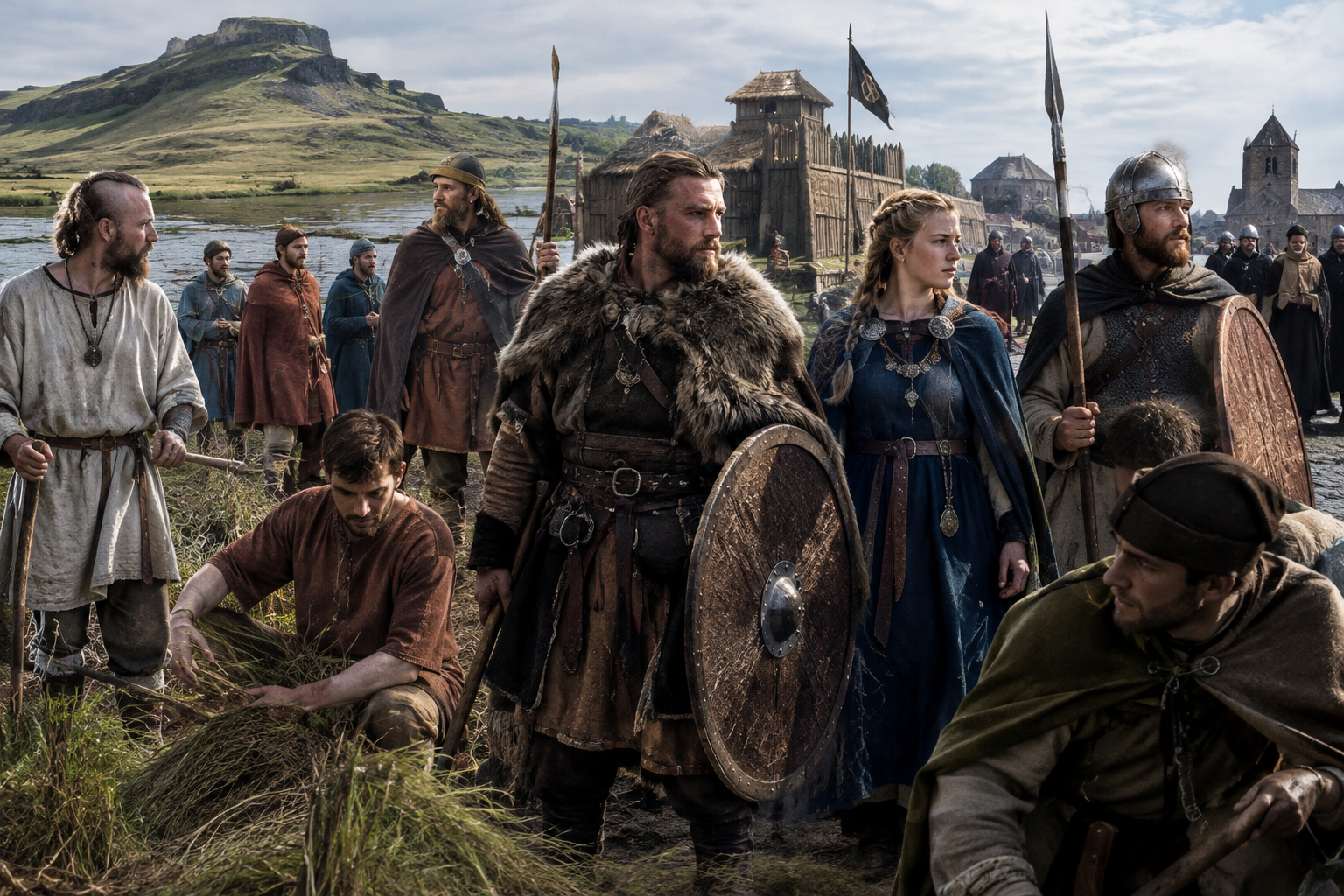
Some Y-DNA branches are interesting because they appear in one dramatic royal burial or one famous battlefield. Haplogroup I2a1b1a2b1a2b3 is interesting for a different reason. The evidence supplied here places it again and again in southern Scandinavia and then across the North Sea into early medieval and Viking Age England. That makes it less a story of a single spectacular dynasty than of a durable paternal line moving through the very worlds that produced Jutes, Angles, Danes, and Vikings.
It is worth saying at the outset what a Y-DNA haplogroup can and cannot tell us. Y-DNA tracks one direct paternal line only: father to son to son across generations. It does not represent a person's full ancestry, still less culture, language, or identity on its own. But when ancient DNA places the same paternal branch in multiple archaeological contexts, it gives us a remarkably crisp way of following one thread through a much larger historical fabric.
The haplogroup named here, I2a1b1a2b1a2b3, is a very specific downstream branch within the broader Y-chromosome haplogroup I, one of the major old European paternal lineages. For an ordinary reader, the long string of letters and numbers may look forbidding, but in practice it means that this is not a vague continental category. It is a narrow twig on a very large family tree.
That distinction matters. We should not simply take the whole history of broad haplogroup I2 and pin it directly onto this much narrower branch. What we can say, from the ancient samples provided, is that this lineage is documented in Iron Age and Viking Age Denmark and in early medieval and Viking Age England. That pattern fits well with what historians and archaeologists already know about movement around the North Sea: people crossing between Jutland, Zealand, eastern England, and later the Danelaw and Viking kingdoms.
For readers who want more background on the deeper prehistoric setting of southern Scandinavia, the community article on Denmark's early population history is a useful companion.
The strongest anchor for this haplogroup in the supplied material is Denmark. And not Denmark in the abstract, but Denmark as archaeology actually finds it: bogs, coastal edges, island settlements, and burial grounds tied to communities living in the shadow of Rome but outside the Roman world.
One of the earliest samples is CGG019202, described as Jute Early Roman Era Denmark Jutland Bog War Alken Enge Year:81 AD. Alken Enge is already famous as a place of conflict and deposition, a watery landscape that preserved grim evidence of Iron Age violence. A paternal line found there immediately places this branch in the sort of society Roman writers only glimpsed from afar: armed groups, regional loyalties, and communities whose dead could end up in extraordinary ritual or post-battle contexts.
From eastern Denmark comes CGG107412, Iron Age Denmark Eastern Sjaelland Varpelev Year:115 AD. Then there is CGG106726, Danii Tribe Denmark Sjaelland Kalundborg Simonsborg Year:175 AD, and CGG107480, Jute Iron Age Denmark Jutland Bulbjerg Year:175 AD. Taken together, these samples suggest not an isolated family accident but a lineage present in more than one part of Denmark, across both Jutland and Zealand, in the first and second centuries AD.
There is an almost pleasing historical neatness to that distribution. Jutland and the Danish islands were precisely the kind of connected but regionally varied world from which later historical peoples such as Jutes, Angles, and Danes emerged. The haplogroup evidence does not prove ethnicity, of course, but it does place this paternal line in the same geography from which those identities were later formed and recorded.
By the Viking Age the line is still visible. CGG017609, Viking Age Denmark Borre Enge Year:793 AD, shows its continued presence in Denmark at the opening edge of the Viking world. That matters because it hints at paternal continuity across many centuries: not one line flashing briefly into view, but one that endured through profound changes in trade, warfare, seafaring, and political organization.
For a broader look at how archaeogenetics reconstructs exactly these sorts of long developments, this article gives an excellent overview.
The most vivid historical turn in this story comes when the lineage appears in England. LAK004, listed as Angle Early Medieval Suffolk England Lakenheath Year:650 AD, places the branch in an Anglo-Saxon setting in East Anglia. That is exactly the kind of evidence historians love: not because it solves everything, but because it gives material form to movements described in texts and inferred from archaeology.
If a paternal lineage seen earlier in Denmark later appears in Suffolk, one plausible interpretation is that we are looking at the kind of North Sea mobility associated with early medieval migration and settlement. That is a historical interpretation, not proof of a direct line from any Danish sample to this man in Lakenheath. Still, the geographical logic is powerful. East Anglia was one of the English regions most closely tied to the North Sea world.
Then comes VK150, Viking St. Brice Massacre Oxford Year:1002 AD. Here the lineage appears in one of the most charged moments of Anglo-Scandinavian history: the St. Brice's Day massacre. In this case, the haplogroup is no longer simply part of Iron Age Denmark or early Anglo-Saxon settlement; it is present in England during the age of Viking conflict, royal policy, and lethal tension between English rulers and Scandinavian settlers or mercenaries.
These English samples make the branch historically compelling because they show the same paternal thread turning up in two different phases of contact: first in the world of Anglo-Saxon migration, later in the Viking Age. Readers interested in that wider setting may enjoy this related piece on the making of the early medieval English gene pool.
At first glance, the House de Robillard seems to belong to a different world altogether. Its seat, the Chateau de Robillard in Saint-Andre-de-Cubzac in Gironde, lies north of Bordeaux on the Dordogne, in a landscape shaped by river traffic, vineyards, farming, and lordship. This is Aquitaine: a region with Roman depth, medieval political drama, and early modern wealth tied to land and trade.
And yet this is exactly where genetics and history become interesting together. Not because we can leap from Danish Iron Age burials to a French noble house and claim a family tree - we cannot - but because lineages travel through long historical processes, while estates and chateaux preserve the later social worlds into which those lineages may eventually be folded.
The description supplied for Chateau de Robillard is especially useful because it resists fantasy. This was not primarily a frontier fortress. It belongs to that later layer of rural noble display in which status, landholding, and control of surrounding resources mattered as much as defense. In other words, the chateau sits in a lived historical landscape, not an isolated fairy-tale setting.
Saint-Andre-de-Cubzac itself stood within a region repeatedly reshaped: by Roman occupation, by the long Anglo-French struggles of the Middle Ages, by the growth of the wine trade, and by the Revolution. That makes the Robillard story a good reminder that noble families existed in places already deep with earlier population history. Medieval and early modern houses did not spring from the soil fully formed. They occupied old corridors of movement and exchange.
Readers interested in the family and its historical setting can continue with the dedicated community article below.
Discover the House de Robillard
So what does haplogroup I2a1b1a2b1a2b3 reveal, responsibly understood? First, it points to a paternal lineage documented in Denmark from the Early Roman Era through the Viking Age. Second, it appears in England in contexts linked to both Anglo-Saxon and Viking-period North Sea movement. Third, it shows how ancient DNA can illuminate broad historical processes - mobility, continuity, settlement, and conflict - without collapsing them into simplistic claims of ethnic purity or direct descent.
As for later noble families such as the House de Robillard, the value of the comparison is contextual. Castles, estates, and surnamed lineages belong to the written historical world; ancient samples belong to the archaeological one. Genetics helps bridge those worlds, but only carefully. A shared broad haplogroup is not proof that an Iron Age man from Jutland was the ancestor of a later lord in Aquitaine. What it does show is that paternal lines can endure, divide, travel, and reappear in very different social settings across centuries.
If this lineage appears in your own results, that places one branch of your paternal ancestry within a story that touches Iron Age Denmark, early medieval England, Viking Age mobility, and the long making of historical Europe. That is quite enough to be interesting without inventing anything more.
MyTrueAncestry lets you compare your DNA with ancient individuals and historical populations, offering a fresh way to think about where one small part of your ancestry may fit into the human past. Those matches do not automatically prove direct descent from any ancient sample or noble house, but they can open remarkable historical perspectives on your family's deeper background.
If you want to see whether your DNA connects with ancient Scandinavians, early medieval Britons, Vikings, or other peoples from the archaeological record, start exploring your results on MyTrueAncestry.






Comments