Haplogroup I2a1b1a2b1a2a1a1a1a1a
– 5 min read


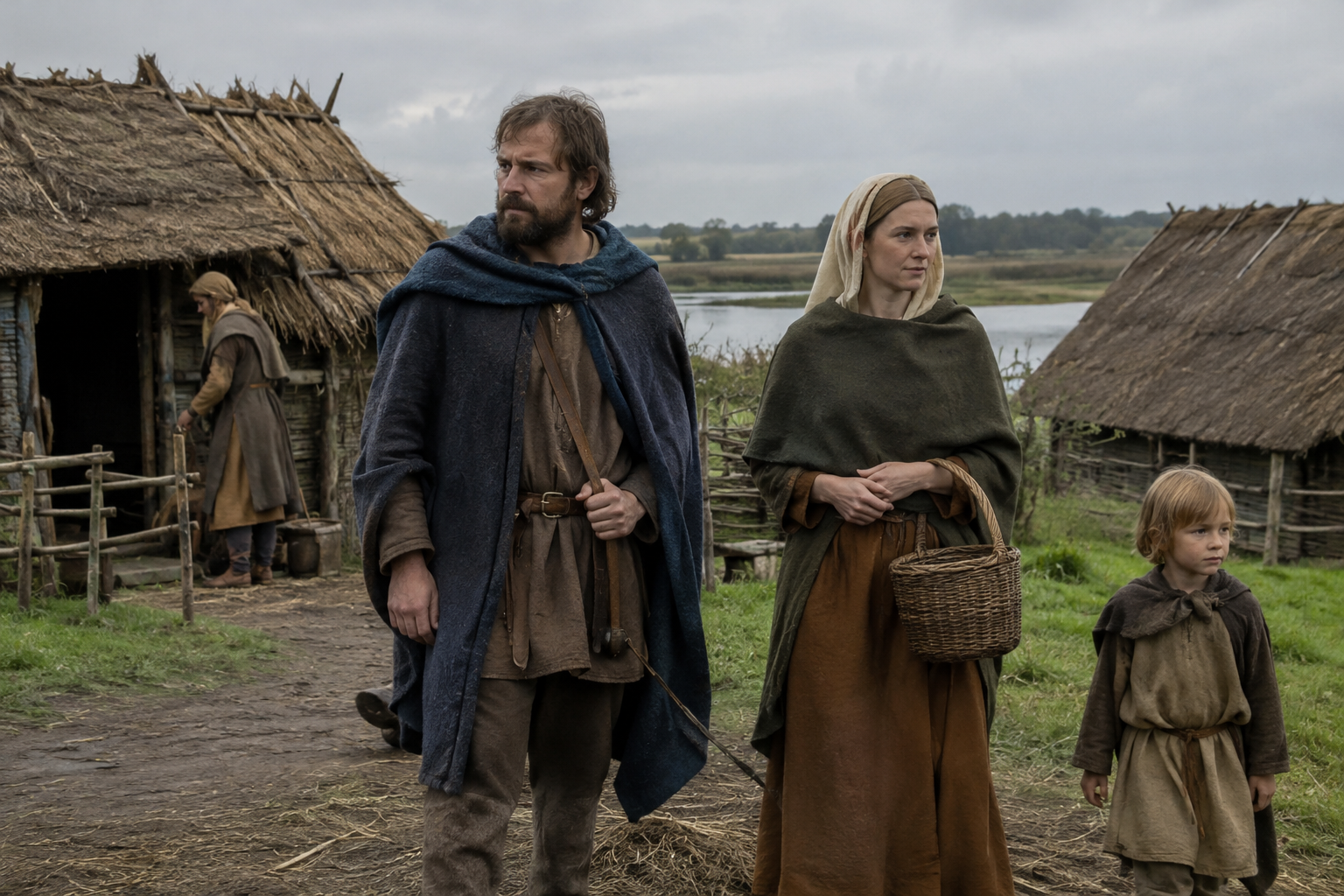
At Lakenheath in Suffolk, one early medieval man has become a small but telling witness to a very large historical change. Sample LAK015, dated to around AD 650, comes from a period when eastern England was no longer Roman, not yet fully "English" in any modern sense, and densely entangled with migration, local continuity, and new political identities. His reported paternal line is placed within the extraordinarily fine-grained Y-DNA branch I2a1b1a2b1a2a1a1a1a1a.
That formidable string of letters and numbers is, of course, only one line of descent: father to father to father. It does not define the whole ancestry, language, or identity of the man buried at Lakenheath. But in a place like seventh-century Suffolk, where archaeology and genetics are both trying to understand how post-Roman Britain became early medieval England, even one paternal lineage can sharpen the picture.
Lakenheath lies in a part of England that mattered enormously in the centuries after Rome's withdrawal. East Anglia sat close to the North Sea world, facing the Low Countries, northern Germany, and southern Scandinavia. Archaeologists have long known that this was one of the key regions for the settlement patterns usually described as Anglo-Saxon, but genetics has complicated the old habit of imagining a simple replacement of one people by another.
That is where LAK015 becomes interesting. He belongs to the middle of the seventh century, by which time kingdoms, cemeteries, speech communities, and inherited landscapes had all been reshaped by several generations of contact. A man living then in Suffolk was inhabiting a world already formed by migration, but also by marriage, landholding, and local survival. His Y-chromosome branch may be very narrow, yet its importance lies in the setting: not an abstract map, but a real person in a real early medieval community.
An ancient DNA study examining this broader transformation in England, The Anglo-Saxon migration and the formation of the early English gene pool, helped show just how regionally varied and historically layered this process was. The big lesson from work of that kind is not that every burial can be neatly labeled, but that eastern England often preserves especially strong evidence for ancestry connected to North Sea migration alongside enduring local complexity.
Anglo-Saxon migration and early English DNA
The article haplogroup here is not simply haplogroup I, or even a broad I2 category, but the very specific branch I2a1b1a2b1a2a1a1a1a1a. Such deep subclade labels reflect the increasingly fine resolution of modern Y-DNA analysis. They are useful because they can separate men who share a remote paternal ancestor from those who share a much more recent one.
Still, caution is essential. A narrow branch name does not automatically come with a securely known homeland, ethnicity, or historical "tribe." The wider I2 family has deep European roots and a long prehistoric history, but that does not license us to assign the same whole biography to this precise terminal branch. For LAK015, the safest reading is practical rather than grandiose: this is one paternal line present in early medieval Suffolk, during the formation of the early English population.
That matters because early medieval England was not made by a single male lineage sweeping everything before it. It was made by many paternal lines, some arriving from across the North Sea, some already present in Britain, and some impossible to sort cleanly into modern historical boxes. A lineage like I2a1b1a2b1a2a1a1a1a1a reminds us that even in regions strongly associated with Anglo-Saxon migration, the male population was not genetically uniform.
It is tempting to turn a seventh-century Suffolk burial into a tidy ethnic label: Anglo-Saxon, Brittonic survivor, migrant descendant, local farmer in a new kingdom. Real life was almost certainly messier. By around AD 650, eastern England had already seen generations of movement and mixture. Political authority had changed, burial customs had changed, and probably speech had changed too, but people themselves did not arrive as neat categories.
That broader context is one reason LAK015 deserves attention even without a lavish grave narrative attached to him. The value of this sample is not that he was necessarily exceptional, but that he helps populate a real demographic landscape. Archaeogenetics is most illuminating when it shifts the conversation from legendary founders to ordinary inhabitants of historical turning points.
In that sense, Lakenheath belongs with a growing body of work showing that post-Roman Britain was neither simple continuity nor simple replacement. It was a long renegotiation of population, kinship, and identity. Y-DNA can illuminate one thread in that renegotiation, especially in places where migration from the Continent was substantial but never socially or biologically total.
Roman and early medieval Britain genomes
There is an old temptation in both genealogy and history to care only about kings, famous invaders, or dynasties with names attached. Ancient DNA has been quietly undermining that habit. Sample LAK015 matters precisely because he is not presented here as a celebrated ruler or a legendary ancestor. He is important because he belonged to the population that actually lived through the making of early medieval England.
For men who carry related I2 branches today, the significance is not a claim to one named person from Suffolk. The significance is that this paternal line, or one very close to it, was present in eastern England in the seventh century, within a society shaped by North Sea migration and local survival alike. That is already a rich historical setting.
It also fits a wider pattern visible in other MyTrueAncestry discussions of early medieval movement around Europe: language spread, political change, and paternal ancestry do not line up in perfectly matching blocks. They overlap, but they are not the same thing. A Y-line can persist through changes in culture, kingdom, and even language.
Germanic languages and ancient genomics
Seventh-century Suffolk was part of one of the most archaeologically famous regions of early medieval Britain. Even when a particular sample comes without a dramatic hoard or a celebrated ship burial, the regional backdrop matters. East Anglia sat within a lively corridor of exchange linking England to the Continent, and its cemeteries have long been central to debates about migration, identity, and the emergence of English kingdoms.
So LAK015 should be read not as a solitary curiosity but as evidence from a zone where ancestry studies are especially informative. The presence of a highly resolved I2 subclade there reminds us that the male population of early East Anglia included lines that do not reduce to a single migration legend. The archaeology of the region shows cultural transformation; the genetics adds the human texture of many different family histories moving through that transformation.
Ancient DNA in post-Roman Britain
The most responsible insight from haplogroup I2a1b1a2b1a2a1a1a1a1a is not a sweeping tale of conquest, but a precise historical foothold. With LAK015 at Lakenheath, this paternal branch appears in early medieval Suffolk around AD 650, right in the heart of the demographic and cultural changes that formed early England. For anyone researching this line today, that places at least one bearer of the branch in a historically important North Sea-facing community where migration and local continuity were working together, not separately.






Comments