Haplogroup I2a1b1a2b1a2a1a

– 6 min read


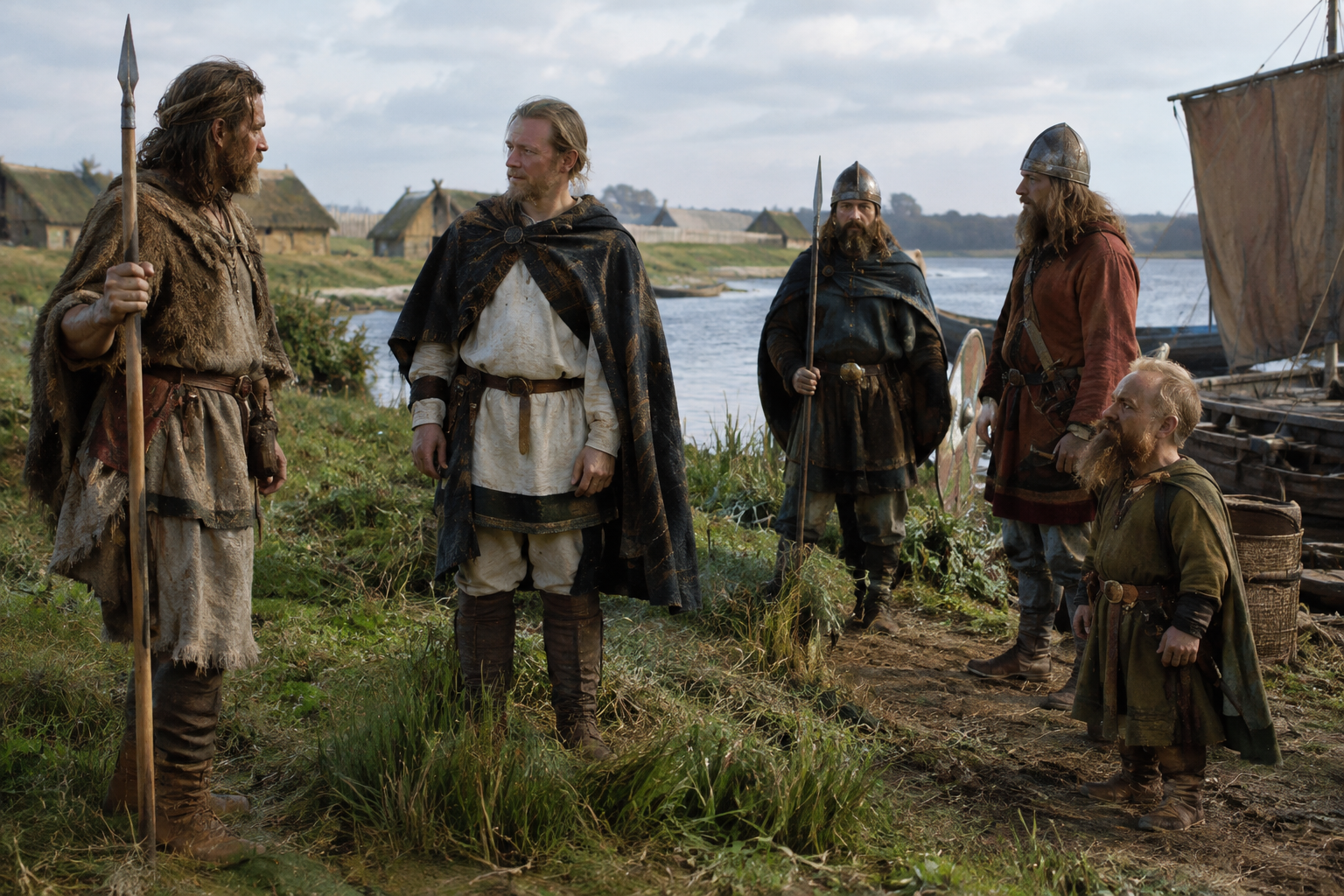
Some Y-chromosome lineages are easiest to understand when they turn up not in abstract trees of letters and numbers, but in real people dug from real ground. Haplogroup I2a1b1a2b1a2a1a belongs to one of those stories. It sits within the wider I haplogroup family, a deeply European branch of paternal ancestry, and its significance lies less in grand slogans than in the pattern of where it appears: northern Europe, the Baltic world, and the Scandinavian sphere of the Roman and Viking ages.
That needs one important caution at the outset. A Y-DNA haplogroup traces only one line of descent: the direct paternal line, father to father to father. It is not a person's whole ancestry, and it does not by itself assign someone to a nation, language, or noble house. But when ancient DNA places related paternal branches in Jutland, Oland, and Uppsala across many centuries, we get a rather striking historical frame for this lineage: one tied to the North Sea and Baltic worlds, to mobility as much as continuity, and to the long human history behind later medieval families and castles.
As a subclade within haplogroup I2, I2a1b1a2b1a2a1a belongs to a wider paternal family that has long been associated with Europe. For this very narrow branch, however, caution matters. We should not simply borrow the entire history of all I2 lineages and paste it onto this one. What we can say, from the evidence supplied here, is that this branch has meaningful archaeological visibility in Scandinavia and adjacent northern regions during the first millennium AD.
That already makes it historically interesting. The first millennium in northern Europe was not static. It saw contacts across the Danish islands, Jutland, southern Sweden, the Baltic, and eventually the North Sea routes into Britain. Populations moved, traded, raided, married, and settled. Paternal lines could persist in one region for centuries and yet still travel with expanding political and maritime networks.
If you want broader background on how archaeogenetics lets us reconstruct such histories, MyTrueAncestry's overview of the field is a useful companion.
The earliest supplied anchor for this haplogroup's story comes from Denmark. One sample is listed as CGG019212, described as Jute Early Roman Era Denmark Jutland Bog War Alken Enge, dated 115 AD. Alken Enge is famous for its association with large-scale violence, a place where human remains were deposited in a wetland after conflict. Even without pushing beyond the data given, the context is powerful: this is not an anonymous marker in a spreadsheet, but a man caught up in the hard politics of Iron Age northern Europe.
Another Danish sample, CGG107532, is identified as Danii Tribe Denmark Forevejlegard, dated 175 AD. The label points us toward the tribal landscapes of Roman-era Denmark, when communities in southern Scandinavia were living in the shadow of the Roman world without being absorbed into it. Here, paternal lineages help reveal something written sources barely can: the biological presence of related male lines among populations that later historians would place in the orbit of early Germanic peoples.
These two Danish finds matter because they suggest that lineages relevant to I2a1b1a2b1a2a1a were already established in Denmark in the second century AD. That does not prove a single local dynasty, still less a direct line to any later family. But it does place this paternal history in a very concrete setting: Jutland's contested landscapes, where tribal identities, warfare, and regional power were already taking shape.
Readers interested in the deeper prehistoric background of Denmark may also enjoy this related study of the country's far older population transitions.
By the Viking Age, the trail continues across the Baltic. Two samples from Oland in Sweden, VK342 and VK348, are both dated to 950 AD. Oland was no sleepy backwater. It sat in the middle of Baltic traffic, connected to trade, seafaring, and the social changes of the late Viking Age. Finding this lineage there suggests either continuity across the Scandinavian world, movement between Denmark and Sweden, or both. In truth, those are not mutually exclusive possibilities.
A third Swedish sample, VK517, is listed as Viking Age Dwarf Uppsala Sweden and dated 1050 AD. Uppsala carries obvious historical weight as one of the great centers of early Swedish power and religion. Even with only the supplied description, the sample places this paternal branch within the orbit of a region that would become central to the formation of medieval Scandinavian kingdoms.
Taken together, the Danish and Swedish samples sketch an intriguing arc from Roman-era Denmark to Viking Age Sweden. Not proof of one uninterrupted family tree, of course, but evidence that related paternal ancestry could be present across the northern world over many centuries. That is exactly the kind of pattern ancient DNA is good at detecting: not legendary founders, but repeated appearances of lineages in places connected by geography, trade, and power.
For more on this wider world, the MyTrueAncestry community has an excellent article on Viking-period population history.
Now, if a lineage appears in Roman-era Denmark and Viking Age Sweden, one naturally asks what this might mean for later Britain. The careful answer is: context, not proof. Northern Britain and eastern England were shaped over centuries by movement across the North Sea, including Anglo-Saxon, Scandinavian, and later Norman networks. A Scandinavian-associated paternal branch turning up in the historical background of Britain would be entirely plausible. But plausible is not the same as demonstrated for any one named medieval family.
That is where castles and noble houses come in, not as genetic proof, but as historical landmarks in regions profoundly shaped by these long northern connections. Consider Alnwick Castle in Northumberland, the great seat of the House of Percy. Begun soon after the Norman Conquest in the late 11th century, it was built to control the border zone between England and Scotland. Over time it became the power base of one of the most formidable noble houses in northern England, deeply involved in border warfare, rebellion, and royal politics. Damaged, rebuilt, partly neglected, and then dramatically restored in the 19th century, Alnwick still stands as a monument to how medieval families rooted themselves in contested landscapes.
Northumberland is precisely the kind of region where the older story matters. Long before the Percies, this was a frontier touched by successive waves of movement from the North Sea world. That does not make the Percy male line genetically Scandinavian, still less specifically assignable to I2a1b1a2b1a2a1a. It does, however, make Alnwick a fitting historical backdrop for thinking about how ancient paternal lineages can persist, mix, and reappear in later political worlds.
Readers who want to follow that family history directly can continue with the Percy article in the community archive.
The House of Boleyn offers a rather different example. Hever Castle in Kent began as a country house in the 13th century and became a moated castle in the 14th century under the Cobham family. It is best known, of course, as the childhood home of Anne Boleyn in the early 1500s, before Henry VIII married her and turned English politics upside down. After later decline, it was restored in the early 20th century by William Waldorf Astor, whose works shaped much of the landscape visitors know today.
Why include the Boleyns in a story that otherwise points north? Because they remind us of a basic rule in genealogical history: family fame and genetic certainty are not the same thing. A noble house may be historically associated with a haplogroup in community discussion, but that does not prove that every branch, every documented member, or every famous individual belonged to that exact paternal lineage. Castles preserve memory wonderfully; they preserve Y-chromosomes rather less well.
Hever and Alnwick together show two useful things. First, later aristocratic England was built from layers of migration, conquest, marriage, and regional continuity. Second, genetics can illuminate that world only when used carefully, alongside records and archaeology rather than in place of them.
So what does I2a1b1a2b1a2a1a reveal? At minimum, it points us toward a paternal history with firm ancient DNA visibility in Denmark and Sweden from 115 AD to 1050 AD, spanning the Roman and Viking ages. The individuals CGG019212, CGG107532, VK342, VK348, and VK517 show that related male-line ancestry was present in the Scandinavian world across many centuries and in very different social settings: war deposition, tribal context, Baltic island life, and a major Swedish center.
What it cannot do, on its own, is prove direct descent from a Viking, a Jutland warrior, a Percy lord, or the Boleyn family of Hever. Shared haplogroups can connect people at very different distances in time, and sometimes only at a broad level. Still, that is not a disappointment. In many ways it is more interesting. Ancient DNA allows us to place our paternal lines inside real historical landscapes, where bog war dead, island burials, and medieval fortresses all belong to one long human story.
If your own Y-DNA falls on a branch like this one, MyTrueAncestry can help you explore whether your results show affinities to ancient individuals from the Scandinavian and North Sea worlds. Such matches do not by themselves prove direct genealogical descent or noble ancestry, but they can open a remarkable window onto the deeper past behind your paternal line.






Comments