Haplogroup I2a1b1a2b1a1a1a1

– 6 min read


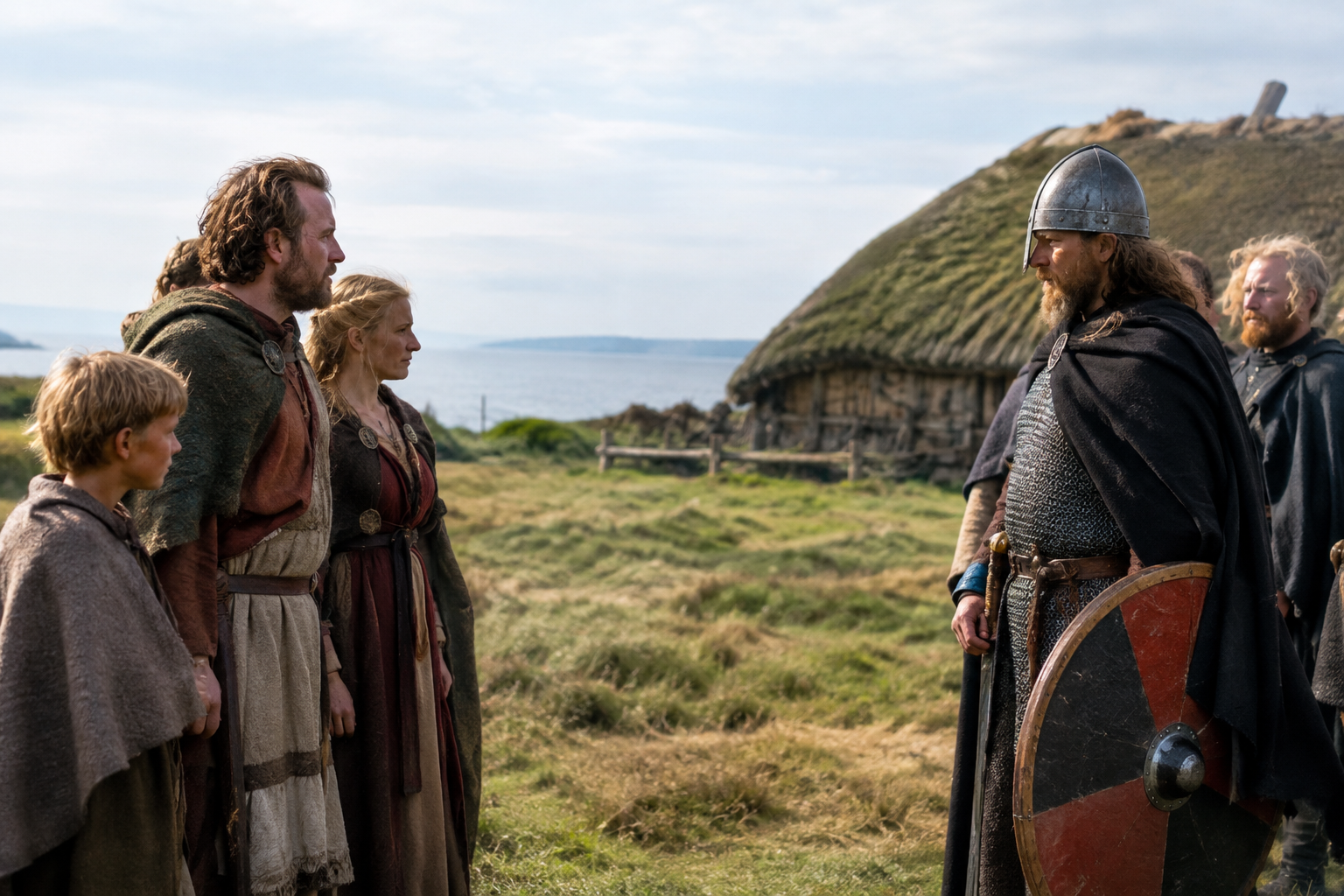
Some Y-chromosome lineages arrive in the historical record with trumpets and banners. Others appear more quietly: a burial in Denmark, a man on an island in Viking Age Sweden, and then much later a castle in northeast Scotland whose stones still remember an older world. Haplogroup I2a1b1a2b1a1a1a1 belongs to that second category. It is a very narrow branch on the human Y-chromosome tree, the sort of lineage that matters precisely because it lets us look closely rather than broadly.
That is worth stressing at the start. Y-DNA haplogroups trace one direct paternal line only: father to son to son across generations. They do not describe a person's full ancestry, culture, language, or identity. Still, these paternal branches are powerful historical tools. When a rare or specific lineage turns up in ancient DNA, it can help us map continuity, movement, and regional connections that written sources alone could never show. In the case of this branch, the evidence supplied here points us toward Scandinavia and the North Sea world, with later historical associations reaching into Scotland.
The deeper ancestry behind this lineage lies within haplogroup I, one of the major old European Y-chromosome families. Broadly speaking, lineages within haplogroup I have long been associated with Europe, and different branches of I2 in particular have appeared in a range of prehistoric and historic European settings. But one must be careful. It would be quite wrong to dump the entire history of haplogroup I2 onto the much narrower subclade I2a1b1a2b1a1a1a1. The tighter the branch, the more modest our claims should become.
What we can say responsibly is that this lineage belongs to a paternal framework with deep European roots, and the supplied ancient samples place that framework in southern Scandinavia and the Baltic world during Late Antiquity and the Viking Age. That alone makes it interesting. These were centuries of profound change: the fading power of Rome, the shifting political landscape of northern Europe, maritime networks across the Baltic, and the emergence of the Viking world that would reshape Britain, Ireland, and the North Atlantic.
For readers interested in the bigger prehistoric backdrop to northern European ancestry, Denmark is one of the key laboratories of ancient DNA.
The first anchor point is CGG107422, described as Ancient Individual:Danii Tribe Denmark Sjaelland Kirkebjerggaard Year:375 AD ID:CGG107422. Even that short description is evocative. Sjaelland, or Zealand, sits at the heart of Denmark, controlling the waters between the Baltic and the North Sea approaches. A date of 375 AD places this man in the late Roman period, when southern Scandinavia stood beyond the imperial frontier yet was deeply tied into wider European exchange networks.
The label "Danii Tribe" is itself a reminder of how archaeology, history, and identity never fit together perfectly. Ancient DNA does not magically confirm an ethnic label from a text. What it does offer is a glimpse of a paternal line present in eastern Denmark at a time when the communities later associated with the Danes were taking shape in historical memory. In other words, CGG107422 does not prove the origin of a people, but he helps place this paternal branch in the right landscape at the right time.
The second sample, VK332, is listed as Ancient Individual:Viking Age Oland Island Sweden Year:858 AD ID:VK332. This is a splendid contrast. Now we are nearly five centuries later and across the water on Oland, the long island off Sweden's southeast coast. By 858 AD, Scandinavia was part of a world of ship routes, trade, raiding, settlement, and diplomacy stretching from the British Isles to the rivers of eastern Europe and beyond.
Again, caution first: the appearance of a related paternal lineage in Viking Age Sweden does not establish direct descent from the Danish individual, nor does it mean all Viking Age Scandinavians shared this haplogroup. But taken together, CGG107422 and VK332 suggest that this paternal branch, or a close surrounding cluster of lineages, formed part of the Scandinavian genetic landscape across a long stretch of time.
That kind of temporal layering is one of the delights of archaeogenetics. We are not looking at abstract percentages. We are looking at two actual men, buried centuries apart, whose Y-chromosomes help us sketch the persistence of paternal ancestry around the Baltic and Kattegat world.
If you want a wider view of how these northern lineages appear in burials, kin groups, and Viking Age population studies, this is a good companion read.
Once a paternal lineage is visible in Denmark and Sweden across Late Antiquity and the Viking Age, the next historical question is obvious: how might such lineages fit into the wider North Sea story? Not by simplistic one-to-one equations of haplogroup with tribe or nation, certainly. But by context. The sea lanes linking Scandinavia, the Scottish east coast, northern England, and the islands were among the great movement corridors of early medieval Europe.
That means lineages found in Scandinavia may also appear, in one branch or another, in places touched by migration, trade, marriage, military service, or settlement around the North Sea. Sometimes that reflects movement; sometimes long-term regional continuity in neighboring populations; sometimes both. Ancient DNA is at its best here when it complicates old certainties. It shows that northern Europe was not sealed into tidy boxes labelled Dane, Swede, Scot, or Norse. It was connected, entangled, and thoroughly human.
For that wider context, readers may enjoy this look at the movement of people across the same maritime sphere that links Scandinavia and Britain.
The supplied noble association brings us to Clan Craig and to Craigston Castle in Aberdeenshire, Scotland. Here, it is especially important to keep our footing. A historical association between a clan and a haplogroup is not proof that every member of that family carried that exact Y-DNA branch, nor that any ancient Scandinavian sample was an ancestor of the clan. What we have instead is a meeting point between genetic context and regional history.
Craigston Castle was built around 1604 by the laird William Urquhart on the site of an earlier house. It is often described as one of the earliest and finest Scottish Z plan castles, where defensive architecture and Renaissance comfort were combined in a peculiarly Scottish way. That alone tells a story about the age in which it was raised. This was no crude medieval holdout. It was a residence built for status, security, and style, in a region where lineage, landholding, and local authority were still deeply important.
Over time the castle passed through the Urquhart family and later owners, yet much of its character endured: towers, painted ceilings, and the accumulated marks of changing Scottish landed life. In the nineteenth century parts were restored and altered, and in more recent memory the castle gained an unexpected transatlantic afterlife through its association with Andree Howard, whose work helped inspire Scottish country dancing in the United States. A fine reminder that ancestral places do not simply preserve the past; they continue to generate new histories.
What does this have to do with haplogroup I2a1b1a2b1a1a1a1? Not proof of dynastic descent, certainly. But castles such as Craigston anchor lineages in landscape. They preserve the memory of families and territories in exactly the regions where ancient, medieval, and early modern population histories overlapped. A Y-DNA lineage may move through time silently; a castle gives that continuity a visible address.
Readers interested in the clan context behind this Scottish association may want to continue with the dedicated community article below.
The real lesson of I2a1b1a2b1a1a1a1 is not that one tiny Y-chromosome branch unlocks a single grand narrative. It is that history is built from scales. At the broad scale, this lineage sits within an old European paternal family. At the closer scale, the supplied ancient DNA places it in the Scandinavian world from 375 AD to 858 AD. At the historical scale, its associated clan and castle point toward the later North Sea and Scottish setting in which paternal lines, landed identity, and family memory still mattered enormously.
Ancient DNA and written history do different jobs. Written genealogy may preserve names, titles, and properties. Ancient DNA reveals biological patterns that no chronicler ever recorded. Put them together carefully, and you begin to see how paternal lines can persist across centuries while cultures, kingdoms, and even languages change around them.
That is the real fascination here. Not a fantasy of direct descent from every skeleton or noble house, but a more interesting truth: your paternal line, if it belongs to a branch like this, may be part of a very old northern European story whose traces survive in graves, islands, coastlines, and castles.
To explore how another associated Scottish lineage enters this same world of regional history and family identity, see the Urquhart connection behind Craigston's builder.
If haplogroup I2a1b1a2b1a1a1a1 appears in your results, ancient DNA can offer a remarkable window into the deep paternal history behind your line, from Scandinavian burials like CGG107422 and VK332 to the later historical landscapes of Scotland and the North Sea world. That does not automatically prove descent from a particular ancient individual or noble family, but it can place your ancestry in a far richer historical setting.
Upload your DNA to MyTrueAncestry and see whether your results connect with ancient samples, archaeological cultures, and historical populations that bring your family history to life.






Comments