Haplogroup I2a1b1a2b1a1a

– 5 min read


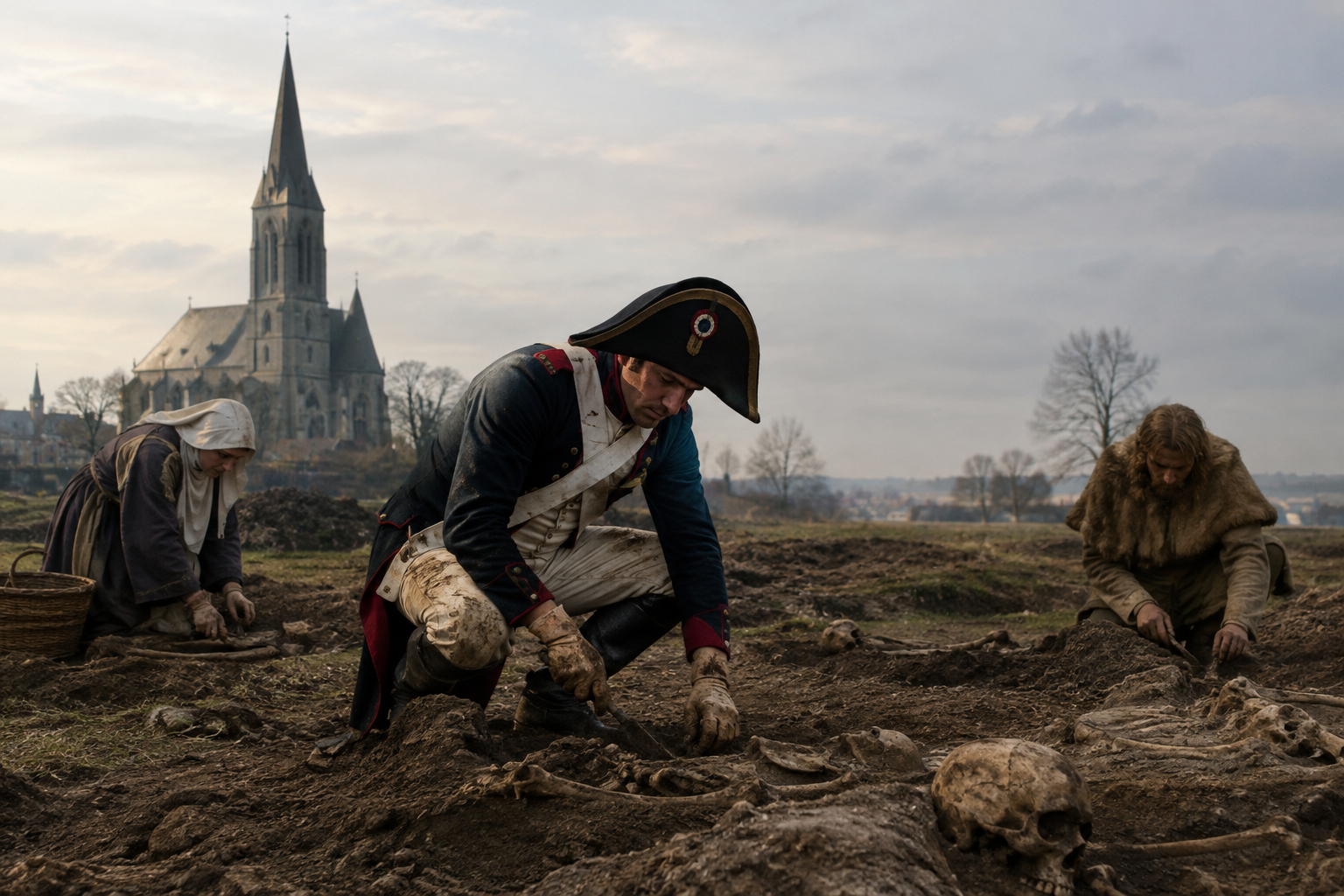
In 1812, the Grande Armee did not simply vanish into legend on the road back from Russia. It left bodies behind, among them the dead recovered from the mass graves at Vilnius. One of those men, sample YYY087A, belongs in this story because he has been associated with the Y-DNA haplogroup I2a1b1a2b1a1a. That makes him a strikingly modern-seeming carrier of a very old paternal line: not a prince in a chronicle, but an ordinary soldier caught in one of Europe's best-known military catastrophes.
That is a useful way into this haplogroup. I2a1b1a2b1a1a is a direct paternal lineage, passed from father to son, and it tells only one narrow part of a person's ancestry. Yet when the same branch or its reported close associations appear in very different settings, here in an early 19th-century wartime grave, in a medieval church context in Belgium, and in an early Saxon burial in northern Germany, it begins to sketch a history rooted in northwestern and central Europe rather than in any single kingdom, tribe, or dramatic migration tale.
The Vilnius mass graves have become one of the most vivid archaeological windows onto Napoleon's retreat. The dead buried there were part of an army that was famously multinational, and that matters. A Y-DNA result from one soldier cannot stand for the whole host, but it can remind us that imperial armies were made up of men carrying deeply local family histories into supranational wars.
Sample YYY087A, dated to 1812 AD and described as a soldier of Napoleon's Grande Armee from the Vilnius mass grave, shows exactly that tension between the individual and the enormous historical machine. The paternal branch reported here, I2a1b1a2b1a1a, is not "Napoleonic" in any cultural sense. Rather, it hints that one man in that shattered army came from a lineage already established in Europe for many centuries before he died in Lithuania.
The wider context of these burials has attracted scientific interest not only for ancestry but also for health and hardship during the campaign. For readers wanting the broader background to that catastrophe, MyTrueAncestry has also looked at the epidemic dimension in the retreat.
The second anchor point is very different. Sample ST0298 comes from Sint-Truiden Onze-Lieve-Vrouwekerk in Belgium and is dated to about 900 AD. Here we move from a battlefield aftermath to the world of an early medieval church community, a setting shaped by urban growth, Christian burial, and the social consolidation of the Low Countries.
What makes Sint-Truiden especially interesting is that it places the lineage in a settled community rather than a highly mobile military one. A man associated with I2a1b1a2b1a1a in this context suggests continuity of paternal lines within the developing medieval population of the region. It does not mean this branch was dominant, nor that everyone in the cemetery shared it. But it does show that the lineage fits comfortably within the human fabric of the central medieval Low Countries.
A recent genetic study on the medieval population of Sint-Truiden has helped frame these burials in terms of urbanization and local population structure, even if any one sample must still be treated carefully rather than turned into a grand ethnic emblem. That wider work can be found here: https://genomebiology.biomedcentral.com/articles/10.1186/s13059-025-03580-z.
The site also speaks to a larger historical question: how much early medieval towns drew in outsiders, and how much they were built by local families whose lineages had been in the region for generations. A single Y-chromosome cannot settle that question. Still, a branch like I2a1b1a2b1a1a appearing here is a small but concrete piece of the answer.
The earliest sample in this small cluster is ADN013, from a Saxon grave at Hannover-Anderten in Lower Saxony, Germany, dated to about 400 AD. That date places the burial in the late Roman and immediately post-Roman world, when northern Germany sat beyond the imperial frontier but was closely entangled with it through trade, recruitment, raiding, and migration.
This is precisely the sort of context in which people are tempted to overstate Y-DNA. A "Saxon" grave is an archaeological label tied to place and period; it is not a guarantee of language, political identity, or some timeless ethnic essence. Even so, the appearance of a lineage associated with I2a1b1a2b1a1a in Lower Saxony around 400 AD is important because it offers an earlier northern European waypoint for the branch or its reported close classification.
In other words, the evidence does not show a single family marching neatly from ancient Germany to medieval Belgium and then into Napoleon's army. History is never that tidy. What it does show is that this paternal line sits plausibly within the demographic world of north-central Europe across a very long span, from the late antique frontier zone to medieval ecclesiastical society and into modern mass warfare.
For readers interested in the broader background of this frontier world, the blending of Roman and non-Roman communities along the German borderlands is explored in another MyTrueAncestry article.
The long string of letters and numbers can make a haplogroup look more precise than the history really is. I2a1b1a2b1a1a is a narrow branch within the broader haplogroup I, one of the major Y-chromosome families long associated with European prehistory and history. But it would be a mistake to pour the entire deep history of haplogroup I, or even all of I2, directly into this one subclade without sample-by-sample evidence.
What we can say from the material here is more modest and more valuable. This branch is reported in, or associated with, individuals from northern Germany, medieval Belgium, and an early 19th-century military burial in Lithuania. That pattern makes it a lineage of historical Europe, present in ordinary men moving through very different institutions: tribal or post-tribal communities, Christian town society, and conscripted imperial armies.
It is also a reminder that paternal ancestry often persists through upheaval. Regimes fall, burial customs change, towns grow, armies collapse, and yet a Y-line can continue quietly through fathers and sons whose names are long forgotten.
None of the three samples is famous on its own. That is exactly why they are useful. Ancient DNA is at its best not only when it identifies kings, but when it lets us place lineages among the anonymous many who actually made history happen.
The Saxon grave at Hannover-Anderten gives this lineage an early foothold in northern Germany. Sint-Truiden places it within the social world of an early medieval church community in the Low Countries. The Vilnius soldier shows the same paternal thread still present many centuries later in a man swept up by one of the great military disasters of modern European history.
There is also a methodological lesson here. Research on early medieval and later European populations keeps showing that mobility and continuity existed side by side. A region could absorb newcomers without losing older local paternal lines entirely. That tension between movement and persistence is one of the most interesting things ancient DNA has added to archaeology.
A classic ancient DNA study on migration-period Europe helped establish just how informative these cemeteries can be when genetics and archaeology are read together, even though no single paper should be forced to answer every regional question: https://www.pnas.org/content/116/25/12363.
If your paternal line falls under I2a1b1a2b1a1a, the most responsible takeaway from these ancient matches is not a claim to one tribe or one heroic ancestor. It is something subtler: this branch appears well at home in the historical populations of northwestern and central Europe, and it turns up in men living very different lives, from a late antique Saxon context to a medieval town churchyard and a Napoleonic mass grave. That is not a fairy-tale pedigree. It is better than that: a glimpse of real continuity across the untidy, human centuries.






Comments