Haplogroup I2a1a2b1a1a1b2

– 5 min read


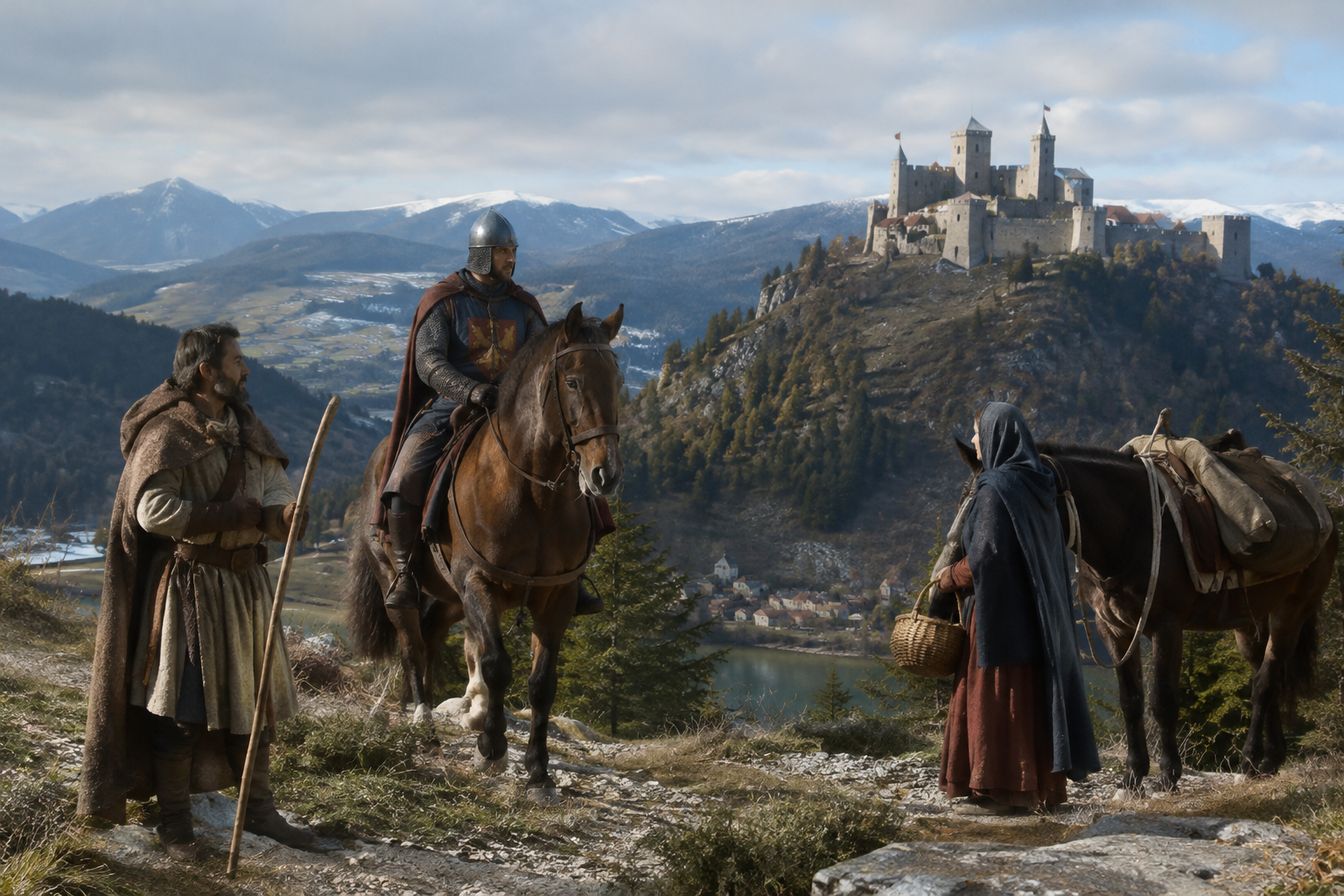
At Krakauer Berg in Peissen, in medieval Germany, one excavated man dated to about AD 1140 carries a notably specific paternal signature: Y-DNA haplogroup I2a1a2b1a1a1b2. He appears in the ancient DNA record as KRA008, and that matters precisely because he is not a legendary king or a neatly documented dynasty-founder. He is a real medieval individual from a real burial ground, and his lineage gives us a rare fixed point for tracking one narrow paternal branch in the lived landscape of central Europe.
That narrowness is important. Y-DNA follows one direct male line only: father to son to son, over many generations. So haplogroup I2a1a2b1a1a1b2 does not describe the whole ancestry, language, or identity of KRA008. What it does offer is a sharply defined thread inside the much larger history of European paternal lines, one that had clearly reached - and was still present in - medieval German communities by the 12th century.
KRA008 comes from Krakauer Berg, Peissen, a site that belongs to the busy, layered world of the High Middle Ages rather than to some misty prehistoric horizon. Around AD 1140, this was a period of village growth, ecclesiastical organization, expanding lordship, and the reshaping of landscapes through cultivation and settlement. A Y-chromosome result from such a context is valuable because it anchors a paternal line in a time when written history is fuller than in prehistory, yet still far patchier than many people imagine.
In other words, this lineage is not appearing in an abstract map. It is showing up in a man who lived in a Christianized, structured medieval society in what is now Germany. That makes the branch historically legible in a different way from earlier prehistoric finds: not just as a population signal, but as part of the demographic fabric of a recognizable medieval region.
An ancient DNA study on medieval Germany and surrounding populations has helped clarify how varied local communities could be, even when they belonged to the same broad cultural world. Research published here offers the larger framework in which burials such as these have become newly informative: https://www.ncbi.nlm.nih.gov/pmc/articles/PMC7588426/.
Medieval Germany and local origins
The long label can look forbidding, but its historical meaning is simple enough. I2a1a2b1a1a1b2 is a very fine-grained sub-branch within haplogroup I, one of the major old European Y-DNA macro-lineages. The deeper history of haplogroup I stretches far back into European prehistory, but that does not mean every later sub-branch shares the same story in the same places at the same times.
That distinction matters especially here. The broad parent haplogroup I2 has deep roots in Europe and appears in very different archaeological settings across millennia, from Mesolithic foragers to later farming and post-Roman populations. But this article's branch is much narrower. With the evidence presently in hand, the safest thing to say is that one carrier of this specific branch, or a closely associated assignment to it, is documented in medieval central Germany through KRA008.
For family historians, that is often how the story begins: not with a sweeping claim about all of Europe, but with a secure sighting in one place and period. A medieval burial does not identify an ethnic label by itself, and it does not prove continuity from any particular prehistoric man. It does, however, show that this paternal branch was part of the male population circulating within the German lands of the 12th century.
Ancient DNA articles sometimes tempt us into thinking only large cemeteries count. But a single well-placed result can be surprisingly useful. KRA008 helps place this branch in the social world of medieval central Europe: a world shaped by local continuity, mobility between villages and towns, and the long aftermath of earlier population changes that had already transformed the continent.
By AD 1140, central Germany sat within a zone where Roman frontiers, post-Roman transformations, Slavic-German contact, Christian expansion, and regional colonization had all left demographic marks. A Y-line found there might reflect deep local persistence, movement from nearby regions, or blending across older cultural frontiers. The point is not to choose one dramatic origin story without evidence. The point is that this lineage belonged to that mixed and changing medieval population, rather than floating outside history.
Germanic languages and genomics
One of the most useful lessons from medieval and late antique genetics is that central Europe was not populated by tidy blocks of biologically uniform peoples. Burial grounds that look culturally coherent can still contain diverse ancestries and varied paternal lines. Equally, a lineage with deep European roots can persist across major changes in language, politics, and religious practice.
That broader pattern helps explain why a branch like I2a1a2b1a1a1b2 can turn up in a medieval German context without needing a dramatic special explanation. Europe's paternal history was not written in a single wave. It was shaped by repeated episodes of settlement, acculturation, marriage, survival, and local demographic luck. Some male lines expanded widely; others survived in smaller pockets before reappearing in the record centuries later.
Seen in that light, KRA008 is less a solitary curiosity than an example of how old European paternal diversity endured into the Middle Ages. The interesting thing is not that he belonged to one pure or isolated stock. It is that a very specific branch of a deeply rooted European haplogroup was still embedded in an ordinary medieval population.
If your own Y-DNA falls under I2a1a2b1a1a1b2, the most responsible takeaway is also the most interesting one. Your direct paternal line belongs to a branch that is attested in medieval Germany through KRA008 at Krakauer Berg Peissen, around AD 1140. That places the lineage within the historical population of central Europe in a firmly documented way.
It does not mean descent from this individual, from a named noble house, or from a single medieval ethnic group. But it does suggest that your paternal line may have been part of the complex male ancestry of central and perhaps adjoining parts of Europe long before modern surnames settled into place. In genealogical terms, that is quite a substantial clue: not a fairy tale, but a real man in a real grave, carrying the same paternal branch into the medieval past.
Medieval burials in German towns
The distinctive strength of haplogroup I2a1a2b1a1a1b2, as far as this evidence allows us to say, is not royal glamour or a dramatic migration legend. It is its appearance in the bones of KRA008, a man from medieval Peissen whose Y-chromosome preserves one exact paternal thread through the crowded history of central Europe. For anyone tracing that branch today, the value lies in that hard archaeological anchor: a lineage not merely imagined, but recovered from the medieval ground itself.






Comments