Haplogroup I2a1a2b1a1a1a1c

– 5 min read


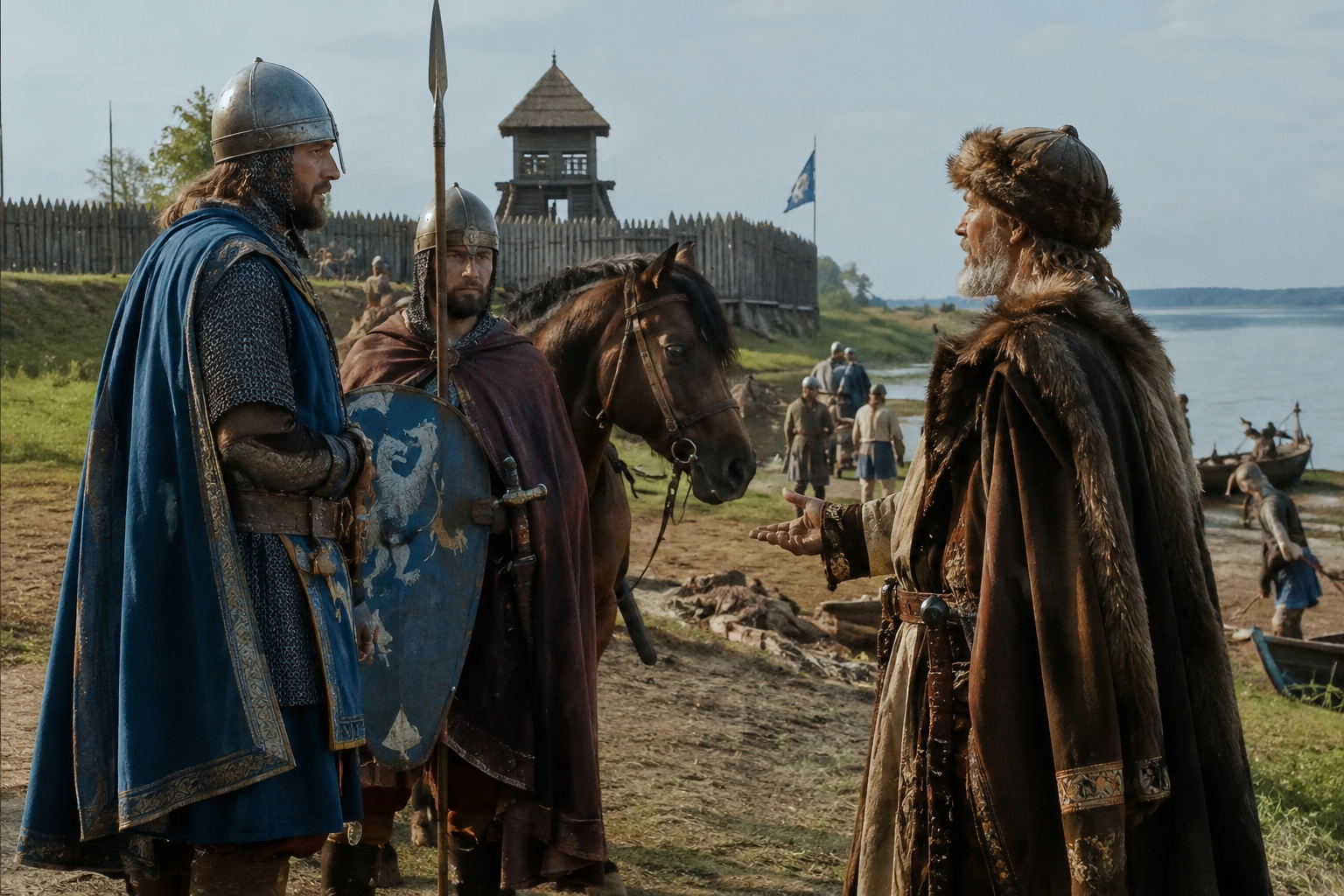
At Zalavar-Varsziget in western Hungary, one excavated man from around AD 850, sample AHS09, offers a small but telling glimpse into the paternal history of haplogroup I2a1a2b1a1a1a1c. He lived in a place that mattered: not an anonymous corner of Europe, but a settlement in the frontier world of the late Carolingian age, where political power, Christianity, and local populations met in the marshy landscape around Lake Balaton.
That matters because a Y-DNA lineage is never the whole story of a person. It traces one direct paternal line only. But when a lineage such as I2a1a2b1a1a1a1c turns up in a well-dated early medieval burial, it anchors that paternal line in a real historical setting: a man, a cemetery, a border region, and a moment when the Carpathian Basin was being reshaped before the Hungarian conquest.
Zalavar is one of those places where the map of early medieval Europe becomes more complicated the closer you look. In the ninth century, this region sat within the orbit of the Carolingian world, yet it was also tied to older local traditions and to the shifting politics of Pannonia. Around AD 850, when AHS09 was buried, western Hungary was not a tidy ethnic block but a contact zone.
That is exactly why this sample is useful. Haplogroup I2 in its broader form is an old European paternal lineage with deep roots on the continent, especially in southeastern and central parts of Europe. But the article haplogroup here is not broad I2; it is the much narrower branch I2a1a2b1a1a1a1c. With the evidence currently in hand, the safest thing to say is that AHS09 has been associated with this precise branch in a medieval Hungarian context. What the burial gives us is not a grand migration epic, but a documented appearance of that paternal line in a frontier settlement at a very specific historical moment.
An ancient DNA study of medieval Hungary and its surrounding populations has helped place such burials into their regional context, showing how varied early medieval communities in the Carpathian Basin could be even within the same broad political sphere here. That wider setting is important, because it warns us against simplistic labels. A Carolingian-period burial in Hungary is not automatically "Frankish" in blood, language, or family origin. The archaeology and the genetics both point instead to mixed and locally grounded communities.
There is always a temptation, especially with a long and precise subclade name, to imagine that the haplogroup itself carries a ready-made historical identity. It does not. The long label I2a1a2b1a1a1a1c tells us this is a very specific twig on a much larger paternal tree. It does not by itself tell us what language AHS09 spoke, what legal status he had, or whether he thought of himself as local, Slavic, Christian, Pannonian, or something else again.
Still, the line is historically meaningful. In the early medieval Carpathian Basin, paternal continuity and paternal change were happening at the same time. Some male lines had been in the region for centuries; others arrived through mobility, military service, marriage patterns, and political expansion. A lineage like I2a1a2b1a1a1a1c fits well into that sort of landscape: one where old European ancestry did not vanish with new kingdoms, but was absorbed into new social worlds.
That is one reason readers interested in broader paternal change in southeastern Europe may also want to compare evidence from neighboring regions, where ancient DNA has revealed continuity in some lines and striking turnover in others.
Croatia's Shifting Paternal Lines
One of the most interesting things about AHS09 is his date. Around AD 850 places him just before the great political transformation usually associated with the arrival of the conquering Hungarians in the late ninth century. That makes this burial especially useful for anyone trying to understand which paternal lines were already present in the region before the new ruling structures of the tenth century took shape.
Too often, the Carpathian Basin is narrated as though history begins anew with each major migration. The archaeology says otherwise. Roman provinces, post-Roman communities, Avar-period societies, Slavic-speaking groups, Carolingian influence, and then Hungarian state formation all overlapped in ways that are messier than textbook boundaries suggest. AHS09 belongs to that layered pre-conquest landscape.
So if you carry I2a1a2b1a1a1a1c today, this sample does not prove descent from one known medieval man, still less from any elite house. What it does suggest is that this branch was present in western Hungary before the foundation of the medieval Hungarian kingdom, in a society already shaped by centuries of local survival and external pressure.
Zalavar is historically valuable because it was not a remote farmstead accidentally preserved by chance. It sits in a region tied to Lower Pannonia and to the Christianizing and administrative ambitions of the ninth-century Carolingian world. Sites in this zone can illuminate how imperial systems actually worked on the ground: not through abstract borders, but through settlements, churches, cemeteries, and families.
That gives AHS09 a significance beyond the individual. A direct paternal line found here was part of a living community in a place where identities were being negotiated. The presence of a narrow I2 branch in this context reminds us that early medieval frontier societies were not made up solely of incoming conquerors or imperial agents. They also included men whose paternal ancestry belonged to older European lineages that continued through political change.
There is a useful comparison here with work on medieval elites and ruling groups in Hungary. Those studies often attract attention because of crowns, dynasties, and conquest narratives. But the social world beneath them matters just as much. A kingdom is built not only by princes, but by the populations already in its fields, settlements, and churchyards.
Broadly speaking, I2-associated paternal lines are often discussed in relation to Europe's deep past, including Balkan and central European populations. But the medieval evidence is what makes this branch feel close at hand. By the ninth century, older paternal lineages were no museum pieces. They were part of active communities living through the collapse of old systems and the formation of new ones.
That point is especially important for western Hungary, which was never isolated. Trade, clerical networks, military obligations, and regional alliances connected it to Bavaria, the eastern Frankish sphere, the Balkans, and the plains beyond. A man carrying I2a1a2b1a1a1a1c at Zalavar was therefore both local and connected: rooted in a European paternal line, yet living in a world of movement and political change.
For a broader backdrop to how mixed early medieval communities could be across Europe, another useful comparison comes from studies of diverse burial populations elsewhere in the former post-Roman world.
Diverse Origins in Early Medieval Madrid
The strongest evidence for I2a1a2b1a1a1a1c in this article is not a legend, a coat of arms, or a claimed royal pedigree. It is a real early medieval burial: AHS09 from Zalavar-Varsziget, around AD 850, in the Carolingian-era landscape of western Hungary. That places this paternal branch in a documented frontier society just before one of central Europe's great political turning points.
For someone researching this haplogroup today, that is the useful takeaway. This lineage can be placed, at least in one known case, among the ordinary but historically important men who lived through the complicated transition between post-Roman Europe and medieval Hungary.






Comments