Haplogroup I2a1a2b1a1a1a1a

– 5 min read


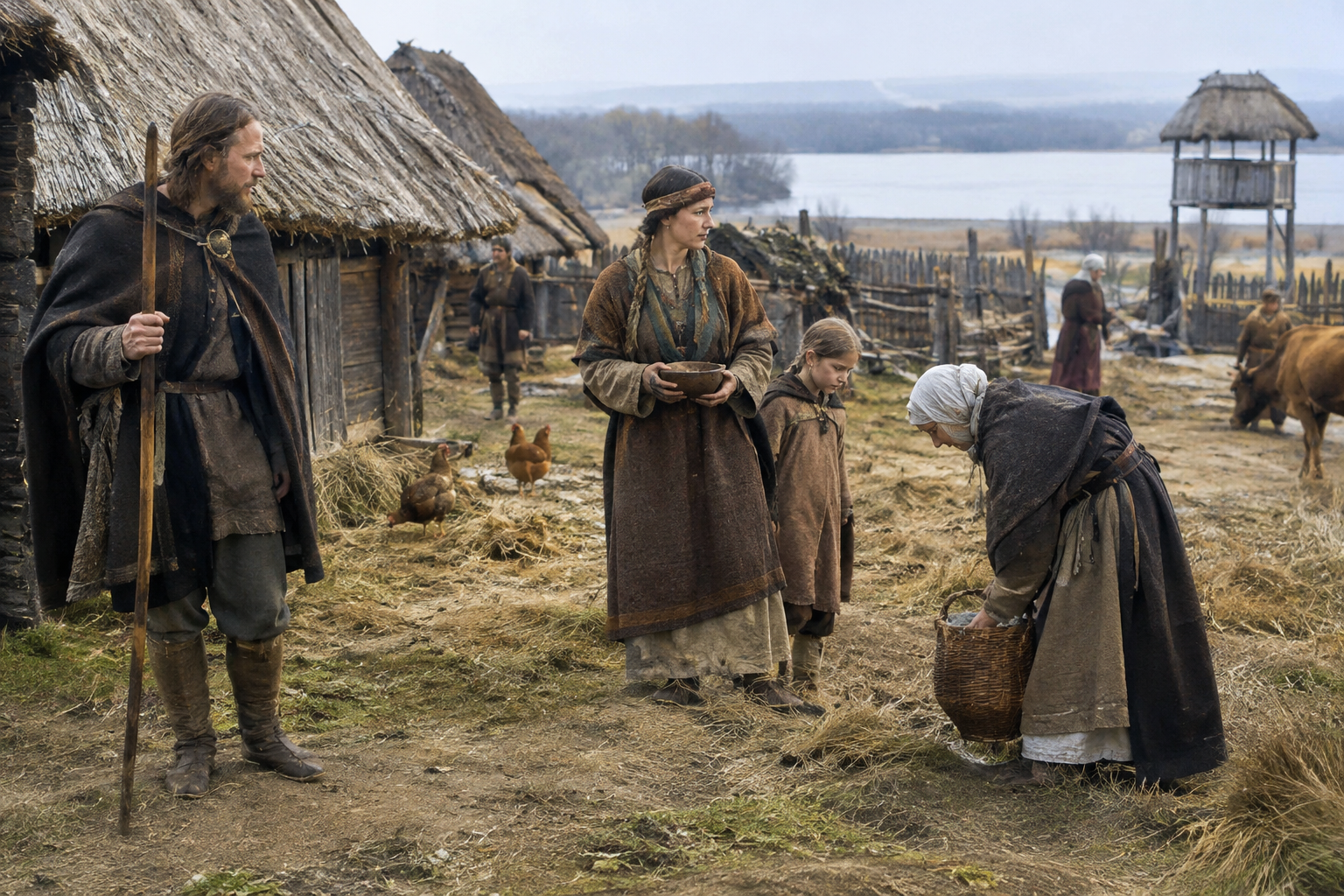
At Pohansko in Moravia, one early medieval man has become a small but revealing guide to a much larger paternal story. The individual identified as POH41, dated to around AD 975, comes from a major settlement landscape in what is now the Czech Republic, a region deeply entangled with the last centuries of Great Moravia and the political reshaping of Central Europe. He is associated here with the Y-DNA branch I2a1a2b1a1a1a1a, a very narrow paternal lineage nested within the much broader haplogroup I2.
That narrowness matters. Y-DNA follows one direct male line only - father to son across generations - so it does not describe a person's whole ancestry, language, or identity. But when a specific branch appears in a historically charged place like Pohansko, it can illuminate how older European paternal lines persisted inside societies that were changing quickly in political, cultural, and religious terms.
Pohansko is not just a point on a map. It is one of the most important early medieval sites in Moravia, associated with fortified settlement, elite activity, and the dense human geography of the ninth to tenth centuries. By about AD 975, when POH41 lived, the world of Great Moravia had already fractured, while new regional powers - especially the Přemyslids in Bohemia and the Árpáds in Hungary - were consolidating around it.
That makes POH41 interesting precisely because he does not stand in a simple story of replacement. A paternal line such as I2a1a2b1a1a1a1a, or a reported association with that branch, suggests continuity of a male line that belongs to a much older European genetic framework than the political labels of the tenth century. The archaeology of Moravia often shows that state formation and Christianization did not arrive on an empty landscape. They were layered onto communities with deeper local roots.
The long label I2a1a2b1a1a1a1a belongs to a very fine branch on the Y-chromosome tree. Its parent haplogroup, I2, is one of the old European paternal lineages, with deep roots in the continent and a long prehistoric and historic presence in parts of the Balkans, Central Europe, and beyond. But it would be careless to take everything known about broad I2 and simply paste it onto this exact subclade.
What we can say more safely is that the appearance of such a lineage in early medieval Moravia fits a pattern seen repeatedly in European archaeogenetics: large cultural changes often occur without all paternal lines being swept away. Men living under new rulers, speaking new languages, or buried within new religious systems could still belong to long-established regional lineages. Genetics does not erase history; it complicates it.
This is one reason ancient DNA has been so useful in Central Europe. It pushes against the old habit of imagining whole peoples moving as neat, self-contained blocks. Research on migration-period and early medieval populations increasingly points instead to mixtures of continuity, mobility, and local survival, a theme that also appears in broader discussions of language spread and population change.
Germanic languages and genomes
It is tempting to read an early medieval Moravian burial and ask whether the man was "Slavic" in a straightforward biological sense. Archaeology and genetics both caution against that shortcut. "Slavic" in the tenth century is a cultural, linguistic, and political label as much as anything else, and communities in Moravia were shaped by local populations, neighboring regions, long-distance contacts, and the afterlives of Roman and post-Roman Europe.
A man such as POH41 could therefore belong to an early medieval society widely described as Slavic while still carrying a paternal line with much older local depth. That is not a contradiction. It is exactly the sort of thing ancient DNA keeps showing us: identities change faster than Y-chromosome trees.
Moravia is especially revealing because it sat in a contact zone. To the west were Bohemia and the eastern Frankish sphere; to the south the Danube corridor linked communities to Bavaria and the former Roman provinces; to the southeast lay the Hungarian plain; and to the north and east were other West Slavic and frontier regions. In such a setting, continuity in one paternal line tells us less about ethnic purity than about the durability of families through upheaval.
One ancient individual cannot stand for an entire kingdom, region, or people. That is the first rule worth keeping in mind. Yet one individual can still be historically important if he sits in the right place and time, and POH41 does exactly that.
Around AD 975, Moravia was living through institutional change: old power centers were reworked, burial customs were shifting under Christian influence, and dynastic politics were redrawing loyalties. If a man from this world carried I2a1a2b1a1a1a1a, that makes the branch visible inside a society often discussed in terms of emerging medieval states rather than long-term local ancestry. It gives that paternal line a secure foothold in a documented archaeological setting.
More broadly, Central and Eastern European ancient DNA has repeatedly shown that early medieval communities were not genetically uniform. Some graves reveal strong local continuity, others suggest mobility or admixture, and many cemeteries contain people whose ancestors did not all come from the same place. The point is not that POH41 proves a grand migration route for this exact subclade, because he does not. The point is that he anchors it in a real historical landscape.
The wider I2 family has a long and complicated European history. In broad outline, lineages within I2 are well known from prehistoric Europe, including populations connected to hunter-gatherer ancestry and later regional continuities. But by the early Middle Ages, those old paternal threads had already passed through thousands of years of demographic change: the spread of farming, Bronze Age migrations, Iron Age societies, Roman frontiers, and post-Roman restructuring.
That long background helps explain why a narrow branch like I2a1a2b1a1a1a1a should not be read through a single historical label. It is not "a Great Moravian haplogroup" in any exclusive sense, nor does it belong automatically to one language family or ethnic tradition. Instead, it is best understood as one surviving twig on a very old European tree, caught in the act of medieval history at Pohansko.
For readers interested in the deeper prehistory behind paternal lines like this one, wider European studies of ancient population structure have made clear that the continent's genetic map was built in layers rather than in one decisive event. That is particularly relevant for I2-related branches, whose history reaches back far beyond the medieval record.
The most useful lesson from POH41 is modest but powerful. This branch appears in an early medieval Moravian context at a moment when Central Europe was being politically transformed, showing that older paternal lines remained present within those new societies. For someone researching I2a1a2b1a1a1a1a today, that does not promise descent from a ruler or membership in a single ancient tribe. What it does suggest is that your direct paternal line may belong to a strand of European history that endured locally through major cultural change and is now visible, however briefly, in the archaeology of Pohansko.






Comments