Haplogroup I2a1a2b

– 6 min read


Some Y-DNA haplogroups are famous because they turn up in royal tombs or in sweeping migration stories. Haplogroup I2a1a2b is interesting for a rather different reason. It appears, from the evidence supplied here, in places that force us to think less about a single dramatic march across Europe and more about long male-line persistence, local survivals, and repeated reappearances in very different societies: Mesolithic Scandinavia, Neolithic Atlantic Europe, Bronze Age Romania and Bulgaria, Iron Age northern Europe, medieval Slavic territories, and even later noble contexts in Hungary.
That matters because Y-DNA traces one very specific line: the direct paternal line, father to son to son. It does not describe a person's whole ancestry, culture, language, or identity. Still, when a lineage such as I2a1a2b appears across such a wide chronological spread, ancient DNA gives us something precious: not a legend of origins, but a set of hard glimpses into where paternal lines were actually found.
I2a1a2b belongs within the broader haplogroup I, one of the major Y-chromosome branches long associated with parts of prehistoric Europe. For a reader outside genetics, the simplest way to think of this is as a branch on a very old paternal family tree. The deeper parent branches are older and broader; the more specific branches, like I2a1a2b, are narrower and represent only one portion of that wider history.
That distinction is important. We should not lazily assign to I2a1a2b every story ever told about haplogroup I or even I2 as a whole. What we can say, from the supplied ancient individuals, is that this lineage appears in remarkably early European contexts and then continues to surface across later prehistoric and medieval settings. That suggests continuity in some regions, movement in others, and a history tied to real communities rather than a single named people.
The earliest supplied clue is striking: I0011, a Neolithic individual from Kanaljorden, Motala in Sweden, dated to 5710 BC. This is the sort of find that reminds us how old some paternal lines in Europe really are. From there, the lineage appears again in Neolithic contexts in the Netherlands, France, Scotland, Orkney, and Ireland, suggesting that whatever precise route this sub-branch took, it was present across a broad swathe of Atlantic and northern Europe very early on.
The ancient DNA list for I2a1a2b reads almost like a map of prehistoric Europe pinned to a museum wall. In the Low Countries, we find SWA002 and SWA004 from Early Neolithic Swifterbant in the Netherlands, both dated to 4105 BC, along with I12091 from Neolithic Swifterbant at Nieuwegein-het Klooster, dated to 4150 BC. Another Dutch case, I38448, comes from Middle Neolithic South Holland Schipluiden Harnaschpolder Grave 6, dated to 3520 BC. These are not dynastic burials. They are the remains of men from farming and mixed subsistence communities whose paternal lines now help chart ancient population structure.
France adds another cluster: I4303 and I4304 from Clos de Roque, Saint Maximin-la-Sainte-Baume, dated to 4680 BC; ROS78 and ROS45 from Neolithic Rosheim, dated to 4600 BC; BERG157-7 from Bergheim, dated to 4100 BC; Es97-1 from Escalles, dated to 4050 BC; and later Neolithic individuals such as OBN004, OBN005, OBN011, and PEN003 around 3500 BC. Put together, these finds suggest that this paternal branch was not marginal in Neolithic western Europe.
Then there is the Atlantic fringe. Scotland and Orkney contribute I36006 and I36007 from Tulloch of Assery A, I36018 from Rattar East, I2637x from the Orkney Islands, mid001 and mid002 from Orkney Rousay, I19286 from Neolithic Scotland, and later I2629 from Bronze Age Isbister, Orkney, dated to 2850 BC. Ireland gives us an even deeper western signal in KGH6, a Mesolithic individual from Killuragh, Limerick, dated to 4714 BC. These burials hint that I2a1a2b may have persisted through the changing worlds of foragers, early farmers, and megalith-building communities in the northwestern seaways.
Readers interested in those northern tomb worlds may enjoy this related MyTrueAncestry article on kinship and burial traditions in Scotland.
Discover Neolithic Tomb Kinship
If the northwestern evidence shows long continuity, the Balkan and Carpathian finds show something else: endurance through major periods of change. In Romania, the lineage appears in I7137 from Bodrogkeresztur Urziceni, dated to 4050 BC; PIE078 from Early Bronze Age Giurgiu Pietrele Magura Gorgana, dated to 3000 BC; GAS004a and GAS004b from Bronze Age Gambas, Wietenberg Culture, dated to 1631 BC; and I10479 from Bronze Age Arman Carlomanesti, Moneoru Culture, dated to 2000 BC. Bulgaria contributes YUN037 and YUN038 from Yunatsite and I19454 from Tell Kran Yasanovo.
This is not proof of one uninterrupted family line across millennia; ancient DNA cannot promise that sort of fairy tale. But geographically it does place I2a1a2b in the Balkans and neighboring regions over a long span. That becomes especially interesting when later medieval finds appear in nearby areas: TOR003 from early medieval northern Croatia, dated to 750 AD; AHPS118 from the Carolingian border zone at Sarbogard-Tringer tanya in Hungary, dated to 950 AD; and two conquest-period Hungarian burials, K2per16_GE and K2per52 from Karos II, dated to 900 AD.
In other words, this branch turns up both in long-settled southeastern European populations and in politically mobile early medieval worlds. That makes it a useful lineage for thinking about how older regional paternal ancestry could persist through the Roman aftermath, Slavic expansions, frontier societies, and the Hungarian conquest period.
For readers who want a broader look at this same region in deep time, this article on Balkan prehistory is an excellent companion.
Read About Balkan Hunter-Gatherers
By the medieval period, I2a1a2b appears in several historically resonant settings. In Poland, there are individuals linked to Piast-era contexts: PCA0521 from Santok in Lubusz Province, PCA0565 from Silesia Milicz, and PCA0316 from Plonsk Masovia, all dated to 1100 AD, as well as PCA0127 from medieval Silesia Niemcza, dated to 950 AD. In Germany, the lineage appears in western Slavic contexts through NDW076 from Niederwuensch and OBM028 from Obermoellern. These samples matter because they show the lineage among medieval communities documented in the written record, not only in prehistoric cemeteries.
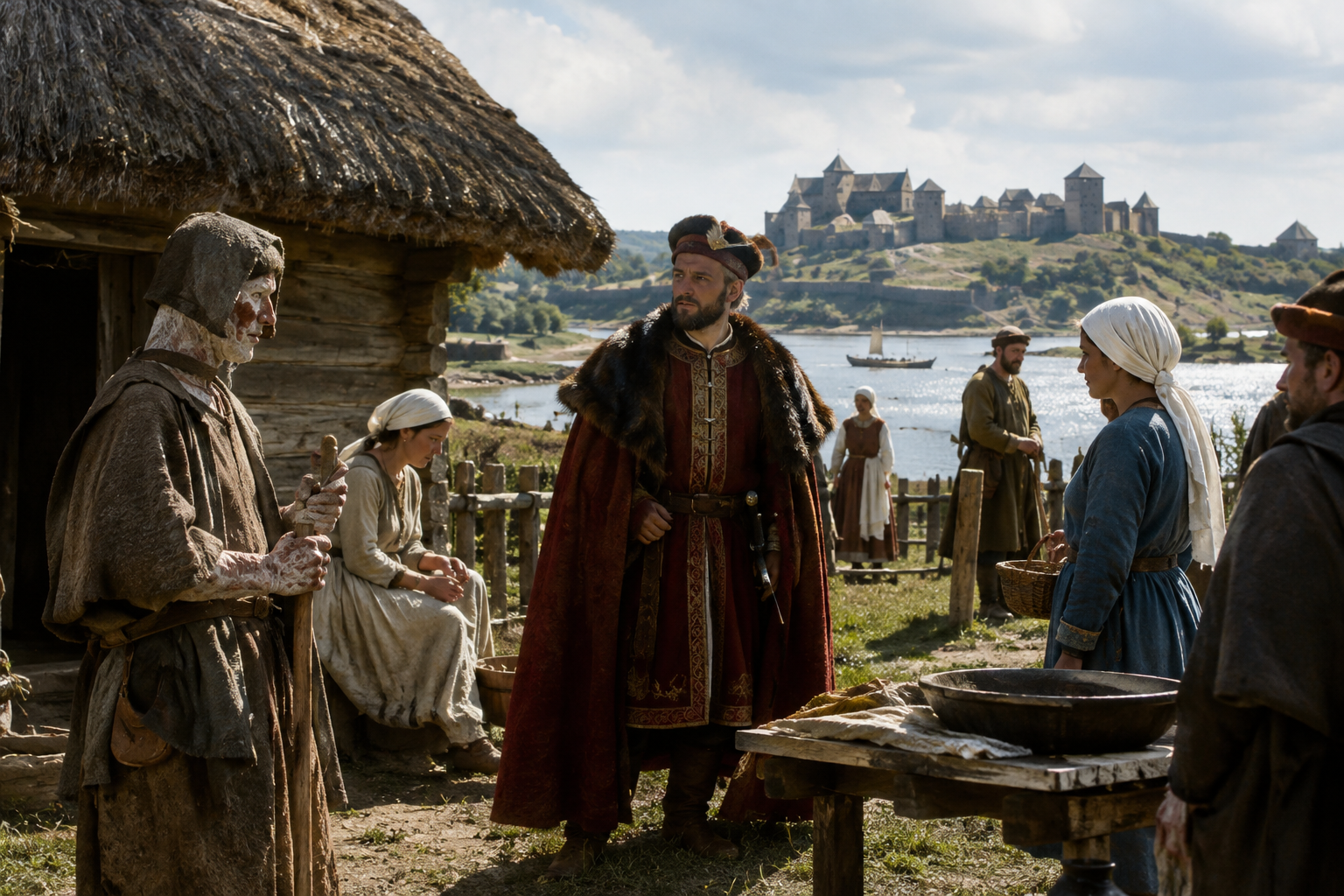
England provides a different sort of glimpse in MMW_H117_1, a medieval leprosy victim from Winchester St Mary Magdalen, dated to 1125 AD. The point here is almost poignantly simple. Haplogroups are not only found in princes and warriors. They are also found in the sick, the poor, and the ordinary dead. Y-DNA history is social history.
The most obviously aristocratic sample in the supplied list is PER02, a Medieval Hungarian Bathory Male Nobility Pericei individual dated to 1500 AD. This is where readers must be especially careful. A noble burial associated with the Bathory name is historically exciting, but it does not mean that every member of the wider Bathory family, let alone every later claimant, necessarily carried the same Y-line. Nor does it justify sweeping claims about all noble houses in the region. What it does offer is a rare bridge between genetic evidence and documented late medieval nobility.
That bridge becomes more interesting when set beside other elite and dynastic studies from the region.
The supplied noble-family field appears effectively empty here, so there is no responsible way to invent a catalogue of clans, castles, or ancestral seats for I2a1a2b. That itself is worth saying plainly. Genetics often gives us a paternal branch before history gives us a coat of arms. The DNA may be there; the heraldry may not.
Still, the Bathory-associated sample PER02 reminds us how such lineages eventually enter the world of documented nobility: estates, fortified residences, county politics, and family memory. Castles in this sense are historical anchors, not genetic proof. They preserve the stories of houses and regions, while ancient DNA tests whether those stories sometimes leave a biological trace.
Poland and Hungary are especially fertile ground for this sort of comparison, because dynastic history, archaeology, and biomolecular work increasingly overlap. A Piast burial and a Bathory nobleman belong to very different political worlds, yet both show how ancient Y-lineages can remain visible inside medieval state formation.
Readers interested in how paternal lines and ruling houses intersect in medieval east-central Europe may want to continue with the Piast story.
I2a1a2b is a useful reminder that paternal ancestry in Europe was never a matter of neat replacement by one people after another. The samples supplied here show this lineage in Mesolithic or early Neolithic northern Europe, in Neolithic farming communities of the Low Countries and France, in Bronze Age Romania and Bulgaria, in Iron Age Denmark and Sweden through CGG106750 and CGG105934, and in medieval Slavic, English, Irish, Polish, Croatian, and Hungarian contexts.
That spread does not tell a single simple story. It tells several overlapping ones: local continuity, demographic mixing, movement across frontiers, and survival of paternal branches through enormous cultural change. Ancient DNA is so valuable precisely because it complicates the tidy old myths. A lineage can be old in one place, mobile in another, and socially unremarkable in one century but noble in the next.
If your own Y-DNA belongs somewhere near this branch, MyTrueAncestry can help place it beside real archaeological individuals like I0011, KGH6, GAS004a, PCA0521, or PER02. Those matches do not prove direct descent from a named noble house or any single ancient man. But they can place your paternal line in the same broad historical landscapes where these men once lived, farmed, fought, migrated, ruled, or were buried.
Upload your DNA to MyTrueAncestry and explore whether your results connect you with the ancient populations and archaeological discoveries behind haplogroups like I2a1a2b.






Comments