Haplogroup I2a1a1b1a1b2

– 6 min read


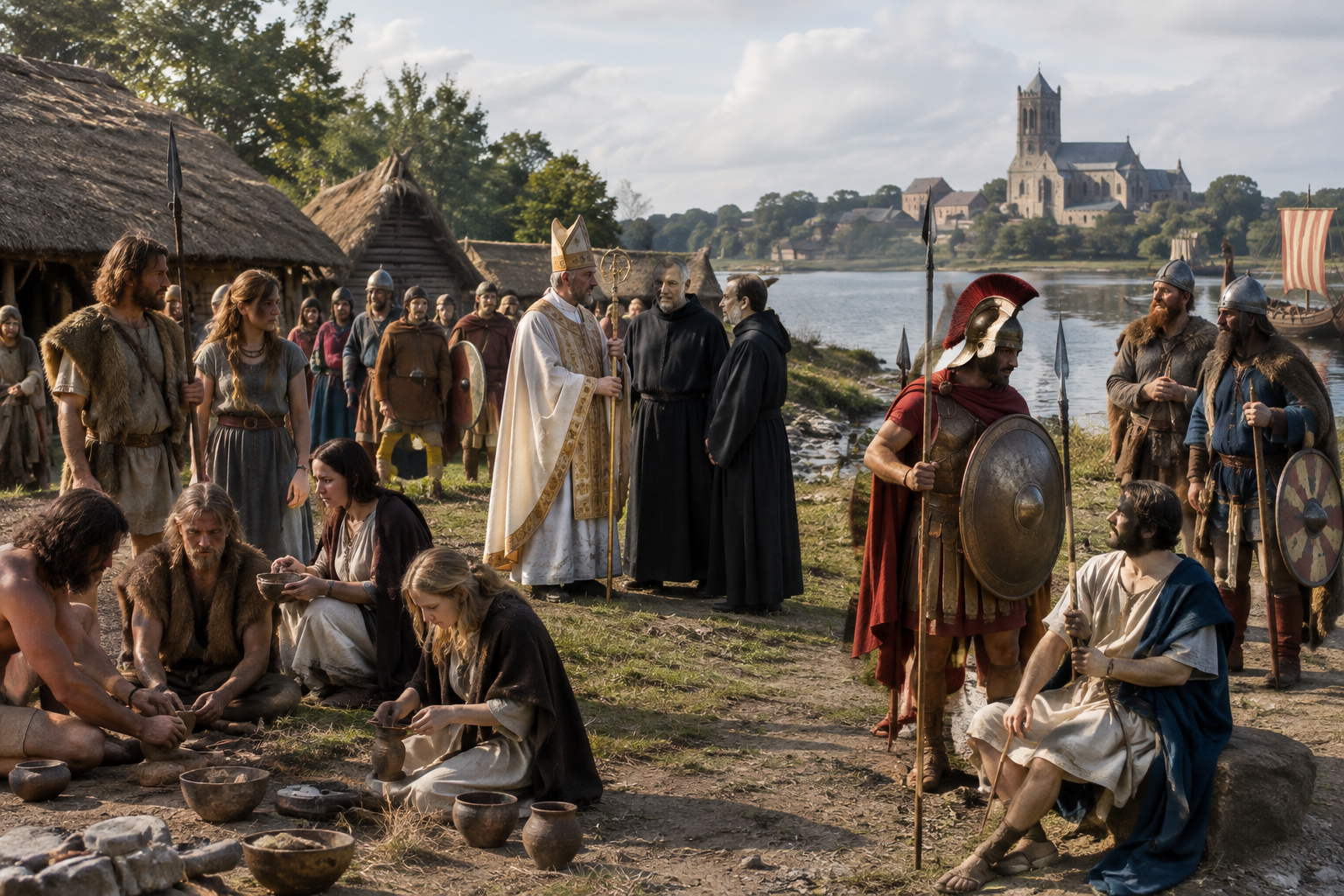
Some Y-DNA haplogroups announce themselves with famous royal studies or heavily debated origin stories. Haplogroup I2a1a1b1a1b2 is more interesting in a quieter, more archaeological way. It appears here not as a slogan for a nation or a tribe, but as a line that surfaces in burials spread across a remarkably long stretch of time: Bronze Age Poland, an ancient mercenary in Sicily, a Carolingian-era burial in the Netherlands, Viking Age Staraya Ladoga, and late medieval Belgium. That is exactly the sort of evidence that makes paternal ancestry so compelling. It is not a tidy family tree. It is a trail of men, places, and historical worlds.
Y-DNA traces one narrow line only: the direct paternal line from father to son. That makes it powerful, but also easy to misuse. A Y-haplogroup does not describe a person's whole ancestry, language, identity, or social class. Nor does sharing a haplogroup prove recent kinship. Still, when a lineage such as I2a1a1b1a1b2 appears repeatedly in ancient remains, it gives us something precious: a way to watch one branch of Europe's paternal history move through changing landscapes, from Bronze Age communities to medieval towns and frontier worlds.
This lineage belongs to the wider haplogroup I, one of the major old European Y-chromosome families. Within that broad tree, branches of I2 are especially important in the study of European prehistory and later regional continuity. For a very specific subclade such as I2a1a1b1a1b2, caution matters. We should not simply lift the full history of all I2 lineages and paste it onto this narrower branch. What we can say, from the supplied evidence, is that this paternal line has a strong archaeological presence in parts of central and northern Europe and later appears in historically mobile settings stretching from the North Sea to the Baltic and the Mediterranean.
The pattern is suggestive. It points to a lineage that was established in European populations long before the medieval age and that remained part of the paternal pool through major cultural changes. That means changes in burial customs, shifts in language, the rise and fall of Bronze Age societies, the movements of Iron Age and early medieval peoples, and the political restructuring of Europe after Rome.
Explore Ancient DNA and Archaeogenetics
The densest cluster of evidence in the supplied material comes from Bronze Age and Late Bronze Age Poland. That alone is striking. At Zerniki Gorne, a series of individuals dated between the 16th and 13th centuries BC carry this paternal signature or a closely related placement in the dataset: poz667 (1448 BC), poz675 (1400 BC), poz649 (1461 BC), poz651 (1461 BC), poz662 (1432 BC), poz665 (1416 BC), poz655 (1350 BC), poz745 (1461 BC), poz746 (1370 BC), poz747 (1500 BC), poz748 (1510 BC), poz658 (1330 BC), and poz684 (1250 BC).
One must be careful with labels such as "Germanic Tribe" in very early contexts. For the Bronze Age, archaeology is usually firmer ground than later ethnic language. But what these samples do show, quite clearly, is repeated paternal continuity in south-central Poland over centuries. Add to them poz543 from Bronze Age Southern Poland Koszyce (1264 BC), poz758 from Subcarpathian Poland Strzyzow (1900 BC), poz507 from South Central Bocheniec (1750 BC), poz715 from Silesia Pielgrzymowice (1375 BC), and the Gustorzyn samples from Pomerania - poz693, poz694, and poz700, all dated to 1500 BC - and a picture emerges of a paternal line well established across different parts of Bronze Age Poland.
This matters because it shifts the discussion away from heroic origin myths. What we are seeing is not one dramatic migration stamped on one grave. We are seeing a lineage embedded in communities over a long period, which is often the more interesting historical reality.
Read About Late Bronze Age Central Europe
Then the trail widens. One of the most intriguing samples is I10949, an Ancient Mercenary First Sicilian War Himera Sicily dated to 480 BC. This does not mean the haplogroup was "Sicilian" in any simple sense. Quite the reverse. A mercenary burial is a reminder that the ancient Mediterranean was full of mobile men whose personal histories crossed political and cultural boundaries. A paternal line rooted in broader European contexts could easily turn up in a military setting far from its earlier concentration.
By the early medieval period, the same lineage or a closely related one appears in the northwest and northeast of Europe. GRO002, from Carolingian Era Groningen Netherlands dated to 885 AD, places the haplogroup in a North Sea world of ports, trade, lordship, and post-Roman political consolidation. Meanwhile VK22, from Viking Age Staraya Ladoga dated to 1000 AD, places it in one of the great contact zones of the Baltic and eastern Europe. Staraya Ladoga was a meeting place: Scandinavian, Slavic, Finnic, and wider trading networks all collided there.
This is the sort of evidence that makes medieval and early medieval genetics so exhilarating. A Y-line does not belong to one frozen identity. It can pass through farming villages, war bands, market towns, and coastal entrepots, accumulating history without announcing its owner in advance.
The three late medieval Belgian samples from St. Rombouts - STR248D, STR248C, and STR248, all dated to 1192 AD - bring the story into a recognizably medieval Christian Europe of churches, towns, guilds, and documentary culture. Here, at last, we are in a world with charters, surnames, and institutions that feel closer to genealogical history. Yet the genetic lesson is almost the opposite of what a family chronicler might hope for. These burials do not magically connect us to one named dynasty. What they show is that the paternal line persisted into medieval urban society, still part of the ordinary and extraordinary business of European life.
The geographical spread from Bronze Age Poland to medieval Belgium does not prove a single continuous family line in the genealogical sense. But it does show durability. This branch survived demographic upheavals and kept turning up in real communities over more than two millennia.
The noble association supplied with this haplogroup is Clan Lindsay, whose early story is tied to Crawford Castle in South Lanarkshire. The castle began as an earthwork motte and bailey, probably built by the Norman lord Baldwin in the late 11th or early 12th century. That alone places it squarely in the world created after the Norman expansion: new military architecture, new lordships, and new strategies for controlling roads and valleys.
Crawford Castle stood in Upper Clydesdale guarding an important route through southern Scotland. It became the caput of the barony of Crawford and gave its name to the Lindsay family, who later rose to great power as the Earls of Crawford. The stronghold was first timber, later rebuilt in stone, then attacked and damaged during the Wars of Scottish Independence when Wallace and his allies struck at English-held castles. By the later Middle Ages it had declined, as newer residences drew aristocratic attention elsewhere. Today only earthworks and slight remains survive, but in historical terms it still marks the beginning of one of medieval Scotland's great lordships.
Now, does that prove that the medieval Lindsays carried I2a1a1b1a1b2? No. It would be irresponsible to claim that. A historical association between a clan article and a haplogroup is not the same thing as a documented dynastic genetic test. But the castle helps us think properly about how paternal lineages and recorded history meet. By the 12th century, some male lines are entering documents, sealing charters, founding baronies, and leaving names attached to places. Ancient DNA gives us the deeper backdrop; castles like Crawford give us the later stage on which named families appear.
Haplogroup I2a1a1b1a1b2 is a good reminder that the past is not organized according to modern labels. In the supplied evidence, this paternal branch appears in Bronze Age Poland, in an ancient mercenary at Himera, in Carolingian Groningen, in Viking Age Staraya Ladoga, and in late medieval Belgium. That does not make it the haplogroup of one people. It makes it the haplogroup of men who lived in different societies across Europe's shifting historical map.
For anyone who carries this lineage today, that is the real fascination. Your direct paternal line may connect, not to one neat legend, but to a long and complicated European story of continuity, movement, adaptation, and local survival. Genetics will not tell you that you descend from a mercenary at Himera or from the Earls of Crawford. What it can do is place your paternal line inside the same broad historical world.
That is where MyTrueAncestry becomes so interesting. By comparing your DNA with ancient samples, you can see whether your own results show links to the kinds of archaeological populations discussed here. Those matches do not prove direct descent from a specific ancient individual or noble family, but they can offer a vivid and sometimes surprising perspective on where your deeper ancestry fits in the human past.






Comments