Haplogroup I1c1c1
– 5 min read


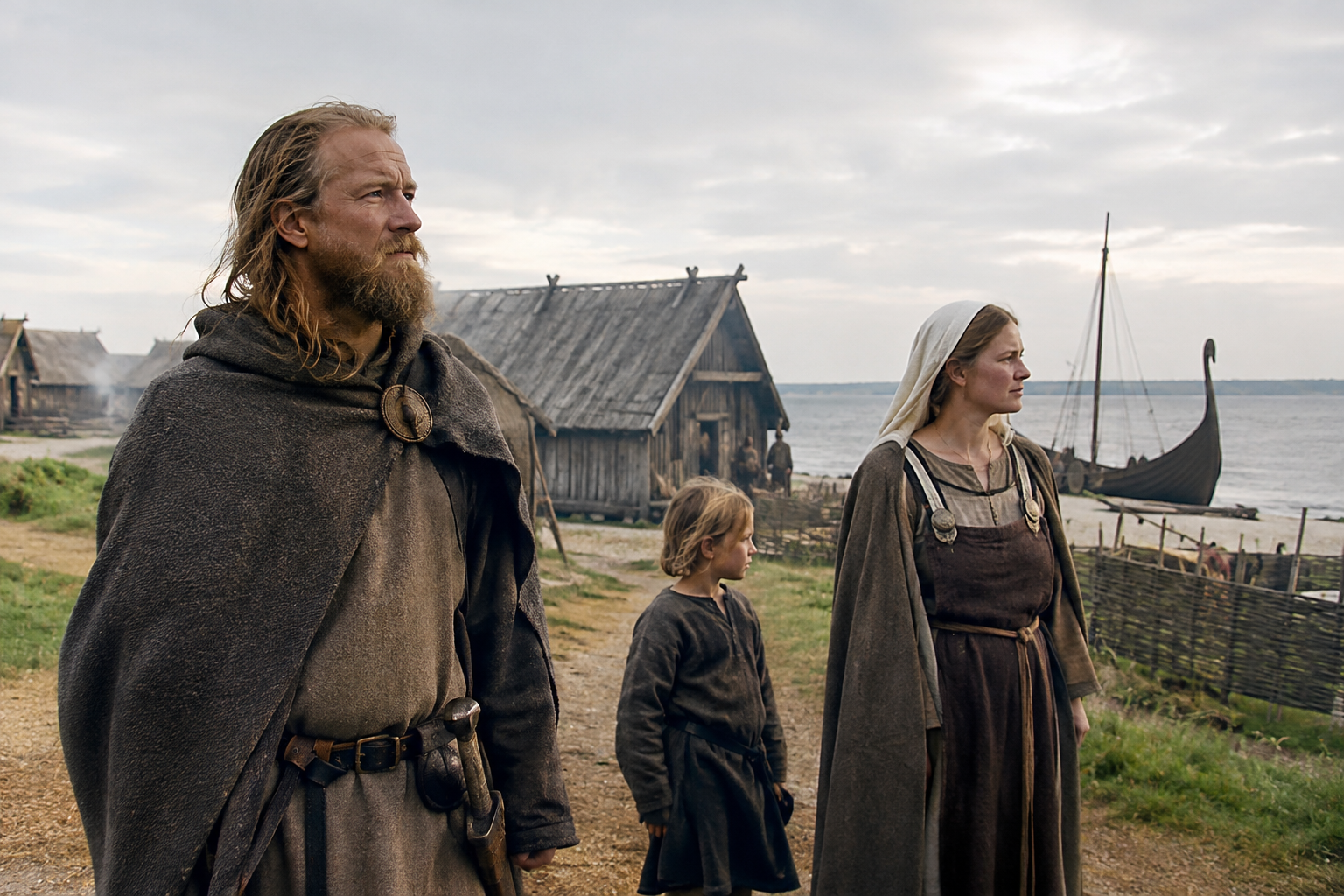
At Kaargarden in Denmark, one Viking Age man has become a small but telling witness to the history of the North Sea world. He is known in the ancient DNA record as VK275, dated to around AD 950, and he is associated with the Y-DNA haplogroup I1c1c1. That may sound like a string of laboratory shorthand, but it places him within one of the best-known paternal lineages of northern Europe, and in a setting where archaeology and genetics meet in unusually vivid fashion.
AD 950 is not an empty date in Scandinavian history. It sits in the later Viking Age, when Denmark was tied into networks of trade, raiding, settlement, and political consolidation stretching from the Baltic to the British Isles and beyond. A man like VK275 was not "the Viking world" in miniature; no single burial ever is. But his paternal line offers a direct glimpse into one strand of male ancestry circulating in that world.
The importance of VK275 begins with place and period. Denmark in the 10th century was not a remote fringe but one of the engines of northern European change. Ports, farms, burial grounds, and royal centres all sat within a landscape shaped by seafaring movement, local continuity, and growing political ambition.
Kaargarden belongs to that wider Danish setting. With the evidence provided here, it would be wrong to invent grave goods, status markers, or family relationships for VK275. What we can say is more disciplined, and in its way more interesting: this is a securely placed Viking Age Danish male whose Y-chromosome was identified closely enough to connect him with I1c1c1, a branch within the larger I1 paternal family long associated with northern Europe.
That matters because Y-DNA traces one direct paternal line only: father to son to son across generations. It does not describe a person's whole ancestry, still less their language, profession, or identity. But when a lineage like I1c1c1 turns up in a Viking Age Danish context, it becomes part of a larger archaeological question about how paternal lines persisted, expanded, and travelled in Scandinavia.
The haplogroup label here deserves a careful reading. I1c1c1 is not the same thing as all of I1. The broader haplogroup I1 is a major northern European Y-chromosome lineage, especially notable in Scandinavia and in regions shaped by later Germanic and Viking-age movements. But the narrower branch named in this article is a more specific twig on that paternal tree, and we should not lazily assign to it every origin story ever told about I1 as a whole.
Still, even this modest level of evidence is useful. A Viking Age Danish individual carrying I1c1c1 fits the general picture of strong I1 representation in parts of Scandinavia during the first millennium AD. That does not prove Kaargarden was a founder site for the branch, nor that every nearby man shared the same paternal ancestry. It does, however, anchor the lineage in the lived population of late Viking Denmark rather than leaving it as a purely modern test result.
Research on Viking Age populations has increasingly shown that Scandinavian communities were neither genetically uniform nor socially simple. A single cemetery or settlement can include people with different ancestry profiles, and cultural labels such as "Viking" describe a historical world, not a single biological type. Within that complexity, lineages like I1c1c1 help illuminate one recurring paternal thread.
If this were an isolated lineage in an unexpected place, the story would be one of surprise. Instead, VK275 is valuable for almost the opposite reason: he represents continuity in a region central to later Scandinavian expansion. Denmark was one of the main launching grounds of Viking activity into England, Frisia, the Frankish coast, and the North Atlantic. A paternal lineage documented there around AD 950 belongs to the historical heartland of those movements.
That does not let us map one man's descendants across Europe like an arrow on a school atlas. Ancient DNA does not work that neatly, and history certainly does not. But it does allow a more grounded statement: the branch I1c1c1 was present in a documented Danish Viking Age individual at precisely the time when Scandinavian male lines were participating in large-scale mobility around the North Sea.
That is one reason articles on wider Germanic population history are helpful companions to this kind of evidence. Broader genomic work on language spread and population movement, for example, helps place Y-lineages in a deeper northern European context without pretending that one chromosome alone explains culture. A preprint on ancient genomics and northern European population history can be found here, and it is best read as regional support for the kind of historical setting in which a sample like VK275 makes sense.
One of the pleasures of Scandinavian archaeology is that the Viking Age never stands alone. It sits on top of much older population histories and flows into the early Christian Middle Ages. Denmark had already seen millennia of change before VK275 lived there: Mesolithic hunter-gatherers, incoming Neolithic farmers, later Bronze Age societies, Iron Age communities, and then the political worlds we call Germanic and Viking.
So a lineage found in the 10th century is part of a very long local sequence, even when we cannot trace that exact sub-branch continuously through every earlier period. This is where caution matters. We should not claim that I1c1c1 can be followed unbroken from prehistory into the Viking Age unless the sample evidence explicitly shows it. But we can say that Viking Age Danish paternal lines emerged from a region with deep demographic roots and repeated episodes of migration and mixture.
That longer Danish background also explains why a haplogroup article should never collapse archaeology into genealogy. The men buried in Viking Age Denmark were heirs to many different ancestral layers. A Y-lineage captures one inherited channel, not the whole population story.
For people researching I1c1c1 today, the Kaargarden evidence has a particular appeal because it is so historically legible. This is not a mysterious prehistoric outlier from a poorly understood context. It is a male from Viking Age Denmark, a place whose connections to migration, trade, warfare, and settlement are richly documented in archaeology and history alike.
That makes VK275 a useful reference point for anyone whose paternal line falls somewhere in this branch. It does not mean a modern carrier descends from this man, his kin group, or even Denmark specifically. But it does suggest that the branch belonged to the real paternal landscape of the Scandinavian world during the period when Norse influence was spreading widely across northern Europe.
That wider maritime setting is worth keeping in view. Viking Age movement was not only conquest. It also meant markets, farmsteads abroad, intermarriage, mercenary service, and seasonal travel. A lineage present in Denmark could remain local, cross the Skagerrak, appear in England, or vanish from one district while surviving in another. Ancient DNA gives us snapshots of that process, not a complete passenger list.
The most distinctive thing about haplogroup I1c1c1 in this case is not a grand dynastic claim or a dramatic tale of a named warrior. It is the firm appearance of this paternal branch in VK275, a man from Kaargarden, Denmark, around AD 950. That places the lineage squarely in the late Viking Age Scandinavian world, where paternal lines moved through societies that were local, mobile, and deeply entangled across the North Sea.
For a modern tester, that is the useful historical takeaway. If your direct paternal line belongs to I1c1c1, the evidence here makes it reasonable to picture one part of that ancestry in the Scandinavian orbit of the 10th century, while remembering that Y-DNA is only one line among thousands in your family tree.






Comments