Haplogroup I1a8
– 5 min read


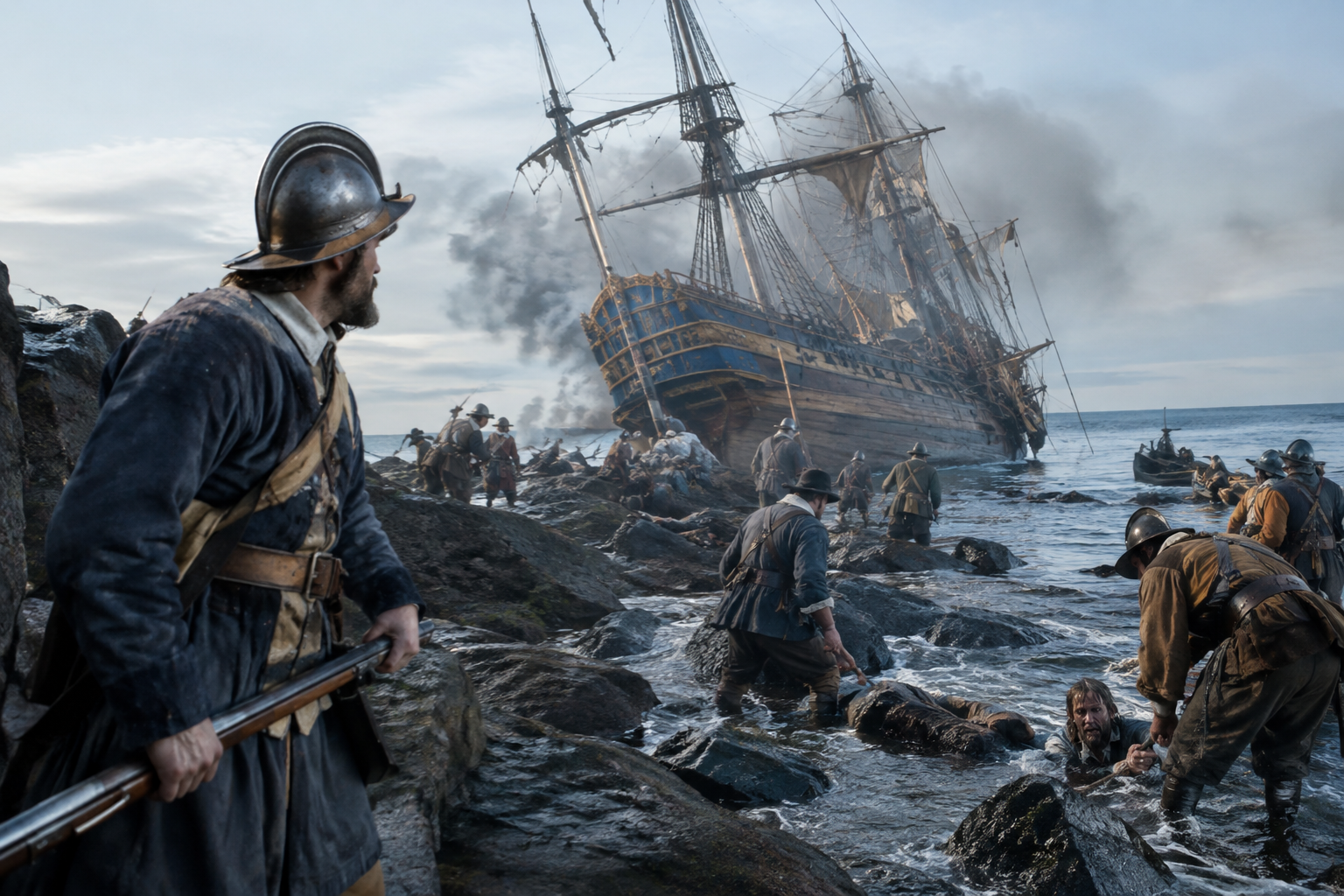
In 1676, during the Battle of Oland, the Swedish warship Stora Kronan exploded and sank with terrible loss of life. One of the men recovered from that disaster, sample kro015, is the most concrete ancient clue here for the Y-DNA haplogroup I1a8. It is an arresting sort of evidence: not a legendary chieftain or a conveniently named dynasty, but a real man from a very well-dated historical catastrophe in the Baltic world.
That matters because I1a8 sits inside the broader Y-chromosome haplogroup I1, a paternal line strongly associated with northern Europe and especially Scandinavia. Y-DNA traces one direct male line only, so it does not describe the whole ancestry of kro015 or of any modern tester. But when a branch like I1a8 turns up in a documented Swedish context, it gives us something valuable: a fixed historical point in the lived world of early modern Scandinavia.
Stora Kronan was one of the largest warships of the Swedish Empire, lost off Oland in the Scanian War between Sweden and Denmark-Norway. The site is unusual in ancient DNA terms because it is not prehistoric, not anonymous in date, and not floating in a haze of broad cultural labels. We know the year. We know the political setting. We know these were men caught in one of the defining naval struggles of 17th-century northern Europe.
Sample kro015 is associated with that wreck and dated to 1676 AD. For a haplogroup article, that makes the find especially useful. Instead of treating I1a8 as an abstract code on a branching tree, we can place it in the body of a Swedish sailor or soldier serving aboard a major royal warship at the height of Sweden's Baltic power.
The story of the wreck itself has already drawn public attention because archaeology and forensic reconstruction can make such losses strikingly personal. For more on the site and its human remains, see this related piece:
The difficult thing with a subclade like I1a8 is that the label sounds precise, but the historical picture can still be quite narrow if only a small number of ancient examples are available. Broadly speaking, I1 is one of the best-known northern European paternal lineages, and it has long been discussed in connection with Scandinavian population history, later Germanic expansions, and the North Sea-Baltic world. But that broader reputation belongs to I1 as a whole, not automatically to every smaller branch under it.
So the safest way to read the evidence is this: I1a8 is documented here in a 17th-century Swedish maritime context. That anchors the lineage in the historical population of Sweden during the age of great-power rivalry in the Baltic. It does not, by itself, prove that every earlier Scandinavian I1 find belonged to I1a8, nor does it license a grand migration story for this precise branch without more directly resolved ancient samples.
This is exactly why archaeogenetics is so useful when handled carefully. Each new ancient male line can sharpen the picture, but only if we resist the temptation to let a familiar parent haplogroup do all the historical work for a rarer descendant branch.
There is also something instructive about the date. Many readers naturally associate Y-DNA discoveries with the deep past - the Bronze Age, the Iron Age, the Viking Age. Yet sample kro015 reminds us that paternal lineages did not stop being historically interesting once written records begin. By 1676, Sweden was a literate, militarized state with taxation, naval administration, and imperial ambitions around the Baltic rim. A man carrying I1a8 in this setting belonged to that very specific historical machinery.
That does not mean he was ethnically simple, locally rooted for countless generations, or representative of all Swedes. Early modern fleets could draw men from different districts and sometimes from beyond the kingdom's ethnic core. But the sample does show that I1a8 formed part of the paternal landscape of Sweden during an age when Scandinavian societies were deeply entangled with war, trade, and state formation.
For readers interested in how genetics has been used to think about Scandinavian-linked language spread and wider Germanic movements, this related article offers the larger background:
The Baltic is one of those regions where archaeology, history, and genetics constantly cross paths. Sweden's eastern and southern horizons opened onto Finland, the eastern Baltic, the Danish straits, and the routes running toward northern Germany and Poland. A lineage found on a Swedish flagship belongs, therefore, not just to "Sweden" in isolation but to a larger northern maritime zone.
That wider setting is worth bearing in mind for anyone with I1a8 today. The paternal line may well have deep roots in Scandinavia or nearby northern Europe, but historical movement around the Baltic could carry such lineages far beyond a single modern national label. Soldiers, sailors, merchants, settlers, and administrators moved through this region for centuries, especially in the late medieval and early modern periods.
Ancient DNA work on Scandinavian and Baltic populations has steadily improved this picture, though not always at the same Y-DNA resolution for every male sample. Research on northern European populations, including Scandinavian contexts, has helped show how genetics can illuminate regional continuity alongside mobility and mixture. One major study relevant to this broader discussion is available here: genetic research on ancient populations of northern Europe.
One sample may sound modest, and in one sense it is. We should not pretend that kro015 alone tells the full story of I1a8. But archaeology is often like that: one securely placed individual can be more valuable than a dozen vague assumptions. Here we have an exact sample ID, a known shipwreck, a fixed year, and a clear Swedish setting.
That gives I1a8 an evidential foothold in real history. It places the branch in the age of cannon fleets and Baltic empires rather than leaving it suspended in a generic map of "northern European ancestry." For descendants and testers, that is often the difference between a code and a context.
There is a wider Scandinavian backdrop too. If your interests run toward medieval and post-medieval population history in the region, these studies of Swedish and nearby northern contexts help broaden the human picture beyond a single male line:
At present, I1a8 is best approached as a northern European paternal branch with at least one firm ancient appearance in 17th-century Sweden, through sample kro015 from the Stora Kronan wreck. That does not turn every bearer into a sailor of the Swedish Empire, of course. But it does place the lineage in a documented Scandinavian historical environment shaped by warfare, seafaring, and Baltic connections.
If you carry I1a8 today, the most responsible takeaway is not a romantic one but a useful one: your direct paternal line fits comfortably within the historical male population of Scandinavia, and specifically Sweden, in the early modern period. As more ancient Y-DNA is resolved at finer levels, branches like this will become less shadowy. For now, kro015 gives I1a8 something precious - a real man, in a real event, at a real moment in history.






Comments