Haplogroup I1a3a1c

– 6 min read


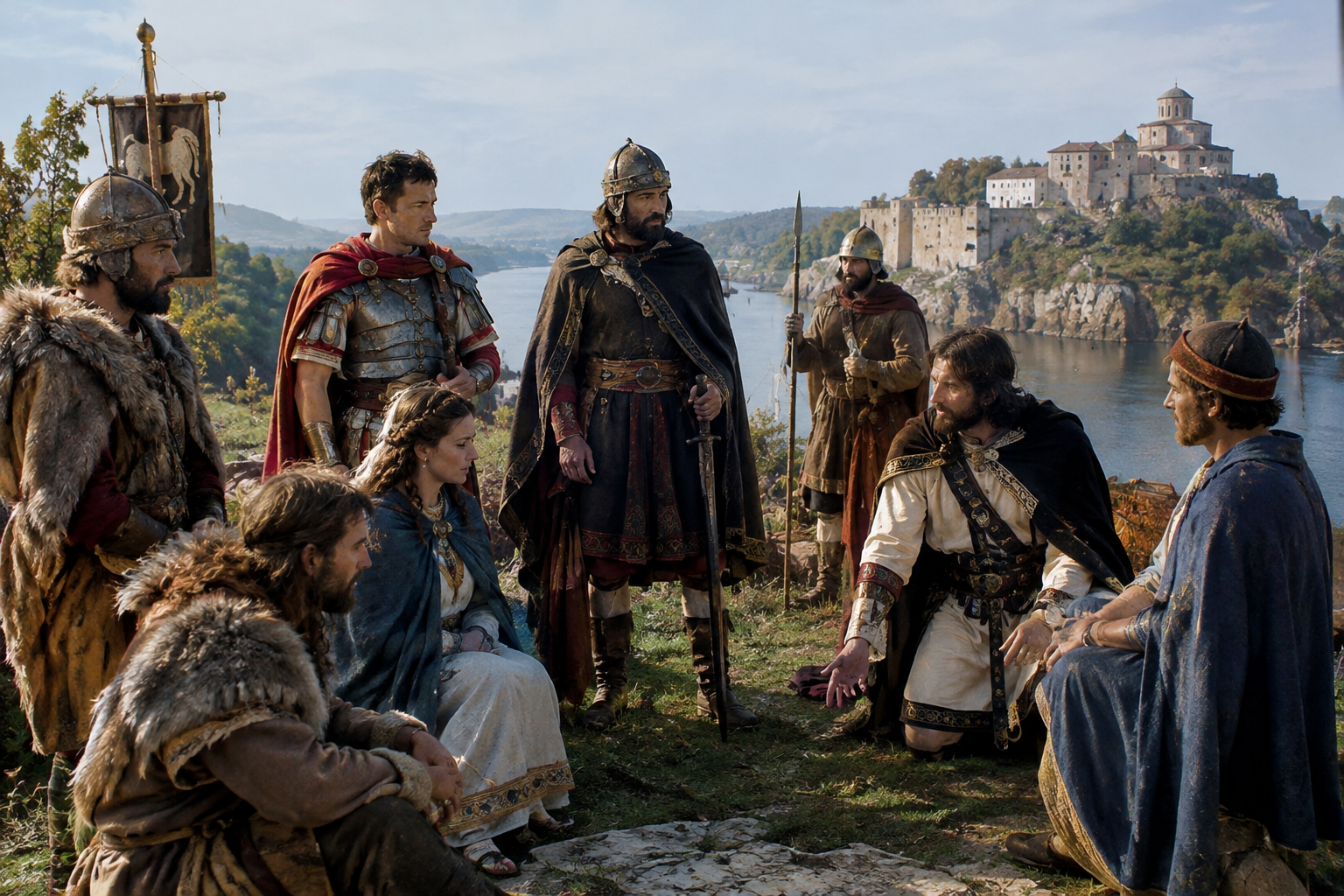
Some Y-chromosome lineages are easy to trap inside modern maps and surnames. Haplogroup I1a3a1c resists that sort of neat filing. Its story, so far as ancient DNA allows us to glimpse it, runs through Iron Age northern Europe, the mobile world of Roman frontiers, the upheavals of the Migration Period, Viking-age warrior networks, and the making of early medieval Britain. It is a paternal line that appears not as a badge of one people, but as a thread moving through many historical settings.
That is also a useful reminder of what Y-DNA can and cannot do. A Y-haplogroup traces one direct paternal line only: father to father to father across the generations. It does not describe a person's whole ancestry, culture, language, or identity. Still, when archaeologists recover this lineage from burials spread across Europe and beyond, it gives us an unusually vivid way of following how male lines could travel, settle, and reappear in very different societies over long stretches of time.
I1a3a1c belongs within the broader Y-DNA haplogroup I1, a lineage long associated in general terms with northern Europe, especially Scandinavia. For a specific branch like I1a3a1c, caution matters. We should not simply pour the entire history of all I1 men into this one narrower subclade. But the pattern of ancient samples supplied here does suggest a historical center of gravity in the north, followed by movement south, west, and east through the great corridors of European history.
What makes that interesting is not some simplistic tale of a tribe marching in lockstep across a continent. Ancient DNA repeatedly shows something messier and more human: mobility, recruitment, intermarriage, political alliances, military service, migration, and resettlement. Paternal lines travel in all those ways. So when this lineage appears in Denmark, Croatia, Spain, England, Hungary, Poland, Italy, and Anatolia, we are not looking at one single event. We are looking at centuries of men moving through connected worlds.
For readers interested in the bigger scientific background, MyTrueAncestry has a good overview of how this field works in Ancient DNA and the Rise of Archaeogenetics.
The earliest supplied clue comes from Denmark: CGG106735, described as a Germanic Tribe Denmark Lolland Oustrup Tonderup mose individual dated to 237 BC. Even in that short label there is a whole landscape. Lolland is part of the Danish islands, a region tied to the Baltic and to the network of seaways that made movement in northern Europe possible long before written chronicles. If a branch related to I1a3a1c was present there in the late Iron Age, that fits comfortably with a northern European setting for this paternal line.
Then the map widens sharply. By 260 AD, sample OSIJ007, a Roman-period Germanic Warrior Mursa Croatia Third Century Crisis burial, places the lineage in the dangerous and militarized world of the Roman frontier. Mursa, in modern Croatia, was no sleepy backwater. In the Third Century Crisis, armies were on the move, emperors rose and fell with alarming speed, and the Danubian provinces were deeply entangled with so-called barbarian groups beyond the imperial borders. A man carrying this paternal line in such a setting may have been an enemy, an ally, a recruit, or something in between. The frontier was full of those blurred categories.
If you want to dig deeper into that violent Croatian context, see The Mursa Mass Grave: Roman Military History in Croatia.
By late antiquity and the early Middle Ages, this paternal line turns up in some of the most revealing places of all. In Spain, CGG022053, a Visigothic Migration Period Spain Estevillas Virgen de la Torre burial dated to 698 AD, points to the post-Roman kingdom of the Visigoths. This does not mean the haplogroup was "Visigothic" in any pure or exclusive sense. But it does place the lineage inside the political world created by migration, conquest, and settlement in Iberia after the Roman Empire's western structures fragmented.
Italy offers another kind of complexity. R110, labeled Vasconic-Roman Mix Crypta Balbi and dated to 500 AD, comes from Rome itself, from a city reinventing itself after empire. The description is a useful warning against tidy ethnic boxes. Ancient people living in former Roman centers were often mixed in ancestry, mobile in origin, and culturally layered. A paternal line with northern associations could end up in a population shaped by local Italian, Roman, and other western Mediterranean connections.
Britain, too, appears in the record with S16508, an Early Medieval Buckinghamshire Wolverton Radcliffe individual dated to 600 AD. That places the lineage in the very centuries when post-Roman England was being transformed. One must not leap from a Y-line to an "Anglo-Saxon identity" as though genetics settles the matter. But it does fit the broader pattern of paternal lines with northern continental ties becoming part of the early medieval English population.
For a wider look at that transformation, readers may enjoy Ancient DNA in Post-Roman Britain.
And then there is RKO003, a Migration Period Hungary Rakoczifalva burial dated to 650 AD. Hungary in this period was not a simple ethnic map but a meeting ground of post-Roman populations, steppe-linked groups, local communities, and migrant elites. A paternal lineage like I1a3a1c appearing there is a reminder that the Carpathian Basin repeatedly gathered people from very different directions.
Perhaps the most dramatic single sample here is VK157, a Viking Age Elite Warrior Bodzia Poland burial dated to 1015 AD. Bodzia has become famous because it reveals just how international the Viking Age could be. Elite status, martial display, and long-distance ties all converge in such graves. A paternal line connected with northern Europe turning up in Poland at this date is no surprise at all once one remembers that the Viking world was not confined to Scandinavia. It stretched through the Baltic, along the river routes of eastern Europe, and into courts, trading towns, and military retinues far from its supposed heartland.
That same wide horizon may help us think about I14832, a Byzantine Roman Zeytinliada Monastery Anatolia burial dated to 800 AD. Anatolia is a long way from Denmark, but not a long way from the pathways of soldiers, pilgrims, merchants, mercenaries, and monks in the medieval eastern Mediterranean. A northern-associated paternal line in Byzantine territory need not mean colonization on a grand scale. One well-traveled man, or a small chain of paternal descendants, can be enough to plant such a lineage far from its earlier centers.
For a broader discussion of Gothic and migration-era diversity across eastern Europe, see Goths as a Multi-Ethnic Community: Ancient DNA. It is very much the sort of world in which a lineage like this appears repeatedly.
What, then, does one do with a later noble family association such as the House of Petty-Fitzmaurice? The sensible answer is: treat it as a historical connection, not as automatic proof. A family's appearance alongside a haplogroup does not mean every male in that family is genetically confirmed for I1a3a1c, nor does it establish direct descent from any ancient sample above. But it does give us a later social world in which to place the enduring importance of paternal lines.
The family's great seat, Bowood House in Wiltshire, belongs to a very different chapter of history from Danish Iron Age bogs or Viking-age Poland. Begun in the early 18th century as a country estate for the Earls of Shelburne, Bowood was reshaped into one of the major houses of Georgian Britain. Henry Keene and Robert Adam worked on the house; Lancelot Capability Brown gave its landscape that carefully staged natural grandeur for which he is still remembered.
Bowood became particularly famous as the home of William Petty, 2nd Earl of Shelburne, later Marquess of Lansdowne. It was not just a noble residence but a place where politics, science, and sociability met. Joseph Priestley carried out experiments there and identified oxygen. In other words, this was an aristocratic seat that also functioned as an intellectual workshop of Georgian Britain. Much of the original great house was later demolished after changing fortunes, though the surviving part was restored and remains a notable historic house.
That is worth pausing over. Ancient DNA gives us burials; noble houses give us archives, architecture, and memory. They are very different forms of evidence. One cannot prove the other. Yet together they show how paternal lineage, land, prestige, and historical storytelling have long been intertwined.
Readers interested in the family itself can continue with The Noble House of Petty-Fitzmaurice.
Read About the Petty-Fitzmaurices
The real fascination of I1a3a1c lies not in any fantasy of pure bloodlines, but in the opposite. This paternal branch appears in northern Europe, on Roman frontiers, in Visigothic Spain, in early medieval England, in the Carpathian Basin, in Viking-age Poland, in Rome, and in Byzantine Anatolia. That is not a story of one fixed identity. It is a story of movement.
Ancient DNA is especially good at recovering that sort of movement because it catches people before later chronicles tidy them into kingdoms, nations, or dynasties. A grave such as CGG106735 or VK157 does not give us a family tree leading neatly to a modern surname. But it does show that paternal lines can endure across astonishing spans of time while passing through radically different political and cultural worlds.
That is why Y-DNA matters. Not because it explains everything, but because it preserves one stubborn line of evidence: a direct paternal thread that can sometimes be traced through archaeology where written history falls silent.
If your own results include I1a3a1c, or a nearby branch, MyTrueAncestry can help place that one paternal line beside ancient individuals from the worlds discussed here. Those comparisons can be historically illuminating without proving direct descent from a specific warrior, monk, or noble house.
Upload your DNA to MyTrueAncestry and see whether your deeper ancestry connects with the ancient populations behind these discoveries.






Comments