Haplogroup I1a3a1a1a3

– 6 min read


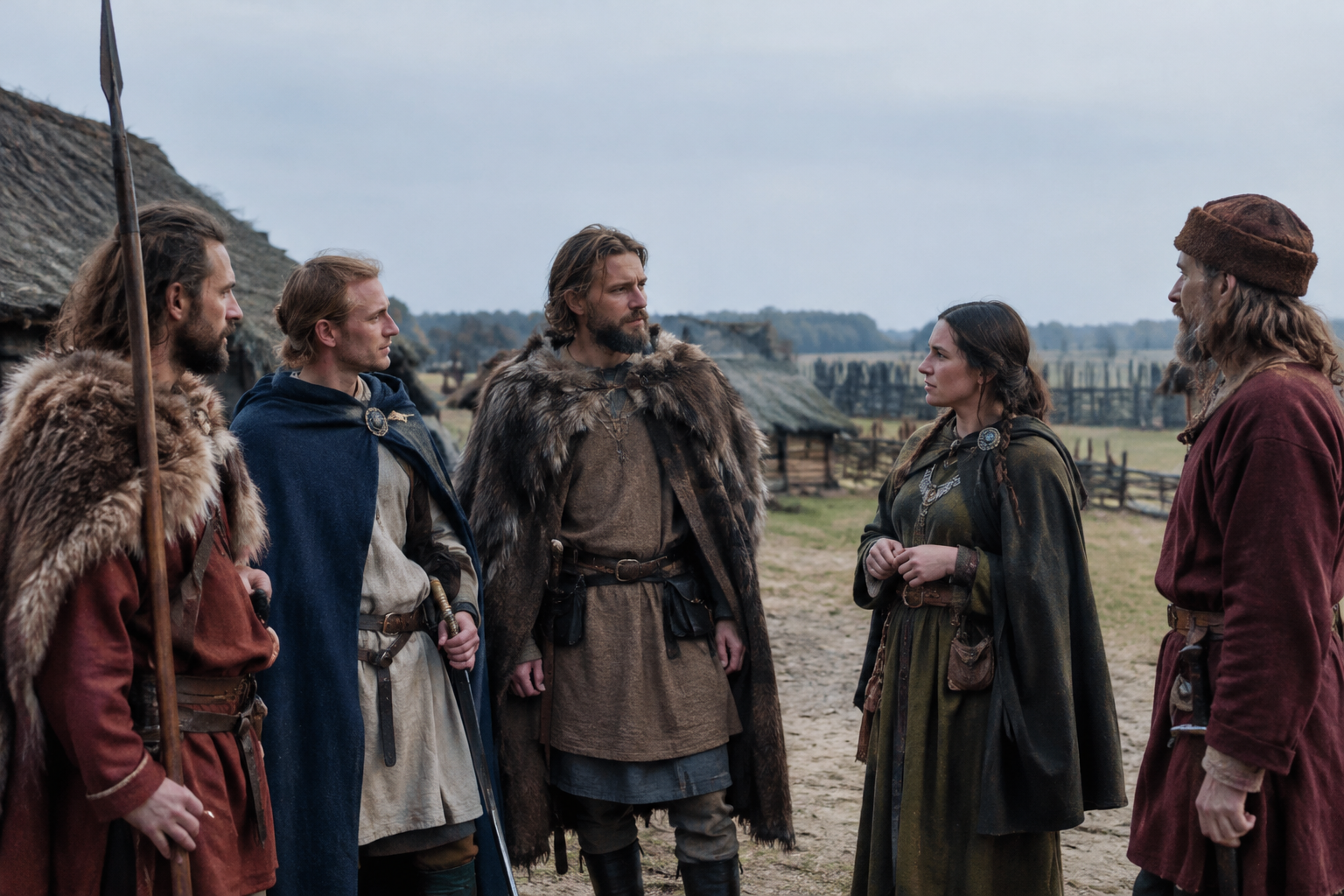
Some Y-chromosome lineages are easy to place in the historical imagination. Others are more elusive, appearing not in a single royal tomb or famous battlefield, but scattered across the moving frontier of late antiquity and the early Middle Ages. Haplogroup I1a3a1a1a3 belongs to that second category. It is interesting precisely because it sits within a branch of Y-DNA long associated, in broad terms, with northern Europe, yet the ancient evidence supplied here places it in a world of Goths, post-Roman Bavaria, and Migration Period Hungary.
That matters because Y-DNA traces one very particular line of ancestry: the direct paternal line, father to son across generations. It does not describe a person's whole ancestry, culture, language, or identity. But when ancient DNA recovers the same paternal branch in burials from different regions and centuries, it gives us a rare chance to watch one narrow lineage move through history alongside larger social upheavals.
Haplogroup I1a3a1a1a3 is a highly specific downstream branch of haplogroup I1. In broad outline, I1 is one of the major Y-chromosome lineages of Europe and is especially well known in northern European genetic history. For a narrow branch such as I1a3a1a1a3, however, caution is essential. We should not simply pour the entire history of I1 into this single subclade and pretend the job is done.
What we can say, responsibly, is that this branch belongs to a paternal family tree with deep European roots, and the ancient individuals supplied here place it in historical settings linked to Germanic-speaking populations during the Roman and post-Roman worlds. The evidence points not to a single neat tribal story, but to mobility across central and eastern Europe: Poland, Bavaria, and Hungary, over several centuries when armies, households, allies, captives, and migrants were all on the move.
The earliest anchors in this small dataset come from Poland, and they are revealing. One sample, PCA0018, is listed as Gothic Wielbark Poland Kowalewko Oborniki Year:160 AD. Another, PL086, comes from Gothic Tribe Poland Maslomecz Wielbark Year:250 AD. These are not just dots on a map. They sit within the wider archaeological world often connected with the Wielbark horizon, a cultural complex long discussed in relation to Gothic movements and identities.
Now, one must be careful here. Archaeological cultures are not the same thing as biological tribes, and a haplogroup is certainly not an ethnicity. Still, these two Polish finds are valuable because they show this paternal branch, or a very close related line, present in communities that archaeology has linked with the Gothic sphere in the centuries before and during the great rearrangements of late Roman Europe.
The Maslomecz material is especially evocative because the Gothic communities of this zone were not biologically uniform. Ancient DNA has repeatedly shown that such groups could be mixed, varied, and socially complex. So when a lineage like I1a3a1a1a3 appears here, it should not be read as "the Gothic haplogroup," but rather as one paternal thread among the men who lived in that world.
By the early medieval period, the same general paternal story seems to have shifted south and west. Sample Alh_282 is listed as Merovingian Period Bavaria Altheim Germany Year:600 AD. That places this lineage in the Frankish-era world of southern Germany, centuries after the earlier Polish burials. Then there is RKF274, from Migration Period Hungary Rakoczifalva Year:650 AD, found in the Carpathian Basin, one of the great crossroads of post-Roman Europe.
These two later samples are important because they sit in regions shaped by the collapse of Roman frontiers and the formation of successor kingdoms. Bavaria and Hungary in this period were not sealed ethnic boxes. They were contact zones, full of local continuity, incoming groups, military service, intermarriage, and political reinvention. A paternal lineage appearing across these places suggests not a single heroic march, but repeated episodes of movement and resettlement over generations.
This is where the story becomes particularly appealing. Ancient DNA gives us men buried in cemeteries. Medieval history gives us named places, lordships, and fortresses. The two do not join into a tidy family tree, and we should resist the temptation to force them together. But they do illuminate the same broad geography of power.
The noble association supplied here is the House Wormley, tied to Tillieres-sur-Avre in Normandy. Tillieres-sur-Avre was a frontier place on the River Avre, and in the early 11th century Duke Richard II of Normandy built a castle there to guard the border with the lands of the French kings. That tells you almost everything essential about its historical character. This was not merely a residence. It was a statement in timber and stone that borders mattered, and that men would fight over them.
The castle changed hands more than once in the rivalry between the Norman dukes and their neighbors, and it was rebuilt after destruction. In other words, Tillieres-sur-Avre belongs to a very old European pattern: the fortified edge, the contested march, the zone where political order had to be defended physically. There is a striking, if only contextual, parallel with the earlier ancient DNA record. The men represented by PCA0018, PL086, Alh_282, and RKF274 also lived in centuries defined by unstable frontiers and shifting loyalties.
That does not prove that the House Wormley descended from any of those ancient individuals, nor that every male member of the family carried haplogroup I1a3a1a1a3. Historical association is not genetic proof. But the comparison is still useful. It reminds us that paternal lineages often persist through the very kinds of borderlands where written records are fragmentary and identities were made and remade.
Read About the House of Wormley
A castle such as Tillieres-sur-Avre preserves one sort of memory. It tells us where power stood, where conflict was expected, and where a noble house located itself within a dangerous landscape. DNA preserves another sort of memory altogether: not offices or titles, but biological descent along one line.
The brilliance of bringing the two together is not that it lets us claim too much. Quite the reverse. It teaches restraint. A Y-DNA branch can survive many changes of language, allegiance, and social rank. A noble family may adopt, branch, fail in the male line, or incorporate new paternal lines over time. Medieval genealogy and archaeogenetics overlap, but imperfectly.
Yet even with those limits, the historical picture is compelling. A specific paternal lineage found in Gothic-associated Poland, then in Merovingian Bavaria and Migration Period Hungary, belongs to the same broad European arena from which medieval frontier lordships later emerged. The world changes from cemetery fields to chartered lordships, from tribal labels to ducal administration, from migration to fortification. But some paternal lines, somewhere within that churn, continued.
Readers interested in Normandy's own deeper past may also enjoy seeing how ancient DNA can reshape long regional histories far earlier than the age of castles.
So what does haplogroup I1a3a1a1a3 reveal? It reveals a paternal line with ancient roots inside the broader European I1 family, and one that appears in historically meaningful contexts across late Iron Age and early medieval Europe. It helps show that the paternal history of Europe was not static. Men moved, communities mixed, and lineages crossed political worlds that later chroniclers would describe as Gothic, Frankish, Bavarian, or Hungarian.
What it cannot do, by itself, is prove that a modern tester descends from a Gothic warrior, a Merovingian notable, or a Norman frontier lord. Shared haplogroups can connect men across very long timescales without indicating any recent genealogical relationship. That is not a disappointment. It is part of what makes ancient DNA so useful: it adds depth and scale to family history, showing where a paternal line sits in the much larger human story.
If your own Y-DNA falls on a branch like I1a3a1a1a3, the real excitement lies in placing that result beside archaeology, migration history, and the landscapes where ancient men once lived and were buried. From Kowalewko Oborniki and Maslomecz to Altheim, Rakoczifalva, and the guarded frontier at Tillieres-sur-Avre, this lineage belongs to a Europe of movement, adaptation, and long memory.
MyTrueAncestry lets you compare your DNA with ancient individuals and historical populations, offering a vivid new way to think about paternal ancestry. These matches can open fascinating windows onto the past, even when they do not prove direct descent from any particular ancient person or noble house.
If you want to see whether your own results connect you with ancient European samples, Migration Period populations, or the deeper history behind medieval families and castles, this is the place to begin.






Comments