Haplogroup I1a2b3a2a2

– 6 min read


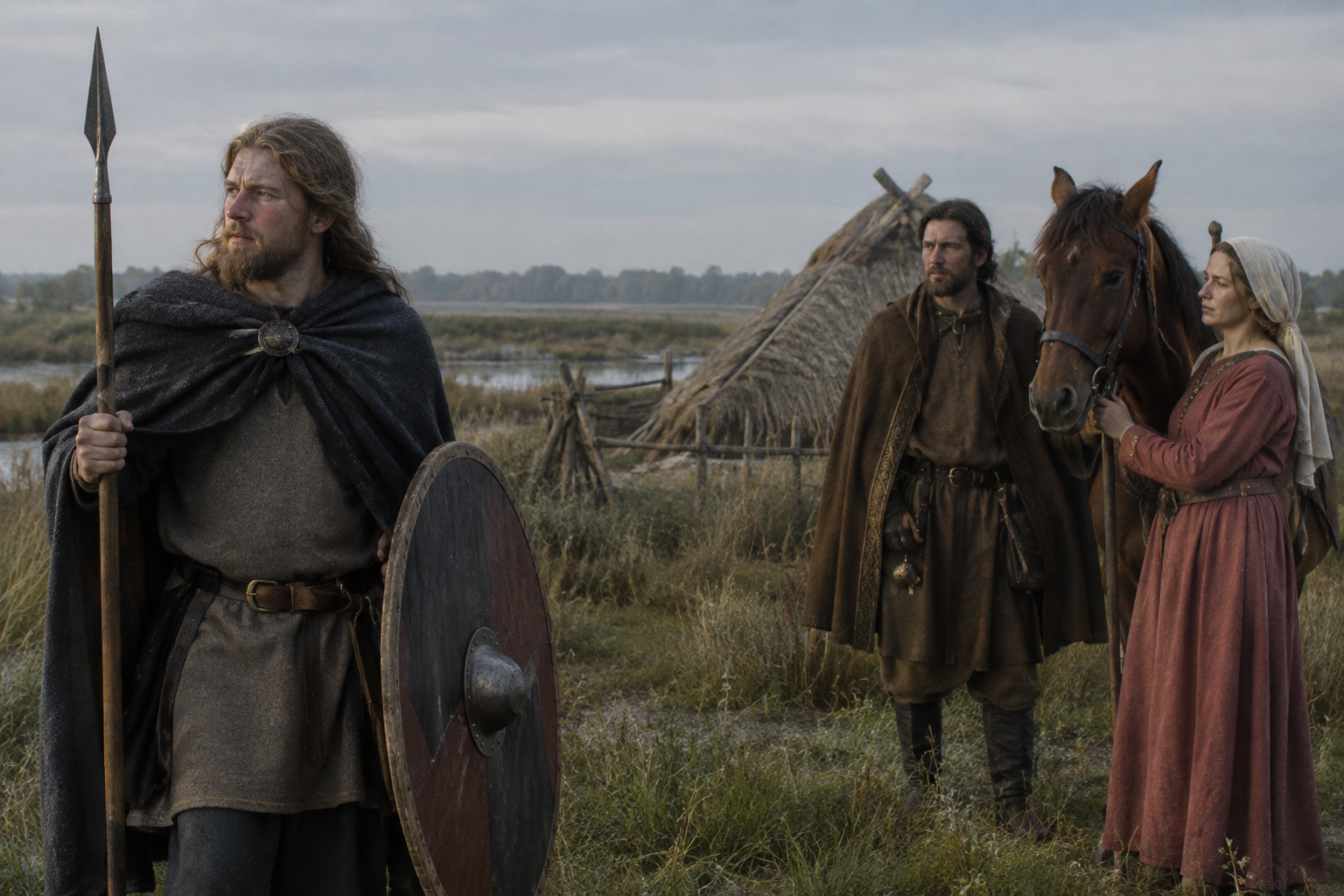
Some Y-DNA haplogroups arrive in the record with trumpets and banners. Others appear more quietly, through a marsh burial in Roman-era Denmark, a grave on the Carolingian frontier, or the long memory of a Norwegian fjord settlement. Haplogroup I1a2b3a2a2 belongs to that second category. It is historically interesting not because we can wrap it neatly around one kingdom or one famous dynasty, but because it sits within a paternal lineage story that has deep roots in northern Europe and keeps reappearing in places shaped by mobility, trade, and local continuity.
As always with Y-DNA, a caution comes first. A Y-chromosome haplogroup traces one direct paternal line only: father to father to father. It does not describe a person's whole ancestry, culture, language, or identity. Nor does sharing a haplogroup prove descent from a particular noble house. But used properly, Y-DNA is extraordinarily revealing. It lets us watch certain paternal branches move across landscapes, survive political upheaval, and sometimes link archaeological discoveries with later historical regions in suggestive, if careful, ways.
The branch name I1a2b3a2a2 places this lineage within the wider Y-DNA haplogroup I1, a well-known northern European paternal cluster. Broadly speaking, I1 is most strongly associated with northern Europe, especially Scandinavia, and it turns up repeatedly in ancient and later historical contexts across the North Sea and Baltic worlds. That does not mean every downstream branch shares the full history of all I1 men, and it would be wrong to treat this very specific subclade as if its exact trajectory were already mapped in detail. But its place in the tree does tell us that we are dealing with a paternal line rooted in the northern European sphere.
That matters because Scandinavia was never an isolated edge of Europe. It was a zone of contact: coasts, islands, bogs, inlets, and sea-lanes tied Denmark, Norway, and Sweden to one another and to the southern Baltic, the North Sea, and the continental mainland. If a branch like I1a2b3a2a2 appears in both Denmark and the Carpathian world in ancient DNA evidence, the interesting question is not "which single people did it belong to?" but rather how northern paternal lines could travel, settle, and persist across different historical settings.
Readers interested in the deeper Scandinavian background may enjoy this broader look at Denmark before the medieval kingdoms fully emerged:
One of the most vivid supplied samples is CGG107534, listed as Ancient Individual:Danii Tribe Denmark Denmark Egedal Mose Year:82 AD ID:CGG107534. Even before we get to the genetics, the setting is arresting. Egedal Mose is a Danish wetland landscape, and bogs and marshes in Iron Age Scandinavia are places where archaeology often catches unusual acts of deposition, ritual behavior, and moments of crisis that ordinary settlement layers miss. The sample's date, 82 AD, places him in a world contemporary with the Roman Empire, but beyond Rome's formal frontiers.
The label "Danii Tribe" invites comparison with the early populations of Denmark later associated with the Danes, though we should be cautious about reading later ethnic identities too neatly backward into the 1st century AD. What matters here is geographic and historical context: this is evidence for the presence of the broader paternal world containing I1-related lineages in Denmark during the Roman period. For a branch such as I1a2b3a2a2, that makes northern Europe not a romantic guess but a sensible frame of reference.
The second key sample, AHPS154, is listed as Ancient Individual:Medieval Hungary Carolingian Border Sarbogard Tringer Tanya Year:950 AD ID:AHPS154. Now the scene changes dramatically. We are no longer in a Danish marsh, but in medieval Hungary, in a region described as the Carolingian Border, at Sarbogard Tringer Tanya, dated to 950 AD. This is a proper frontier world: post-Roman, post-Carolingian, and entangled with the transformations surrounding the Hungarian conquest period and the reorganization of central Europe.
Scientifically, the important point is restraint. The presence of this sample in the input does not allow us to claim a direct line from the man in Egedal Mose to the man at Sarbogard, nor to declare that the exact same subclade marched intact from Denmark to Hungary. What it does show is that paternal lineages in this wider northern European orbit could appear in very different settings over many centuries. Ancient DNA is often most useful not when it proves a tidy ancestry tale, but when it reveals how untidy real history was.
If you want to follow that Hungarian frontier story further, this article is an excellent companion piece:
Explore Hungarian Conquest DNA
So what kind of movement might connect these worlds? Here we must separate evidence from hypothesis. It is well established that northern Europe and the continental mainland were linked throughout later prehistory and history by exchange, warfare, migration, and service in military retinues. Roman-era Denmark was part of that connected northern zone, even outside imperial rule. By the early medieval period, central Europe had become a mosaic of local populations, incoming elites, frontier communities, and mixed settlements shaped by the collapse of Rome, the spread of Christianity, and new political formations.
In that light, a northern-associated paternal branch appearing later in Hungary is not especially surprising. It could reflect long-term continuity of older European lineages, movement through Germanic or other northern networks, or the complicated reshuffling of populations in the centuries after Rome. Ancient DNA does not force us to choose a single story where the evidence does not yet do so.
This broader pattern - continuity mixed with movement - is exactly why archaeogenetics has become so useful. It allows us to compare the written record, which usually notices kings and wars, with the biological record, which catches ordinary and extraordinary men alike in burials, settlements, and borderlands.
For a wider introduction to how that works across the field, this MyTrueAncestry article is worth reading:
The supplied noble association is House Anker, linked here with Paleet, a small village in western Norway in Alver municipality in Vestland county. That is a rather lovely reminder that ancestry is not only about grand castles with battlements and heraldic beasts. Sometimes the real historical landscape is a village by the fjord, where farms, landing places, boathouses, and field systems tell the story better than any genealogical fantasy.
Paleet belongs to a region shaped over many centuries by coastal settlement, fishing, small-scale trade, and travel by boat. In western Norway, that is not a mere picturesque backdrop. The fjords were roads. Communities that might look remote on a modern map were often closely connected by water, and their history stretches back through the medieval kingdom of Norway into the older Norse world of local farms, assemblies, and later church organization.
That makes House Anker historically relevant in a grounded sense. Not because we can prove that all men associated with the house carried haplogroup I1a2b3a2a2 - we cannot - but because the house stands in a region where northern paternal lineages, including branches within I1, are entirely at home historically. The archaeology of farms, graves, boathouses, and worked landscapes in coastal Norway gives us the setting in which such lineages persisted, mixed, and were woven into later local identities.
There is also a useful methodological point here. Noble families preserve names, estates, and documentary memory; ancient DNA preserves biological clues from much older lives. The two do not automatically match. A place like Paleet helps bridge them geographically, not genealogically. It lets us picture the kind of world in which a northern paternal lineage might endure across centuries, even when the paper trail runs thin.
For readers curious about the historical family dimension, this related piece provides a natural next step:
Haplogroup I1a2b3a2a2 is a good example of why the most responsible genetic history is often the most interesting. Instead of claiming too much, we can say something both modest and meaningful. This lineage belongs to a paternal branch nested in the northern European, especially Scandinavian, Y-DNA world. The supplied ancient individuals place that wider story in two revealing contexts: Roman-era Denmark with CGG107534, and frontier medieval Hungary with AHPS154. Together they hint at a pattern of persistence and movement across a large swathe of Europe.
Then the Norwegian connection at Paleet reminds us that paternal ancestry is lived out in places: not in abstract frequency maps alone, but in villages, farmsteads, waterways, graves, and political regions that changed hands while families stayed, adapted, and sometimes rose into the documentary record. Genetics cannot tell us everything about those people. It cannot assign them a single identity or prove descent from a noble house merely because a surname or region looks tempting. But it can put real bones, real dates, and real landscapes back into the story.
If your own Y-DNA points toward a branch like I1a2b3a2a2, that does not make you a Viking, a Dane, or a member of House Anker. What it does do is connect one paternal line of your ancestry to a historical world stretching from Scandinavian wetlands to medieval borderlands and Norwegian fjord communities. That is quite enough to be getting on with.
Upload your DNA to MyTrueAncestry to explore whether your results show similarities to ancient individuals such as CGG107534 or AHPS154, and to discover how your paternal line may fit into the wider human past. These matches can offer remarkable historical perspective, even when they do not prove direct descent from a particular person or noble family.






Comments