Haplogroup I1a2b1c1a

– 6 min read


Some Y-chromosome lineages arrive in history wearing a label everyone recognizes. Others come to us in a much more intriguing way: as a very narrow branch, tucked deep inside a much older paternal tree, glimpsed in scattered burials, family associations, and the odd famous individual. Haplogroup I1a2b1c1a belongs to that second category. It is not the whole story of northern European paternal history, but a small and specific branch within it, and that is precisely what makes it interesting.
Y-DNA haplogroups trace a single direct paternal line: father to son to son across the centuries. They do not describe a person's full ancestry, culture, language, or identity. Still, they can be remarkably useful. A branch like I1a2b1c1a reminds us that history is not only written in chronicles, charters, and castle walls, but also preserved in the biology of lineages that passed through migrations, wars, settlements, and dynastic change. With this haplogroup, the broad backdrop is the history of haplogroup I1, a lineage most strongly associated with northern Europe, while the narrow subclade asks a more exacting question: where, and in which historical settings, did this particular paternal twig endure?
I1a2b1c1a is a downstream branch of haplogroup I1, one of the major paternal lineages associated with parts of Scandinavia and the wider North Sea world. In broad terms, I1 is well known in studies of northern European male ancestry, especially in regions influenced over time by Germanic-speaking populations and later Viking Age and medieval movements. But caution matters here: the full history of I1 cannot simply be pasted onto every much narrower descendant branch. A subclade such as I1a2b1c1a may represent only one later offshoot within that larger northern story.
What can reasonably be said is that such a branch fits most comfortably in a landscape shaped by the movement of men and families around the North Sea, the Baltic, and the British Isles over many centuries. Some of those movements belong to late prehistory, some to the Roman and post-Roman worlds, some to the Anglo-Saxon and Scandinavian expansions, and some to much later elite and non-elite population continuities. Ancient DNA has made that picture at once clearer and more complicated. It shows not one neat tribal procession, but repeated mixing, local survival, and regional reshuffling.
The supplied evidence gives us two especially striking reference points. One is from early medieval England. The other is from one of the most famous musicians in European history. Together, they make the point rather beautifully: paternal lineages do not belong to a single class, kingdom, or profession. They pass through ordinary settlements and extraordinary lives alike.
The first sample is ELY005, from Angle Ely Cambridgeshire, dated to 550 AD. That date places the individual in the centuries after Roman rule in Britain had collapsed, when eastern England was being transformed by migration, settlement, and cultural change. Ely and the Cambridgeshire fen-edge sit in a region that became deeply involved in the making of early medieval England. A paternal lineage found there in 550 AD belongs in exactly the sort of historical setting where northern European Y-chromosome branches can illuminate real population movement.
Yet even here, we must resist a lazy shortcut. A Y-line does not tell us everything about ELY005's identity. It cannot by itself prove whether this man thought of himself in terms we would call Angle, Saxon, Briton, or anything else. What it does offer is a valuable paternal signal within a region where ancient DNA has repeatedly shown links to continental North Sea populations, local continuity, and social complexity side by side.
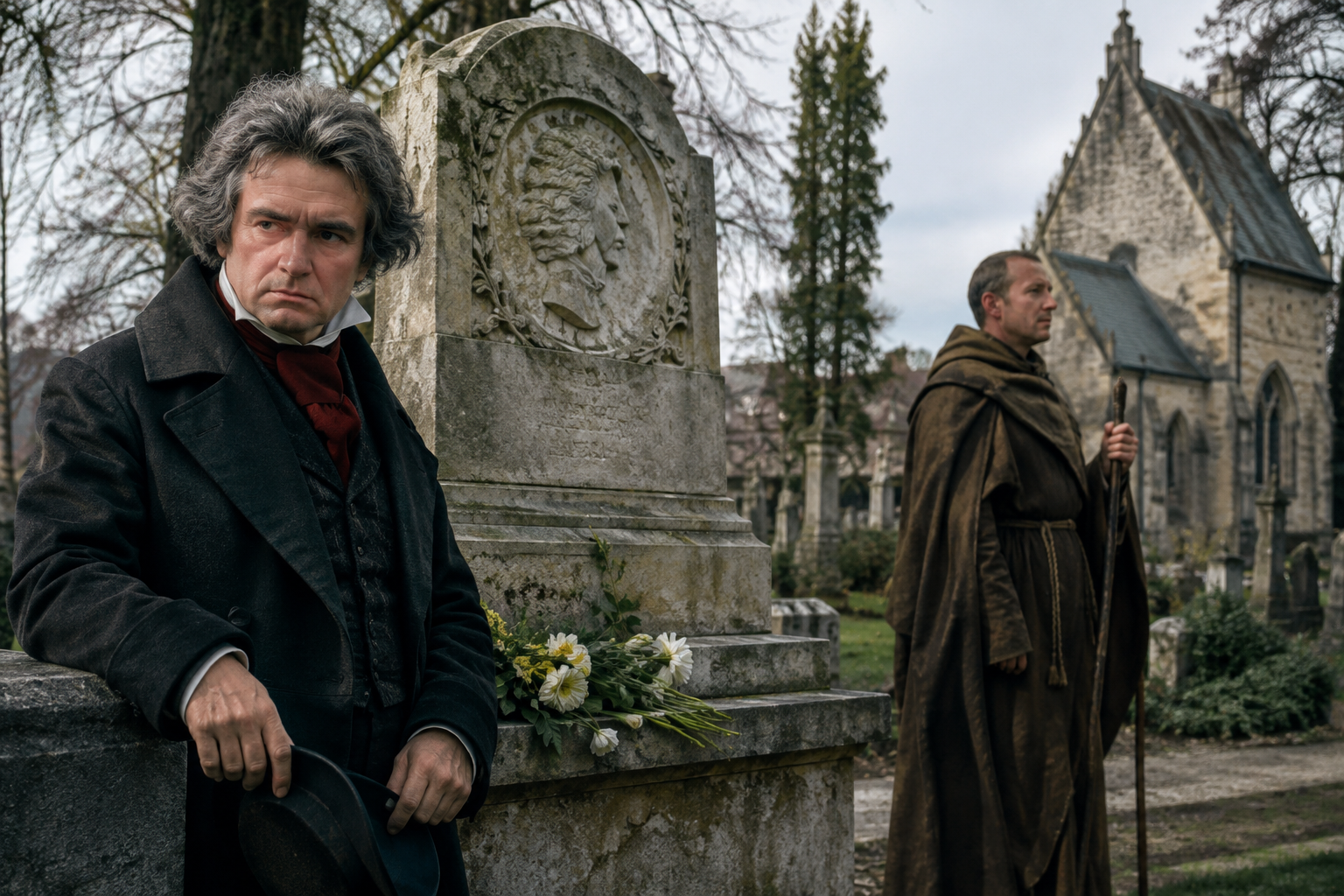
The second sample, lvb, is Ludwig van Beethoven, from Wiener Zentralfriedhof, dated 1827 AD. This is a very different sort of anchor point. Beethoven is not "ancient" in the archaeological sense, but genetically he is useful because he shows that this paternal branch, or a very close place within that paternal framework, persisted into the modern historical era in central Europe. In other words, the story does not stop in migration-period cemeteries. It continues through the literate, documented, early modern and modern world.
Beethoven's presence is also a good reminder of scale. Shared Y-DNA does not mean that a modern tester is a close cousin of Beethoven, still less that all men with related surnames are connected to him. But it does place a famous documented individual into the same broad paternal conversation as early medieval and northern European historical populations.
Read Roman and Early Medieval Britain
If ELY005 gives us one solid early medieval point in Cambridgeshire, the wider historical geography matters too. Eastern England was never isolated. It faced the North Sea, and with it came traders, settlers, raiders, mercenaries, churchmen, and aristocrats. Over time, paternal lineages associated with northern Europe could move by ship more quickly than armies marched by land. A subclade like I1a2b1c1a may therefore be better understood not as the badge of one people, but as part of a network of related paternal histories spread through North Sea corridors.
This helps explain why the noble associations supplied for this haplogroup are suggestive without being conclusive. They belong to Scotland and Essex, regions shaped in very different ways by medieval politics, but both tied into wider northern European currents. Genetics and history meet here not in tidy family trees, but in the fact that certain regions repeatedly served as landing grounds, frontier zones, and centres of lineage survival.
Consider first House de Mandeville and Walden Castle in Essex. Built soon after the Norman Conquest, probably in the late 11th or early 12th century by Geoffrey de Mandeville, the castle was a motte-and-bailey statement of conquest. Later rebuilt in stone, it became a baronial centre whose fortunes rose and fell during the Anarchy. That is a very particular political world: Norman power imposed on an English landscape already layered with Roman, early medieval, and Scandinavian connections.
Essex, of course, is not far in historical terms from Cambridgeshire. That does not prove any direct paternal continuity from ELY005 to the de Mandevilles. But it does place both the ancient sample and the later noble house inside the same broad eastern English zone, where continental and insular populations had been mingling for centuries before the Normans added yet another ruling stratum.
Then there is Clan Paterson and Bannockburn House near Stirling in Scotland. The house itself is later, built around 1675 and enlarged in the 1730s for the Nicol family, but its setting matters enormously. This is land bound to the memory of Bannockburn in 1314, where Robert the Bruce defeated Edward II. It is not a medieval fortress, but it sits in a place where Scottish identity, noble service, and national memory are thick in the ground. A haplogroup association here is best read as regional and historical context, not proof that every Paterson male shared one exact Y-branch.
Explore the House de Mandeville
Finally, Clan Borthwick brings us to one of the grand survivals of Scottish lordship: Borthwick Castle in Midlothian, built in the 1430s for Sir William de Borthwick. It is among the best-preserved great tower houses in Scotland, and like so many castles, it condensed military ambition, aristocratic residence, and political theatre into one building. Mary Queen of Scots famously stayed there in 1567 and, according to tradition, escaped in disguise when the castle was besieged. Cromwell's artillery later damaged it in 1650, but much survived.
What castles such as Walden and Borthwick preserve is not DNA, but historical memory: the places where lineages claimed authority, displayed permanence, and tried to outlast chaos. In that sense they are excellent companions to Y-DNA history. The chromosome records one paternal thread; the castle records the social world in which some such threads became visible in documents and stone.
The most responsible way to understand haplogroup I1a2b1c1a is as a narrow paternal lineage within a larger northern European family of Y-chromosome branches. The sample ELY005 shows that this kind of paternal ancestry was present in early medieval eastern England. The sample lvb shows its survival into much later historical Europe. The associations with the de Mandevilles, Patersons, and Borthwicks place the haplogroup in a world of Norman lordship, Scottish memory, and medieval fortification, but without turning those associations into claims of proven descent.
That distinction matters. Sharing a haplogroup with an ancient individual does not make him your direct ancestor. Sharing a haplogroup with a noble house does not make someone part of that dynasty. And yet none of this makes the evidence less exciting. Quite the reverse. Ancient DNA gives us something written genealogy alone cannot: the ability to see paternal continuity and change across periods where surnames did not yet exist, where chronicles are silent, and where the ordinary dead would otherwise vanish from history.
For readers interested in the deeper northern background to lineages like this one, North Sea mobility and settlement are especially relevant themes.
If your Y-DNA falls on a branch such as I1a2b1c1a, you are looking at one direct paternal line among many thousands of ancestors. But that one line can still open an unexpectedly vivid window onto early medieval England, the North Sea world, central European continuity, and the later landscapes of noble families and castles. MyTrueAncestry lets you compare your DNA with ancient individuals and historical populations, offering clues to where your deeper ancestry may intersect with the archaeological record, even when it does not prove descent from any specific famous person or family.






Comments