Haplogroup I1a2a2a4b2c
– 4 min read


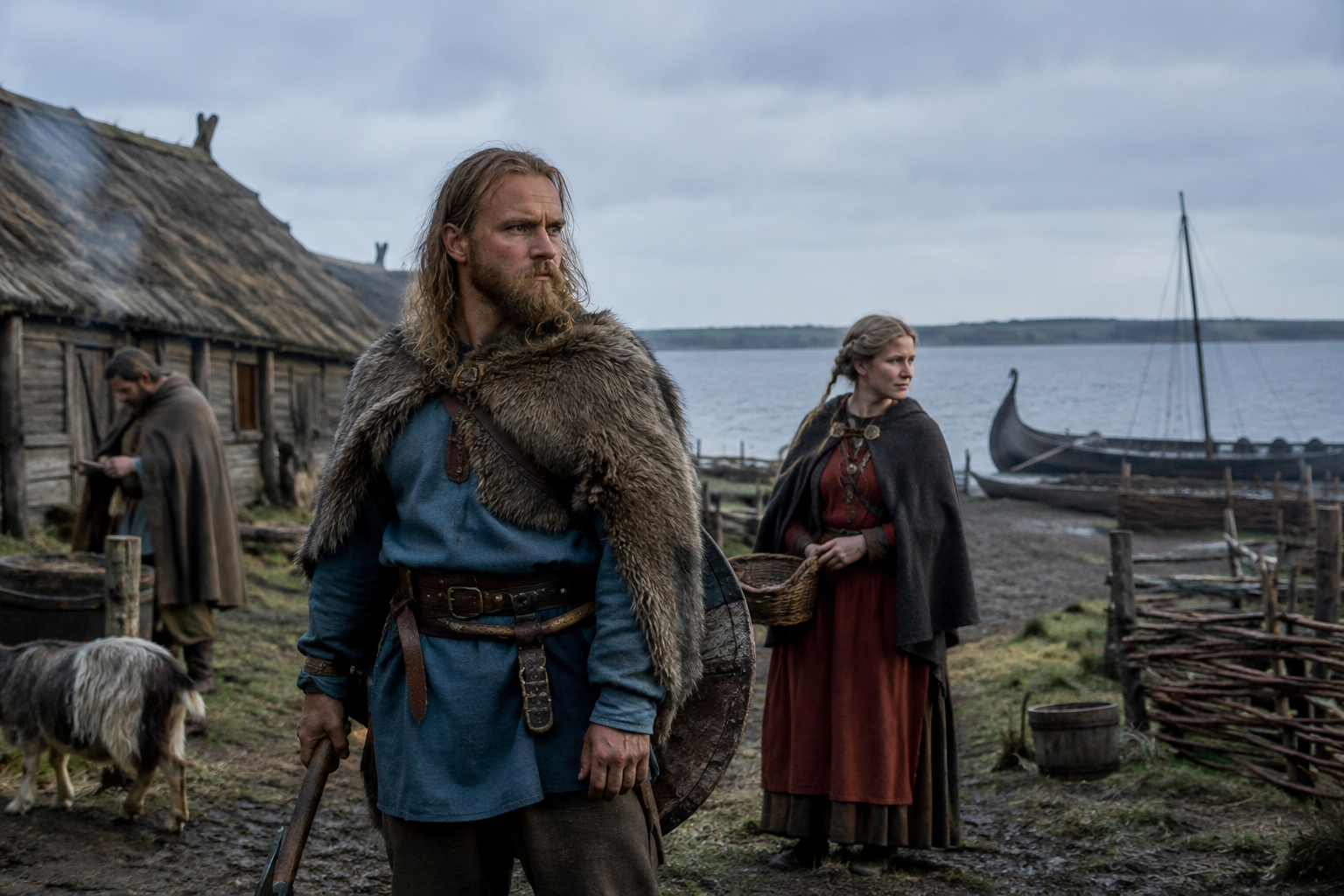
At Galgedil on the Danish island of Funen, one Viking Age burial has become unexpectedly useful to modern paternal-line research. The individual known as VK446, dated to around AD 925, belonged to the broad historical world of late Viking Age Denmark: a period of ship routes, local lordship, conversion in progress, and communities tied as much to the Baltic and North Sea as to their own fields and farmsteads. For people interested in the Y-DNA haplogroup I1a2a2a4b2c, this burial matters because it anchors that paternal line, or a reported association with it, in a real excavated Scandinavian context.
That is worth pausing over. Y-DNA tracks one direct paternal line only - father to son across generations - so it is not a person's whole ancestry, still less a shortcut to ethnicity. But when a lineage appears in an ancient burial from Viking Age Denmark, it gives that branch a proper archaeological setting rather than leaving it as an abstract code on a modern results page.
Funen sat in a strategically important part of Denmark, between Jutland and Zealand, at the meeting point of inland routes and wider seaways. By the 10th century, this was not a remote fringe but part of the heartland of a changing Scandinavian world. Burials from the period belong to societies that were local in daily life yet deeply connected through trade, warfare, marriage, and migration.
The sample VK446 comes from that setting. With only one ancient individual supplied here, the interest lies not in building a grand dynasty around him, but in recognizing what the evidence can securely offer: a paternal line associated with I1a2a2a4b2c in Viking Age Denmark around the early 10th century. That places the branch within the same broad historical landscape that produced the Scandinavian expansions so often discussed in both archaeology and historical linguistics.
A preprint on Viking population history and mobility, available at https://www.biorxiv.org/content/10.1101/703405v1, helped frame this wider genomic picture by investigating ancient individuals from the Viking world. Even when a single haplogroup match is the detail that catches the eye, the larger lesson from such work is that Viking Age Scandinavia was not genetically uniform. It was a connected zone with regional continuities, movement, and mixture.
The longer name matters. I1a2a2a4b2c is a very narrow twig on the much larger Y-DNA tree. Its parent haplogroup, I1, is well known in studies of northern Europe and is especially associated with later prehistoric and historic populations in Scandinavia and nearby regions. But one must be careful here: the history of the broad I1 branch is not automatically the history of this exact subclade.
What we can say with confidence is more modest and more useful. If your line falls under I1a2a2a4b2c, it belongs within a paternal family of lineages that became important in northern Europe, and one ancient point of comparison places that branch in Viking Age Denmark. That is already a meaningful historical coordinate. It does not prove that every modern carrier descends from Danish Vikings in a simple or exclusive sense, but it does situate the branch in a recognizably Scandinavian archaeological horizon.
There is a temptation, when faced with one ancient sample, to treat it as too little. Archaeologically, though, one well-placed burial can be very revealing. VK446 shows that this paternal line was present in a community living through the last great phase of the Viking Age, just before the political and religious consolidation of medieval Denmark gathered pace.
That is historically important because the early 10th century was a hinge moment. Scandinavian identities were being reshaped by expanding kingship, intensified overseas contact, and the gradual spread of Christianity. A paternal lineage found in that world may have descendants whose later family histories wandered far beyond Denmark - into the British Isles, the North Atlantic, or the southern Baltic - even though the excavated individual himself belongs firmly to Funen.
In other words, the Galgedil burial is not just "a Viking." He is evidence that this Y-line was part of the human fabric of Denmark at a time when Scandinavian men and their descendants could be moving, settling, and intermarrying across a very large map.
There is also a more local point to make. Funen did not suddenly become important in the Viking Age. Danish islands had already been part of long prehistoric sequences of settlement, farming, exchange, and cultural change stretching back through the Bronze and Iron Ages into the Neolithic. That deep continuity matters when we think about Y-chromosome lineages, because paternal branches do not arrive on stage fully formed at the moment they first appear in a written source.
Ancient DNA studies from Denmark have shown how dramatic earlier population changes could be, especially around the Mesolithic-Neolithic transition and later prehistoric transformations. By the Viking Age, however, Scandinavia was carrying the results of many older demographic layers. A lineage such as I1a2a2a4b2c belongs somewhere in that long northern European story, even if the supplied evidence here gives us only one secure excavated snapshot rather than a full sequence.
One of the most useful things ancient DNA has done is make the old textbook categories look less tidy. "Danish," "Norse," "Germanic," and "Viking" are all real historical terms, but they do different jobs. Some describe language, some culture, some political allegiance, some activity. None is identical to a Y-DNA branch.
That caution is especially relevant for a lineage like I1a2a2a4b2c. Because it sits under a broadly Scandinavian-associated parent haplogroup, it may be tempting to turn it into a badge of fixed identity. The burial at Galgedil suggests something more historically interesting: a paternal line embedded in a real community in Viking Age Denmark, within a world of movement and contact rather than biological isolation.
That broader pattern also fits what archaeogenetics keeps showing across early medieval Europe. Population history around the North Sea and Baltic was shaped by continuity and mobility at the same time. Lineages persisted, but they also travelled.
For someone researching I1a2a2a4b2c, the most solid historical takeaway is pleasingly concrete. This branch is associated here with VK446, an ancient individual from Galgedil, Funen, Denmark, dated to about AD 925. That does not give you a saga hero or a guaranteed royal pedigree. It gives you something better: a genuine archaeological foothold in late Viking Age Scandinavia, where one paternal line now has a name, a place, and a date.
That is how ancient DNA is most useful when handled carefully. It does not turn lineage into myth. It puts lineage back among real people, in real cemeteries, in the untidy and fascinating history of the northern world.






Comments