Haplogroup I1a2a2a3a4

– 9 min read


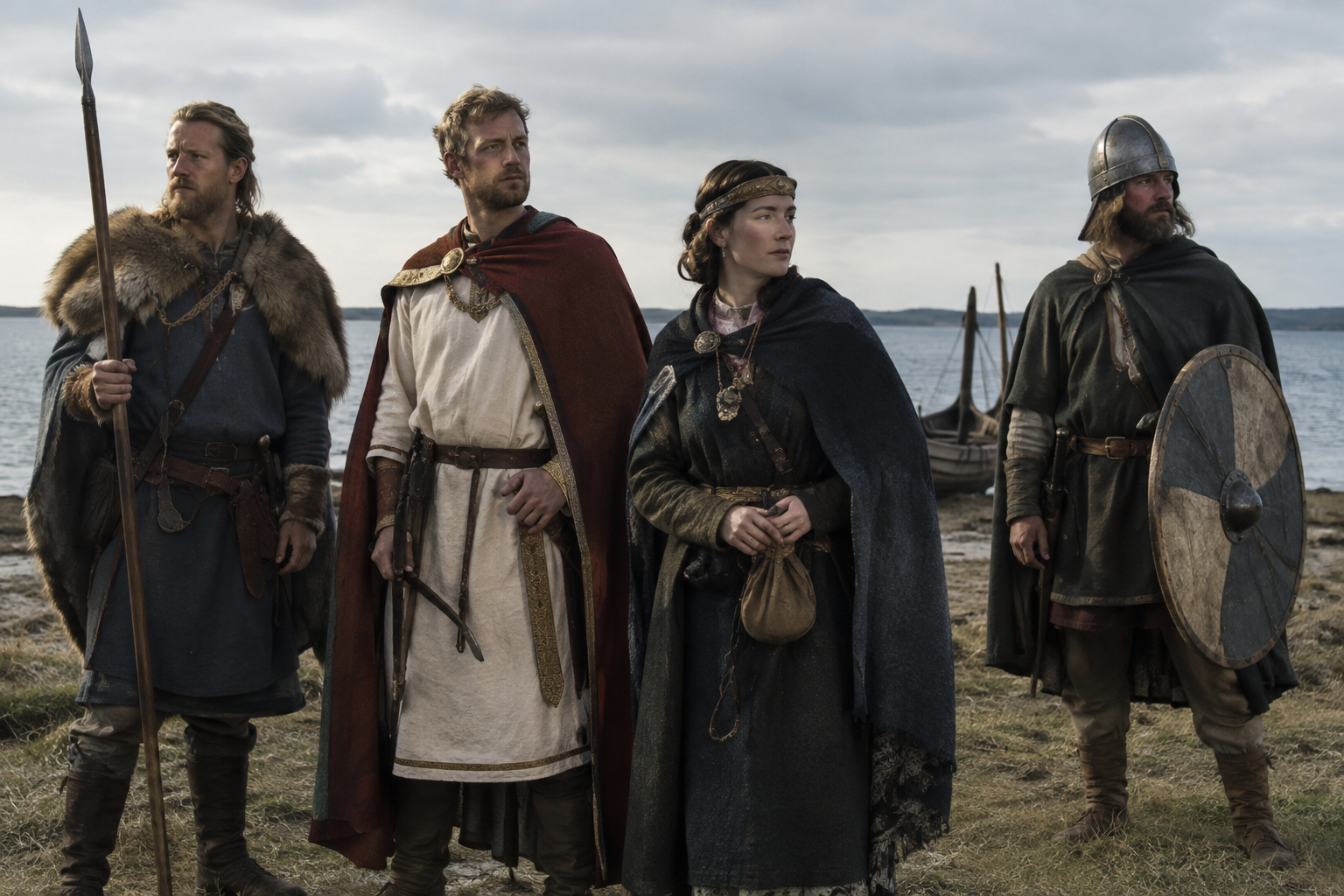
Some Y-DNA haplogroups arrive with trumpets: famous royal burials, neat maps, and a shelf of studies. Others are narrower, more elusive, and in some ways more interesting. Haplogroup I1a2a2a3a4 belongs to that second category. It sits deep within the wider Y-chromosome tree, inside the broad I1 family that is often associated in general terms with northern Europe, especially Scandinavia. But a subclade this specific should not simply inherit every story told about I1 as a whole. The proper question is more modest, and more revealing: where do we actually see this paternal line appearing in the historical record, and what sort of world does it belong to?
That is where ancient DNA becomes invaluable. Y-DNA traces one direct paternal line only - father to son to son - and so it is never a summary of a person's total ancestry. But it can illuminate the movement of male lineages across centuries with remarkable clarity. In the case of I1a2a2a3a4, the supplied ancient evidence places us in a striking arc of northern and eastern Europe: Denmark in the Late Roman Age, Saaremaa in the Vendel Age, Oland in Viking Age Sweden, and Shestovitsa in Viking Age Ukraine. That is not the whole history of the haplogroup, but it is enough to sketch a world of seaways, warbands, noble households, and long-distance mobility.
The broader haplogroup I1 is widely discussed as a paternal lineage with strong roots in northern Europe, especially Scandinavia. That much is a reasonable starting point. But when we descend to a branch as specific as I1a2a2a3a4, caution becomes essential. We should not claim a precise homeland, age, or migration route unless the evidence is directly in hand. What we can say is that the supplied ancient cases place this lineage in regions tied to Scandinavian and Baltic history during the first millennium AD.
That is already historically rich terrain. The Late Roman and post-Roman north was not isolated. Southern Scandinavia was connected to the Roman world through trade, prestige goods, military service, and imitation of imperial fashions. Later, in the Vendel and Viking periods, the Baltic became a corridor of movement linking Sweden, Denmark, the eastern Baltic islands, the river routes of what is now Ukraine and Russia, and eventually the Black Sea world. A paternal branch appearing in these regions across several centuries may reflect not a single tribe or ethnicity, but recurring participation in this northern maritime sphere.
For readers interested in the longer background to Scandinavia before these first-millennium burials, MyTrueAncestry's piece on Denmark's Mesolithic-Neolithic Transition: Culture, Genetics, and Timing is a helpful reminder that later historical populations were built on much older layers of ancestry and settlement.
The earliest supplied anchor is VK521, described as Late Roman Age Noble Brondsager Torsiinre Denmark, dated to 290 AD. Even without forcing too much from the label "noble," this is an arresting context. Denmark in the late 3rd century was outside the Roman Empire, yet deeply entangled with it. A paternal lineage like this appearing in such a burial hints at status, local continuity, or both. At the very least, it shows that the line was present in southern Scandinavia well before the classic Viking Age.
Then comes VK496, from Vendel Age Saaremaa Salme II-XXIII, dated to 725 AD. Salme is one of those finds that makes historians sit up straight. Saaremaa, the great island off Estonia, stood on one of the main crossroads of the Baltic. The Vendel Age belongs to the centuries just before the Viking Age proper, when elite warrior culture, ship burials, and far-flung contacts were already taking shape. A lineage found here connects our haplogroup not merely to a static homeland but to a zone of movement, raiding, alliance, and maritime ambition.
Next is VK343, from Viking Age Oland Sweden, dated to 950 AD. Oland lies off Sweden's southeast coast, facing the Baltic routes that linked Scandinavia with the eastern world. By 950 AD, this was no provincial backwater. It was a frontier of exchange, with merchants, sailors, and political actors moving between islands, ports, and inland power centers. A sample from Oland helps place I1a2a2a3a4 in the heart of the Scandinavian world during the Viking centuries.
Finally, VK539 comes from Viking Age Shestovitsa Ukraine, dated to 1000 AD. This is perhaps the most suggestive of the four, because it points east along the riverine routes of the Viking world. Shestovitsa lay within the orbit of the Dnieper corridor, one of the great arteries linking the Baltic to Byzantium and the Black Sea. A Scandinavian-associated paternal lineage appearing there fits the broader historical picture of movement by traders, mercenaries, settlers, and local elites in the world often associated with the Rus. It does not prove that every such individual was ethnically Scandinavian, nor that one burial tells the whole story of the region. But it shows how far these male lines could travel.
If you want to follow those eastern connections further, the MyTrueAncestry article on Ancient DNA and Migrations in the Northern Black Sea Region offers a useful wider frame for the same zone of mobility.
Taken together, these four samples do not give us a grand, finished saga of I1a2a2a3a4. They do, however, give us something historians prize even more: a pattern with historical texture. This paternal branch appears in Denmark in the Late Roman Age, in the eastern Baltic in the Vendel Age, in Sweden in the Viking Age, and in Ukraine at the far end of the Viking river networks. That distribution fits a northern European lineage participating in the connected world of the Baltic and the east.
It is tempting to leap from such evidence to tidy claims about Goths, Vikings, Rus, or named dynasties. Better not to. Haplogroups do not equal peoples, and a shared Y-branch does not mean direct descent between ancient individuals separated by centuries. What ancient DNA does provide is a framework in which written history, archaeology, and later genealogy can speak to one another. It lets us see that the male lineages of early medieval Europe were often durable, mobile, and embedded in political worlds larger than any single kingdom.
Readers interested in how burial evidence and kinship illuminate Swedish history more broadly may enjoy Genomes and Graves: Kinship and Childhood in Medieval Swedish Multiple Burials, which shows how much can be recovered when genetics and archaeology are read together.
Discover Medieval Swedish Kinship
The same caution applies when we move from ancient graves into the better-documented world of later families. Y-DNA can sometimes be associated with particular houses through paternal-line testing or genealogical tradition, but that does not mean every historical bearer of a surname or title shared the same exact lineage. Even so, noble families and their estates can offer a useful afterlife for the story, showing how paternal history persisted into the age of archives, country houses, and named dynasties.
Among the later families associated with this haplogroup are House Abney and House Tolstoy, two houses from very different corners of Europe and very different social worlds. Set side by side, they remind us that a paternal lineage with ancient roots in the Scandinavian and Baltic sphere need not remain confined to one narrow historical setting.
House Abney belongs to the English world of landed families and later gentry culture. The name is tied above all here to Cheadle, where Abney Hall became the best-known seat associated with the house. In this context, the interest lies less in medieval war-making than in the long continuity of family identity into the modern period, when estates, public reputation, and local standing mattered as much as fortification. As with many surname-based lineages, any genetic association should be treated carefully: it may reflect one paternal line linked to the house, not a universal marker for everyone connected with the name.
House Tolstoy carries us into the Russian aristocratic tradition. The Tolstoys were a noble family of long standing, and the association is made especially vivid by the figure of Leo Tolstoy, whose life and writings turned family history into world literature. That matters in a haplogroup article because it shows how paternal lines move from archaeology into documentary history. Instead of a burial label and a sample number, we suddenly have letters, estates, education, reforming ideas, and one of the best-known writers in Russian history. None of that proves a direct line from the ancient men discussed above to the Tolstoys, but it does show how later noble houses can provide a human setting for thinking about the deeper time of paternal ancestry.
Together these houses show the range of what a haplogroup association can mean: not a single dynasty marching unchanged through history, but a set of later family traditions attached to particular paternal lines, preserved in very different national settings.
The residences associated with these houses are not both castles in the strict medieval sense, but they are exactly the kind of places that make family history tangible. They are the built landscapes in which later generations remembered status, property, and ancestry.
Abney Hall, in Cheadle, is a Victorian house rather than a fortress, rebuilt in the 1840s for the Watts family. Its connection to House Abney lies in that wider tradition of named family seats and local prestige. What makes Abney Hall especially memorable is its later cultural life. Agatha Christie stayed there while visiting her sister, and the house helped inspire some of her fiction. During the First World War it served as a hospital, and in the 20th century it passed into public ownership before becoming a school. So although it does not belong to the age of battlements and moats, it offers something equally useful to the historian: a clear example of how elite residences survive by being adapted to new purposes while remaining landmarks in local memory.
Yasnaya Polyana, near Tula in Russia, is the ancestral estate most closely associated with House Tolstoy. Founded in the 17th century and long owned by the Tolstoy family, it is best known as the place where Leo Tolstoy was born, lived, wrote many of his major works, and was buried. It later became a museum preserving the house, park, and school connected with his life and ideas. In contrast to the sparse clues of ancient DNA, Yasnaya Polyana gives us an estate whose rooms, grounds, and records are still part of the historical landscape. It does not prove a genetic claim by itself, but it does anchor the family in a real place that can still be studied as part of Russia's noble past.
For readers tracing paternal heritage, such residences matter because they show how lineages eventually enter the documentary and architectural record. Bones and haplogroups tell us where a male line appeared; estates like Abney Hall and Yasnaya Polyana show how some later families associated with those lines were remembered.
The supplied noble associations take us into a much later world, but an illuminating one. House Abney is linked here with Abney Hall in Cheadle, a house built in 1847 for Alfred Orell and later enlarged by Sir James Watts. This is not a medieval fortress but a Victorian country house, and that difference matters. It represents a later chapter in elite family history: the age of industrial wealth, legal power, philanthropy, and literary memory. During both world wars the hall served public purposes, and its later life as part of a school preserved the building even as its social role changed. For students of lineage, this is a useful reminder that families endure not only through bloodlines, but through estates that are repurposed, reinterpreted, and remembered.
House Tolstoy and Yasnaya Polyana, near Tula in Russia, offer a different aristocratic landscape. The estate was the home of Leo Tolstoy, who was born there in 1828 and wrote much of War and Peace and Anna Karenina on the property. Preserved after his death, it remains a rare window into Russian noble life, but also into its strains and contradictions: peasant labor, education, landownership, reform, conscience. In historical terms, Yasnaya Polyana belongs to the world at the far eastern end of the broad zone touched by our ancient samples. That does not prove any direct genetic link to I1a2a2a3a4, and it certainly does not assign the haplogroup to the entire Tolstoy family. What it does provide is context. The same eastern European landscapes that once saw Viking Age movement later became homes to great landed families whose histories were recorded in text rather than bone.
For readers curious about that aristocratic world in its own right, MyTrueAncestry also has The House of Tolstoy.
Read About the House of Tolstoy
I1a2a2a3a4 is a good example of how a narrow paternal lineage can still open a large historical panorama. Its current evidence points toward the Scandinavian and Baltic sphere, with appearances stretching from Late Roman Denmark to Viking Age Ukraine. That is enough to place it in one of the most dynamic regions of early medieval Europe, where local continuity and long-distance mobility went hand in hand.
Just as importantly, it shows the limits as well as the power of Y-DNA. A haplogroup can connect burials across centuries without proving a neat family tree. It can place a paternal line in a warrior cemetery, an island world, or a noble landscape without reducing history to genes. The real excitement lies in combining the strands: archaeology for place, DNA for lineage, and family history for the later records that ancient bones cannot provide.
If your own Y-DNA or autosomal results point toward northern or eastern Europe, MyTrueAncestry can help you explore whether your ancestry shows connections to ancient individuals like VK521, VK496, VK343, or VK539, and to the historical populations among whom such paternal lines moved. Those matches do not prove direct descent from a particular warrior or noble house, but they can offer a wonderfully concrete way into the past.






Comments