Haplogroup I1a2a2a1

– 6 min read


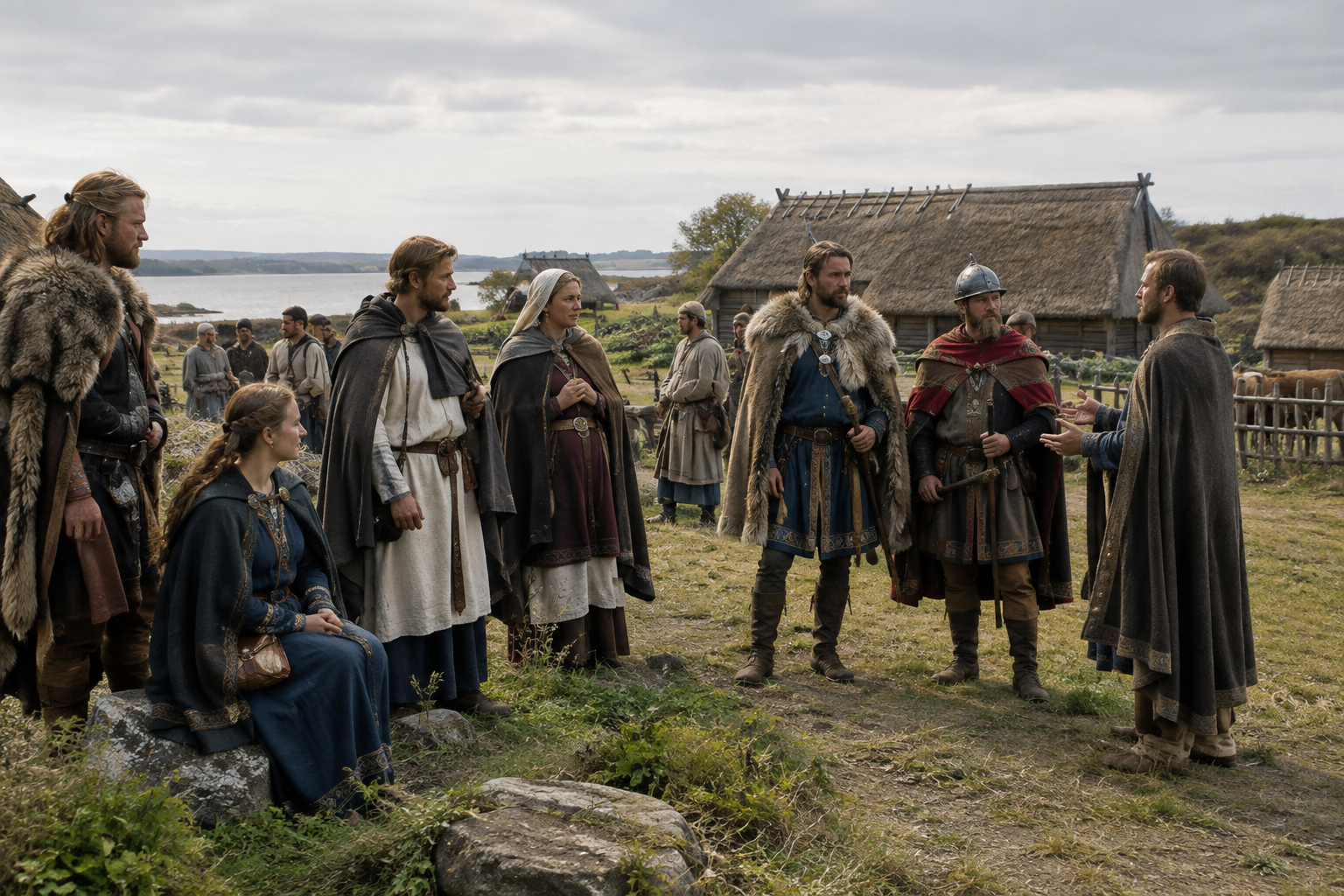
There is something wonderfully stubborn about a Y-chromosome lineage. Kingdoms vanish, languages shift, monasteries rise and fall, and yet a paternal branch can still be traced in the bones of men buried centuries apart around the North Sea and deep into early medieval Europe. Haplogroup I1a2a2a1 belongs to that kind of story: not a neat tale of one tribe marching under one banner, but a long, layered history visible in graves from Denmark, England, Germany, Poland, and Hungary.
As ever with Y-DNA, a warning is part of the fascination. A haplogroup traces only one direct paternal line - father to father to father - and not a person's whole ancestry. So this is not the history of an entire people, still less a certificate of ethnic identity. But it is a powerful historical tool. In the case of I1a2a2a1, the supplied ancient DNA points toward a lineage moving through Iron Age Scandinavia, appearing in Migration Period and early medieval contexts, and remaining visible into Viking Age Denmark. That makes it especially interesting for anyone exploring paternal ancestry linked to the Germanic-speaking world of the North Sea and Baltic.
The wider haplogroup I1 is well known in discussions of northern European paternal ancestry, especially in Scandinavia. That does not mean every branch of I1 shares exactly the same story, and it would be careless to paste the whole history of I1 directly onto the narrower clade I1a2a2a1. Still, the sample pattern here is striking. Several of the earliest supplied individuals come from Denmark, suggesting that this branch, or very close related branches, had a meaningful presence in southern Scandinavia before the Viking Age.
The chronology matters. We are not looking at a lineage that suddenly appears with Viking raiders in the 9th or 10th century. Instead, the evidence reaches back into the Nordic Iron Age. That gives I1a2a2a1 a longer northern context, one connected to the societies that developed in Denmark and the western Baltic before the famous age of longships and sagas.
The Danish material is perhaps the clearest place to begin. At Gevninge Overdrev on the Danish islands, sample CGG107535, dated to 57 AD, places this paternal line in a Nordic Iron Age setting well before the Viking period. Another Danish sample, VK532 from Kragehaven Odetofter, dated to 100 AD, points in the same direction. Then there is CGG107413 from Varpelev Vest, Eastern Sjaelland, dated to 375 AD. Three samples, across centuries, in Denmark: that is not proof of uninterrupted descent from one local family, but it does suggest regional continuity of related paternal lines.
And then the map begins to widen. In what is described simply as Goth Maslomecz, sample PCA0100, dated to 300 AD, places the lineage in a Late Iron Age Gothic-associated context east of the German frontier world. This is fascinating precisely because it complicates any crude notion that one Y-line equals one people. Gothic communities were historically mobile and archaeologically mixed. A paternal branch found in both Denmark and Maslomecz helps illustrate how men, families, and military followings could move across northern and central Europe in Late Antiquity.
By the Migration Period the trail continues in central Europe. Sample R11875 from a Migration Era Grave at Hassleben, Thuringia, Germany, dated to 450 AD, shows the lineage in another setting shaped by the collapse of Roman power and the rearrangement of populations north of the Alps. Then, at Rakoczifalva in Hungary, sample RKO007, dated to 650 AD, demonstrates that this paternal branch could also appear in the Carpathian Basin during the post-Roman centuries, when many groups with different histories and identities intersected there.
That does not prove one simple migration route from Denmark to Hungary. But it does fit a broader historical world in which northern and central European paternal lines circulated widely through war bands, settlement, marriage networks, and elite mobility.
The English samples are especially valuable because they place I1a2a2a1 in the story of early medieval Britain without turning genetics into a cartoon. Sample OAI005, an Angle from Oakington, England dated to 470 AD, and sample SED007 from Anglo-Saxon Sedgeford, England Norfolk dated to 600 AD, show this paternal lineage in the centuries when new political and cultural identities were forming in post-Roman England.
These men were not "the Anglo-Saxons" in total, of course. No one lineage can stand for an entire migration. But they do show how a paternal branch with strong Scandinavian and northern European associations appears in early English burial grounds linked to Angle and Anglo-Saxon contexts. That is historically plausible, archaeologically useful, and far more interesting than any simplistic claim about purity or permanence.
The line also turns up in socially prominent settings on the Continent. ErgDF2, from Late Merovingian Bavarian Elite Ergoldsbach Doernbacher Feld Germany, dated to 680 AD, suggests that this branch was present in high-status circles in early medieval Bavaria. That is a reminder that paternal lineages can travel not just with migrants, but with retainers, dynasties, and elite households.
By the Viking Age, the Danish evidence returns in grand style. VK445 from Gammel Lejre, Sealand Denmark, dated to 900 AD, and CGG106824 from Trelleborg, Kingdom of Denmark, dated to 975 AD, place the lineage in two sites loaded with political meaning. Lejre is bound up with early royal and aristocratic traditions; Trelleborg belongs to the ring-fort world of a more centralized Danish kingdom. Again, this is not proof that I1a2a2a1 was a "royal haplogroup." It is, however, evidence that men bearing this paternal line were present in important Viking Age Danish settings.
How do we move from Iron Age burials and Viking fortresses to medieval noble landscapes? Carefully. Genetics and genealogy are not the same thing. A shared haplogroup does not prove descent from a particular lord, monk, or knight. But regional and historical context still matters, and that is where the supplied association with House Haynes becomes interesting.
Chicksands Priory in Bedfordshire began around 1150 as a Gilbertine house founded by Payn de Beauchamp and his wife Rohese. The Gilbertines were unusual - the only major monastic order founded in England - and Chicksands grew through the Middle Ages as a religious community before the Dissolution under Henry VIII in the 1530s. Later reshaped into a country house, the estate still preserved key medieval remains, above all its Romanesque chapel, chapter house, and cloister fragments.
There is a pleasing historical irony here. The ancient samples associated with I1a2a2a1 belong to the mobile worlds of Iron Age Scandinavia, Gothic movement, Anglo-Saxon settlement, and Viking Denmark. Chicksands Priory belongs to a later England in which those older population histories had long since been folded into local society, lordship, and piety. A paternal lineage that once appears in Oakington or Sedgeford would, by the high Middle Ages, be living in a world of priors, patrons, landed estates, and Norman-founded institutions.
Chicksands itself embodies those layers. Norman religious ambition, Tudor destruction, country-house reinvention, and even twentieth-century military and intelligence use all accumulated on one site. That does not make the priory a genetic monument. But it does make it a vivid historical stage on which the long afterlife of early medieval lineages can be imagined.
If we stand back from the graves and the priory, the broad picture is clear enough. I1a2a2a1 appears here as a northern European paternal lineage with especially strong evidence in Denmark, then visible across the Migration Period and early medieval world from Gothic-associated Maslomecz to Thuringia, Bavaria, England, Hungary, and Viking Age Danish centers. It is a fine example of how ancient DNA can recover movement and continuity at the same time.
It also teaches a useful lesson in restraint. This haplogroup does not prove that every carrier was Danish, Gothic, Anglo-Saxon, or noble. It does not prove direct descent from any ancient individual listed above, nor from the patrons or later owners of Chicksands Priory. What it does offer is something subtler and, in some ways, better: a documented paternal thread running through some of the most consequential centuries in northern European history.
Readers interested in the wider background of this world may also enjoy the broader North Sea perspective in the MyTrueAncestry article on migrations between Scandinavia and Britain.
If your own Y-DNA connects to a lineage like I1a2a2a1, MyTrueAncestry can help place that result beside real ancient individuals such as CGG107535, OAI005, ErgDF2, or VK445. These comparisons do not by themselves prove direct descent or noble ancestry, but they can reveal remarkable historical connections across ancient populations, medieval regions, and the deep paternal past.






Comments