Haplogroup I1a2a1a2

– 5 min read


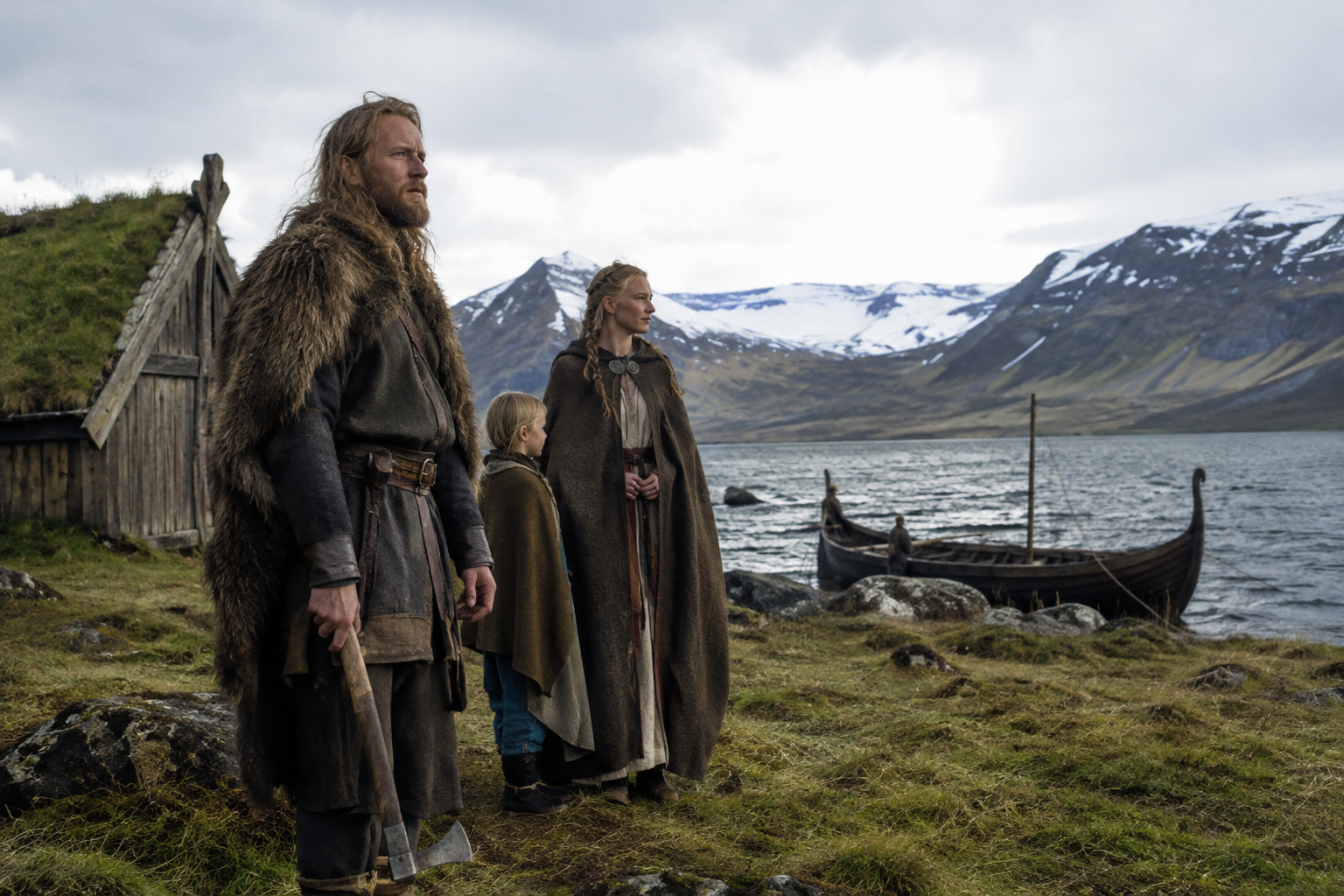
At Smyrlaberg in Húnavatnshreppur, in northern Iceland, one Viking Age man dated to around AD 935 has become a small but telling witness to a much larger story. He is recorded as sample SBT-A1, and his reported association with the Y-DNA branch I1a2a1a2 places him within a paternal lineage that fits neatly into one of the most historically interesting regions for early medieval North Atlantic settlement: the Scandinavian world at the moment it was expanding westward.
That matters because Iceland is not just another Viking Age site. It is a colonizing society in formation, a place where ancestry, mobility, and family lines can be studied against a fairly tight historical horizon. Y-DNA traces one direct paternal line only, not a person's whole ancestry, but in a setting like tenth-century Iceland even that narrow thread can tell us something precise about how male lineages moved into a new island society.
The date attached to SBT-A1, around AD 935, places him within the first generations after Iceland's settlement began in earnest in the late ninth century. That is exactly the period when farms were being established, regional communities were taking shape, and the social map of Iceland was being drawn by migrants with roots in Scandinavia and the North Atlantic diaspora.
The haplogroup label here is also worth handling carefully. I1a2a1a2 is a fine-grained branch inside the broader Y-DNA haplogroup I1, a lineage strongly associated in many ancient and modern studies with northern Europe, especially Scandinavia. But the narrow branch should not be given an invented saga of its own. What the Smyrlaberg evidence really allows us to say is more modest and more useful: by the tenth century, a paternal line within the I1 family was present among Viking Age settlers in Iceland.
That may sound simple, but in archaeology simple facts are often the valuable ones. Iceland's early population was formed through movement from Norway and from Norse communities already established in the British Isles and North Atlantic. A man like SBT-A1 belongs to that human traffic of settlement, kinship, and land-taking, even if one grave cannot by itself tell us whether his father's line came directly from Norway or by a more complicated route.
To understand why this branch is historically suggestive, it helps to step back to its parent lineage. Haplogroup I1 is one of the best known paternal lines in discussions of early Germanic-speaking populations and later Scandinavian expansions. It appears frequently in modern northern Europe, and it is often brought into conversation with the movements that carried Norse languages, people, and social practices around the North Sea and into the North Atlantic.
That broader background makes SBT-A1 legible. He does not stand for all Vikings, still less for all Icelanders, but he does fit a pattern in which some Viking Age male lines in Iceland belonged to lineages common in the Scandinavian sphere. In other words, the genetic signal is consistent with the historical picture rather than overturning it.
This is one reason ancient DNA has changed the study of the Viking world so dramatically. It lets us test assumptions that were once built only from later texts and place-names. Research on Viking Age populations, including work published in a major ancient DNA study of the Viking world, has shown again and again that Viking expansion was real, wide-ranging, and genetically varied. The old stereotype of a single uniform "Viking people" is much too tidy.
That last point is especially important for a lineage like I1a2a1a2. People are often tempted to translate a Y-DNA branch straight into an ethnic badge: Norse, Viking, Germanic, and so on. Archaeology is usually less obliging. Viking Age Iceland was peopled by communities whose ancestry could be mixed even when their language, law, and social identity were firmly Norse.
A paternal lineage such as I1a2a1a2 could therefore travel in many historical packages. It might belong to a family rooted for generations in western Scandinavia. It might also have passed through Norse-settled parts of the British Isles before arriving in Iceland. The point is not to flatten the evidence into a slogan, but to recognise that settlement history in the North Atlantic was built from households, alliances, marriages, and inherited lines carried across the sea.
SBT-A1 is useful because he pins that abstract process to a real individual at a real place. Smyrlaberg is not a legend. It is an archaeological location in a frontier society where people were turning migration into permanence.
There is only one ancient sample listed here, and that scarcity is part of the story. Articles about haplogroups can sometimes lapse into grand claims built on very little. Better, surely, to do the opposite and ask what one secure point of evidence can genuinely contribute.
In this case, SBT-A1 helps anchor I1a2a1a2 in the Viking Age North Atlantic by around the mid-tenth century. That does not reveal the full age of the branch, its place of origin, or every route by which it spread. But it does show the branch in a historically meaningful setting: one of the best known episodes of maritime expansion in medieval Europe.
It also reminds us that Iceland is unusually valuable for this kind of work. Because settlement there occurred within a fairly constrained historical period, individuals from the first centuries of Icelandic life can illuminate how lineages were carried into a new colony. A paternal line found in that setting is not just "Scandinavian" in a vague sense; it is tied to a society being assembled before our eyes from graves, farms, law codes, and now genomes.
For readers interested in the longer background, the wider I1 family often enters debates about the spread of Germanic-speaking populations. Here caution is essential. A haplogroup does not equal a language, and no single Y-line founded the Germanic world. Still, male-line data can sometimes illuminate the demographic side of language history, especially when set alongside archaeology and regional migration patterns.
That is where a subclade like I1a2a1a2 becomes interesting. Not because it "proves" a language, but because it sits inside a lineage family repeatedly seen in northern Europe and therefore belongs to the same broad demographic landscape from which Viking Age Scandinavian expansion emerged. If your own paternal line falls here, the most defensible historical frame is not a cinematic Viking fantasy but the very real world of northern European male-line continuity, branching, and movement over many centuries.
Germanic Languages and Genomics
It is tempting to ask whether a branch like I1a2a1a2 belongs to some famous settler, chieftain, or later noble house. Here the evidence does not justify that leap, and there is no need to force one. The real value of the Smyrlaberg find is more archaeological than aristocratic: it shows this paternal line in the lived landscape of early Iceland.
That landscape was part of a larger Norse world stretching from Scandinavia to the Faroes, Iceland, Greenland, and beyond. Ancient DNA from these regions continues to sharpen the picture, often showing how mobile and connected these communities were while still preserving distinctive local histories.
On present evidence, I1a2a1a2 is best approached through the sort of world represented by SBT-A1: Viking Age northern Europe, and more specifically the Scandinavian expansion into Iceland by around AD 935. That is not a complete biography of the branch, but it is a solid historical foothold. For someone researching this paternal line today, the most useful takeaway is that at least one bearer of it stood within the first centuries of Iceland's Norse society, where migration became settlement and family lines became history.






Comments