Haplogroup I1a2a1a1d1a1a2c10a2b

– 5 min read


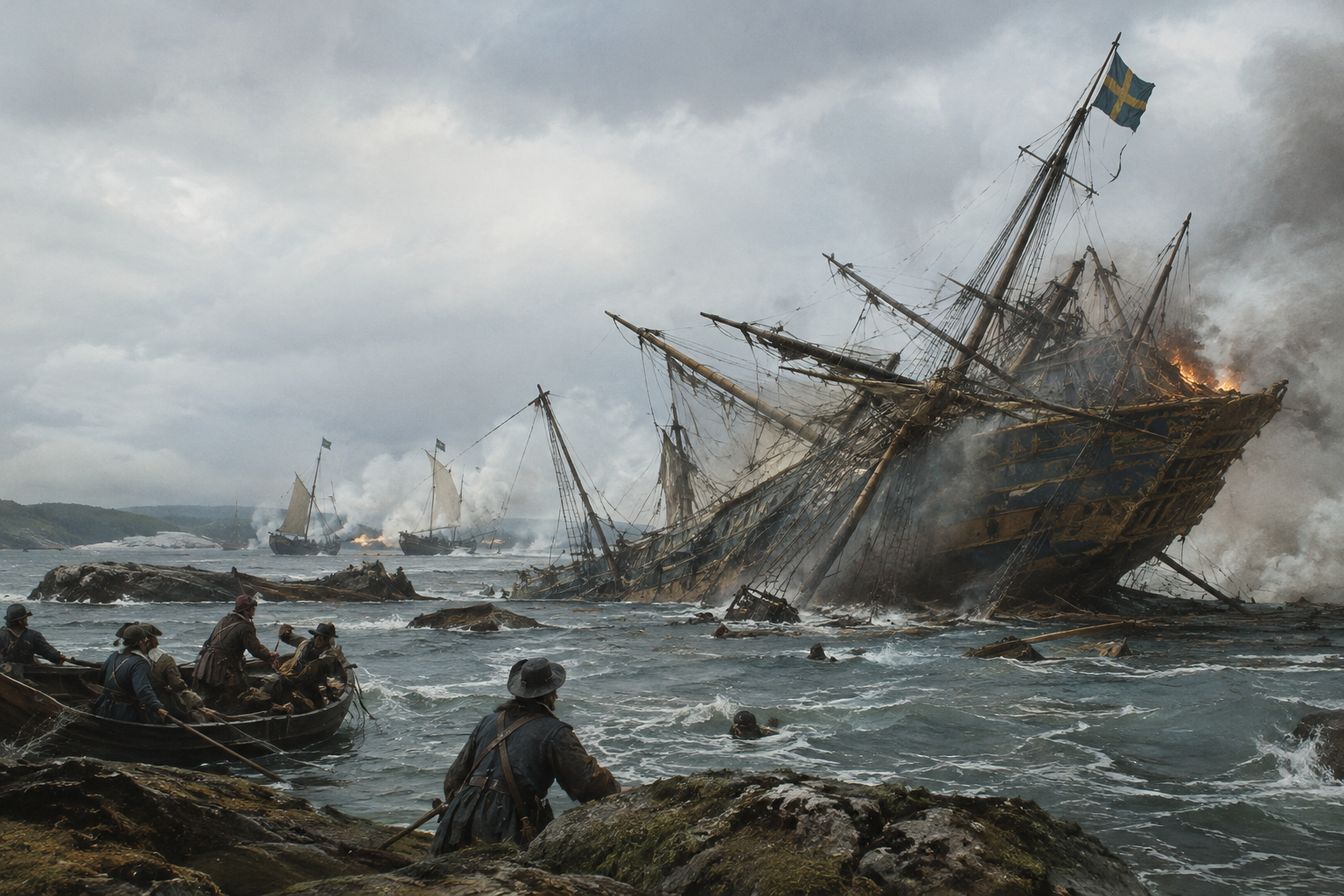
One of the most vivid appearances of the Y-DNA branch I1a2a1a1d1a1a2c10a2b comes not from a princely tomb or a famous battlefield on land, but from the wreck of the Stora Kronan, the great Swedish warship lost in 1676 during the Battle of Oland. The ancient individual identified as kro004, recovered from this seventeenth-century maritime disaster, anchors this lineage in a very specific historical world: the Baltic, the Swedish navy, and the age when states were turning seafaring into a machine of war.
That matters because a Y-DNA lineage is not a badge of ethnicity or rank. It traces one direct paternal line only. But when a branch like I1a2a1a1d1a1a2c10a2b turns up in a securely dated context such as kro004, it gives us something refreshingly solid: one documented man, in one documented place, at one of the best-known moments in Scandinavian military history.
The Stora Kronan sank off Oland in 1676, during the Scanian War, when Sweden fought a coalition led by Denmark-Norway. This was no obscure coastal mishap. The ship was one of the largest in the Swedish fleet, and its destruction became one of the worst maritime catastrophes in Swedish history. The sample kro004 belongs to that catastrophe.
What gives the find its force is the combination of archaeology and chronology. A shipwreck of this kind is a time capsule, but a brutal one. The people aboard were not buried in a formal cemetery or commemorated in family chapels; they were caught in a state-organized war at sea. In that sense, kro004 is a reminder that paternal lineages do not survive history in tidy genealogical boxes. They pass through crews, conscription, service, danger, and sudden death.
The broader haplogroup context matters too. The article branch sits within I1, a well-known Y-chromosome lineage with deep roots in northern Europe and especially strong later associations in Scandinavia. That does not mean every I1 branch shares the same detailed history, and it certainly does not allow us to project the precise story of this very narrow terminal line deep into prehistory without direct evidence. What kro004 shows securely is that this paternal branch, or a reported association with it, was present in Sweden in the late seventeenth century.
It is tempting, when faced with a long technical label such as I1a2a1a1d1a1a2c10a2b, to imagine a neat chain leading straight back to some named Viking, chieftain, or tribe. Archaeology is rarely so obliging. What a sample like kro004 gives us instead is a fixed historical checkpoint. This branch was present among men living in the Swedish realm during the naval age, and it appears in a context linked to the Baltic world rather than to an isolated inland pedigree.
That is especially useful in Scandinavia, where paternal-line studies often intersect with sweeping stories about Germanic expansions, Viking mobility, and the formation of medieval kingdoms. Those larger histories are real, but they are made up of countless individual lines, most of which surface only occasionally in ancient DNA. A single secure identification from 1676 is therefore modest in scope but valuable in method: it ties the lineage to an actual excavated person rather than to abstract frequency maps.
A major ancient-genomics study of populations connected with the spread of Germanic languages, published in Cell, helped frame how archaeologists think about northern European population history across long periods. That kind of research is important background here, though it should not be overused. It helps explain why I1 and related northern paternal lines attract so much attention, while kro004 shows how those broader patterns eventually appear in a very specific historical individual.
By the seventeenth century, Sweden was a major Baltic power. Its armies and fleets drew manpower from different regions of the kingdom, and its wars connected coastal towns, inland parishes, ports, and islands into one military system. A man like kro004 may have belonged to any of those overlapping worlds. The point is not that we can reconstruct his biography in detail; we cannot. The point is that his paternal line was part of the lived population that staffed Sweden's imperial ambitions.
This is where Y-DNA can be historically illuminating without becoming fanciful. A lineage that probably had a much older northern European background had, by 1676, become part of an early modern naval crew. That is history in miniature. Ancient DNA often works best not when it confirms grand legends, but when it restores ordinary historical presence to people otherwise lost in mass events.
The exact label I1a2a1a1d1a1a2c10a2b is far narrower than the broad parent haplogroup I1. That distinction is crucial. The parent lineage has a large literature and a wide northern European footprint; this terminal branch is a much finer twig on that tree. Without multiple ancient samples across earlier centuries, it would be irresponsible to assign this exact subclade a grand migration route, a single ethnic identity, or a named medieval dynasty.
What can be said more responsibly is that this reported branch sits comfortably within a Scandinavian historical setting. The evidence at hand places it in Sweden in 1676, in the wreck context of the Stora Kronan. That may fit wider expectations about northern European I1 diversity, but the strength of the article lies in its restraint: one branch, one excavated man, one securely historical disaster.
This caution is not a weakness. In fact, it is how archaeogenetics becomes useful to family historians. A lineage does not need a saga to matter. Sometimes the clearest insight comes from a documented individual whose world we understand well even if his name is lost.
The Battle of Oland belonged to a period when the Baltic Sea was one of Europe's most fiercely contested regions. Control of sea lanes meant control of trade, troop movements, and political influence. The loss of the Stora Kronan was therefore not just a human tragedy but a geopolitical event. To find a paternal lineage like I1a2a1a1d1a1a2c10a2b in that wreck is to place it squarely inside the machinery of seventeenth-century state conflict.
That setting also helps explain why maritime archaeology is so powerful. A rural churchyard may tell us about local continuity; a warship can reveal the human composition of a state at war. Even with only one named sample here, the context is unusually strong. We are not looking at a vaguely dated skeleton from an uncertain landscape, but at a man tied to one famous ship and one famous year.
For someone researching a paternal line assigned to I1a2a1a1d1a1a2c10a2b, the most distinctive thing in the present evidence is not royal glamour or remote prehistory. It is the hard historical fact of a Scandinavian man from the Stora Kronan, sample kro004, who lived and died in the Baltic world of 1676. That places the branch, at least in one known case, within the population history of early modern Sweden and the wider northern European zone where I1 lineages are historically prominent.
It is a small window, but a very real one. And in ancient DNA, reality is better than romance.






Comments