Haplogroup I1a2a1a1d

– 5 min read


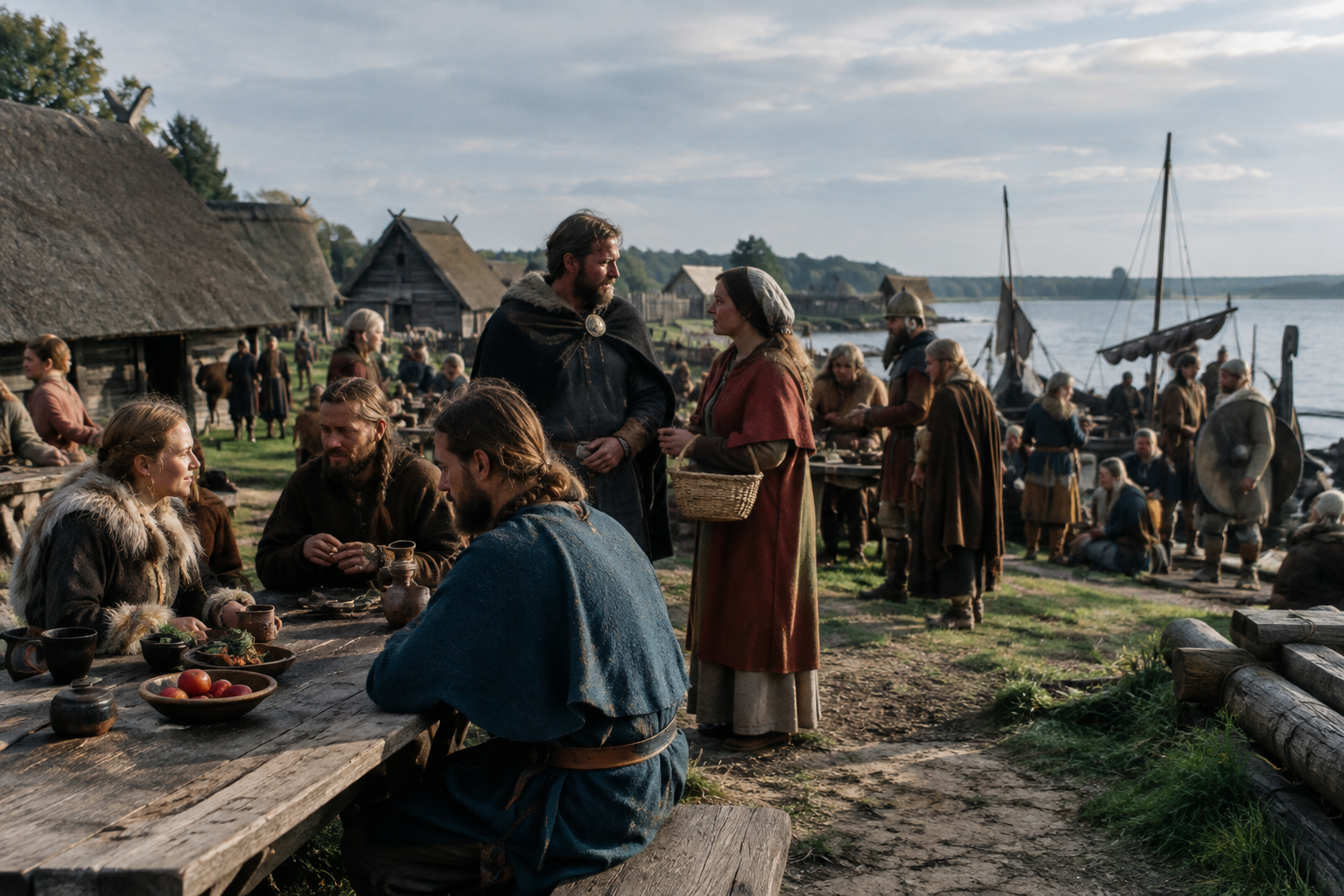
Some Y-chromosome lineages are known from one corner of history only. Others keep turning up in places that make us stop and think. Haplogroup I1a2a1a1d belongs to that second category. It sits within the wider I1 branch, a paternal lineage long associated with northern Europe, but this very specific subclade becomes interesting not because it can be turned into a slogan about "Vikings" or "Germanic blood," but because ancient DNA shows it appearing across a striking geographical arc: Denmark, Sweden, Norway, Poland, Germany, Hungary, Croatia, Belgium, and beyond.
That is exactly why Y-DNA matters. A Y-haplogroup traces one narrow line of descent: father to son to son again. It does not describe a person's full ancestry, culture, language, or identity. But when the same paternal branch appears in burials from the Bronze Age, Iron Age, Migration Period, Viking Age, and medieval towns, it gives us a rare way to watch one thread of male-line history persist through enormous political and cultural change.
The wider haplogroup I1 is generally understood as a northern European Y-lineage, and the evidence supplied here fits that broad picture well. What we cannot do responsibly is pretend that the full history of all I1 men belongs automatically to the narrower branch I1a2a1a1d. Still, the ancient samples suggest that this lineage, or a very close paternal neighborhood around it, had a strong presence in southern Scandinavia and later appeared repeatedly in the world shaped by Germanic migrations.
One of the earliest signposts in the dataset is an Early Bronze Age Norway Viken Fredrikstad individual dated to 1240 BC, sample CGG105645_CGG105646. That does not "prove" the modern distribution of the haplogroup, but it does place this paternal line deep in the Scandinavian past. By the Roman Iron Age, the picture becomes richer: a cluster of men from Zealand in Denmark appears in the 2nd to 4th centuries AD, including CGG107442 from Asnaes, CGG107447 from Gedebjerg, CGG106721 from Kalundborg Simonsborg, CGG107502 from Stenlille, CGG107507 from Vester Egesborg Vordingborg, and later CGG107427 from Regnemark and CGG107416 from Praesto Endegaarde.
That concentration matters. It suggests that southern Scandinavia was not merely a romantic backdrop for this paternal branch, but one of the core regions in which it can actually be observed archaeologically.
Then the story starts to travel. Ancient DNA often makes the Migration Period look less like a tidy invasion map and more like a jumble of family lines, alliances, and local mixtures. This haplogroup is a good example. In Poland, sample PL065 from the Gothic Tribe Poland Maslomecz Wielbark context, dated to 250 AD, places the lineage in a community usually linked archaeologically with the Goths. Nearby in time and region is GRK018 from Migration Period Poland Grodek nad Bugiem, dated to 400 AD.
These are not labels to be taken too literally. A burial called "Gothic" in archaeology does not mean DNA can tell us a man "was a Goth" in some essential sense. But these samples do show the paternal line present in eastern-central European communities caught up in the great movements and re-formations of late antiquity.
South and west of there, the same pattern continues. OBM005 from the Thuringii Tribe German Obermoellern context around 500 AD places the lineage in central Germany. SZL041, from Longobard Period Pannonia Savaria Szeleste Barbaricum Hungary dated to 525 AD, shows it in the Carpathian Basin during the age when Lombard and other post-Roman groups were moving through former imperial frontier zones. R3660 from Migration Period Scitarjevo Croatia dated to 500 AD extends that picture into the Balkans.
And then there is Bavaria. Three separate burials from Merovingian Period Bavaria Altheim Germany, all dated to 600 AD - Alh_117, Alh_132, and Alh_150 - suggest that this was not an isolated stray lineage but a recurring paternal presence in early medieval communities of the Frankish world.
Read About the Maslomecz Goths
If the Migration Period samples show movement, the later Scandinavian material shows durability. In Sweden, CGG105932_CGG105933 from Iron Age Sweden Albacksbacken Maglarp dated to 263 AD already signals an early foothold. By the Vendel and Viking ages, the lineage is still visible. VK492 from Vendel Age Saaremaa Salme II-II dated to 725 AD is particularly evocative because Salme is tied to a martial seaborne world spanning the Baltic. VK443 from Viking Age Oland Island Sweden dated to 900 AD and gor164 from Viking Age Sweden Stockholm Gorla dated to 1050 AD extend that continuity into the late first millennium.
Even after the Viking Age, the branch remains visible in urban and trading settings. SWG015 from Post Viking Age Hedeby Schleswig Rathausmarkt Southern Jutland dated to 1105 AD places it in one of northern Europe's great emporia. mbs022 from Medieval Sigtuna Sweden dated to 1100 AD puts it in an early Swedish town with royal and ecclesiastical importance. In Hungary, KBS28 from the Medieval Hungary Carolingian Border Himod Kaposztas context dated to 850 AD shows the same paternal thread present on another important frontier.
By the later Middle Ages it is still there, now in fully urban Christian Europe. Sample ST0006 from Medieval Belgium Sint-Truiden Onze-Lieve-Vrouwekerk, dated to 1345 AD, reminds us that lineages once found in tribal cemeteries and migration-era graves also ended up in merchant towns, parish churches, and crowded medieval communities.
Discover Medieval Sint-Truiden
What has any of this to do with an English noble house? Quite a lot in context, and very little in the sense of proof. The supplied family association points us to the House of Wyatt and Allington Castle in Kent. That castle began as a manor after the Norman Conquest and took recognizable fortified form in the late 13th century under Stephen de Penchester. In the 15th century it passed to Sir Thomas Wyatt the elder, and then to his son, the poet and courtier Sir Thomas Wyatt, becoming a notable Tudor residence before the family's fall after Wyatt's Rebellion against Mary I in 1554.
It is a splendid example of how family memory attaches itself to stone. Allington Castle survives with Norman, medieval, and Tudor layers visible in its fabric, later restored in the early 20th century by Sir Martin Conway. Yet the castle does not certify a haplogroup, and the haplogroup does not certify descent from the Wyatts. What it offers instead is historical setting.
Kent sat at the edge of the North Sea world. Roman, Frankish, Scandinavian, Norman, and English influences all washed across it. A paternal lineage with repeated ancient appearances in Denmark, Sweden, northern Germany, the Low Countries, and medieval England's wider North Sea neighborhood is exactly the sort of lineage one might expect to encounter in the background population from which later English families emerged. That is a contextual observation, not a genealogical verdict.
The value of haplogroup I1a2a1a1d lies in its spread across time and place. It appears early in Scandinavia, persists through Iron Age Denmark and Sweden, turns up among Migration Period and early medieval groups across central and eastern Europe, and remains visible in medieval towns from Sigtuna to Sint-Truiden. That is not the story of a single people marching under one banner. It is the story of a paternal lineage surviving while identities changed around it: Bronze Age communities, Roman Iron Age groups, Goth-associated cemeteries, Thuringian and Lombard-period settings, Merovingian Bavaria, Viking networks, and later medieval Christian towns.
That is also why ancient DNA is such a useful companion to written history. Chronicles tell us about kings, rebellions, saints, and sieges. DNA sometimes tells us something quieter and, in its way, more unsettling: that beneath these dramatic changes, some paternal lines carried on for centuries in ordinary men whose names are lost, but whose bones still speak.
If your own Y-DNA falls within I1 or one of its downstream branches, MyTrueAncestry may help you explore whether your paternal line shows affinities with ancient individuals like CGG107442, PL065, Alh_117, VK443, or ST0006. Such matches do not prove direct descent from any one ancient person, still less from a noble house such as the Wyatts. But they can place your ancestry inside a far older historical landscape than any surviving family tree.
Upload your DNA to MyTrueAncestry and see whether your results connect you to the Scandinavian Bronze Age, the Migration Period world, Viking Age towns, or the medieval societies that later built and inhabited places like Allington Castle.






Comments