Haplogroup I1a2a1a1b
– 5 min read


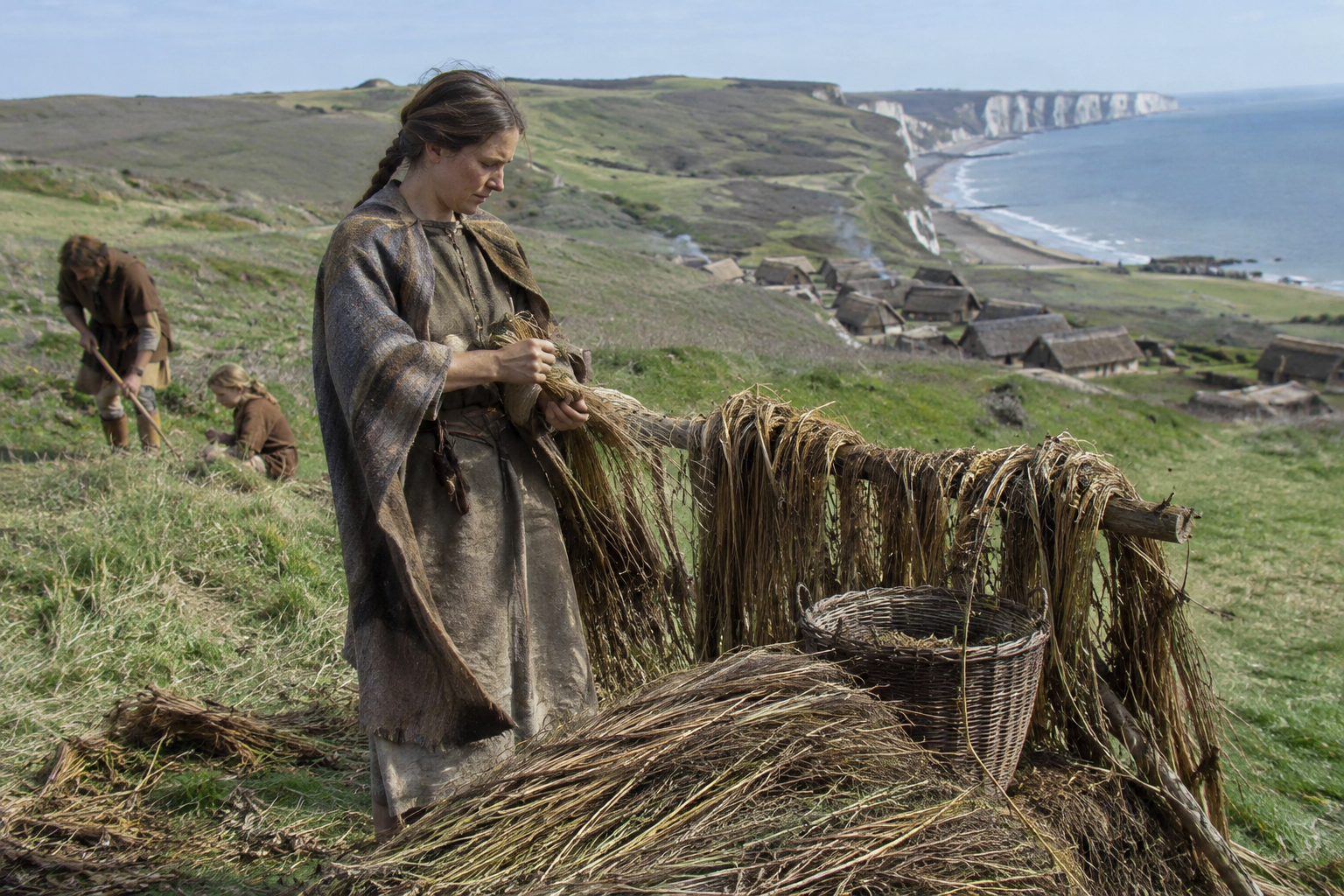
At Buckland near Dover, one early Anglo-Saxon burial has become especially useful for thinking about the Y-DNA haplogroup I1a2a1a1b. The individual known as BUK052, dated here to around AD 400, is identified as a Jutish or early Anglo-Saxon period male from southeastern England. That matters because Dover was not some remote corner of Britain. It sat at the narrow sea crossing, where movement between the Continent and Kent was practical, frequent, and historically consequential.
The interest of I1a2a1a1b lies in that setting. This is a very specific paternal branch within the wider haplogroup I1, a lineage strongly associated in broad terms with northern Europe, especially Scandinavia and areas touched by later Germanic expansions. But the narrow branch named here should not simply be treated as a shorthand for "all Germanic migrants". What BUK052 gives us is something much more archaeologically satisfying: one direct paternal line turning up in a real early medieval community at the moment when eastern and southern Britain were being reshaped by migration, settlement, and new identities.
Buckland cemetery has become one of the emblematic sites for the study of early Anglo-Saxon Kent. Dover's position is the key to understanding why. If people from the opposite shores of the North Sea and the southern North Sea world were arriving in post-Roman Britain, Kent was one of the likeliest places to see it first and most clearly.
That does not mean every burial in Kent belonged to a recent migrant, nor that every "Jutish" label used in archaeology maps neatly onto a single biological population. But in a site like Buckland, ancient DNA becomes especially valuable because it can be set beside the wider historical problem: how newcomers, locals, and mixed communities formed the populations of early England. In that context, BUK052 is not just a technical haplogroup call. He is evidence that one branch of the northern European Y-chromosome pool was present in the burial communities of early Kent.
A broader ancient DNA study of early medieval England, linked to these burials, explored exactly this question of migration and mixture in the making of the early English gene pool: research on the Anglo-Saxon migration and the formation of the early English gene pool. Without overloading one sample with too much meaning, BUK052 fits the larger picture in which eastern England shows substantial continental North Sea connections after the end of Roman rule.
Because Y-DNA follows one direct paternal line, it is wonderfully precise in one sense and quite limited in another. It can show that a man belonged to a particular male lineage, but it cannot by itself tell us his full ancestry, his language, or how he identified himself. A man with haplogroup I1a2a1a1b in early Kent might have been a first-generation migrant, the son of mixed parents, or part of a community already established across the Channel zone.
Still, the wider structure matters. I1 is one of the best-known northern European paternal haplogroups in both modern and ancient discussions of Scandinavian and Germanic-associated populations. A subclade such as I1a2a1a1b is therefore most usefully read as evidence of one narrow branch within that broader northern world, not as a magic ethnic label. In archaeology, the sensible question is not "Was he really a Jute?" as though DNA could settle a line from Bede, but rather: what does this burial add to the pattern of North Sea-linked male ancestry in early medieval Kent?
Kent is often described in early medieval history through the old tribal names: Jutes, Saxons, Angles. Those labels are real parts of the textual tradition, but ancient DNA has made the picture more interesting and less tidy. Communities in early England were neither biologically uniform nor sealed off. They were made through mobility, marriage, inheritance, and the politics of the post-Roman centuries.
That is precisely why BUK052 is so useful. Dover's cemetery does not sit at the end of a simple migration arrow running from one homeland to one destination. It belongs to a coastal contact zone. Goods, people, styles, and probably stories crossed there repeatedly. When a paternal lineage like I1a2a1a1b appears in this landscape, it helps anchor the historical fact that some of the men buried in early Kent had lineages tied into that wider North Sea world.
Germanic languages and genomics
The description of BUK052 as a Jute from the early Anglo-Saxon period should be handled with care, but not with timidity. "Jutish" has long been used for parts of Kent and the Isle of Wight in early medieval scholarship, drawing on later written sources and on archaeological patterning. Yet archaeology rarely gives us tribes in neat museum cases. It gives us cemeteries, artifacts, settlement zones, and now genomes.
So the important point is not to treat haplogroup I1a2a1a1b as proof of a textbook people called the Jutes marching into Kent in a single wave. The point is that one early burial from Buckland belongs to a paternal branch consistent with the kinds of northern European male ancestry one would expect in that migration-period environment. In other words, the DNA does not replace the historical debate; it sharpens it.
There is a useful wider frame here in MyTrueAncestry's discussion of post-Roman Britain, where the transformation of Roman provinces into early medieval kingdoms can be seen not just in artifacts and chronicles, but in genomes. BUK052 belongs squarely in that turning point.
If you are tracing I1a2a1a1b today, the Buckland evidence points toward a lineage present in the migration-period networks that linked Britain to the continental and Scandinavian-facing shores of the North Sea. That does not establish one exact place of origin for every modern carrier of the branch. It does, however, place the haplogroup in a historically vivid environment: the formation of early English society after Rome, when Kent stood at the front door of exchange with the Continent.
For family historians, that is often the most valuable kind of finding. Not a grandiose claim of descent from a named warrior or royal house, but a firmer footing in a real archaeological landscape. BUK052 shows that this paternal line, or a reported association with this branch, was present among the men buried in one of the most important early Anglo-Saxon cemeteries in England.
North Sea migrations to Britain
The best-supported insight for I1a2a1a1b is not a mythic origin story but a historically grounded one. This branch appears in an early medieval burial at Buckland, Dover, in the very region where continental migration had one of its clearest and earliest impacts on post-Roman Britain. For anyone researching this paternal line, that makes early Kent a meaningful point of reference: a place where archaeology, history, and ancient DNA briefly line up and let us see one small male lineage inside a very large transformation.






Comments