Haplogroup I1a2a1a1a2

– 5 min read


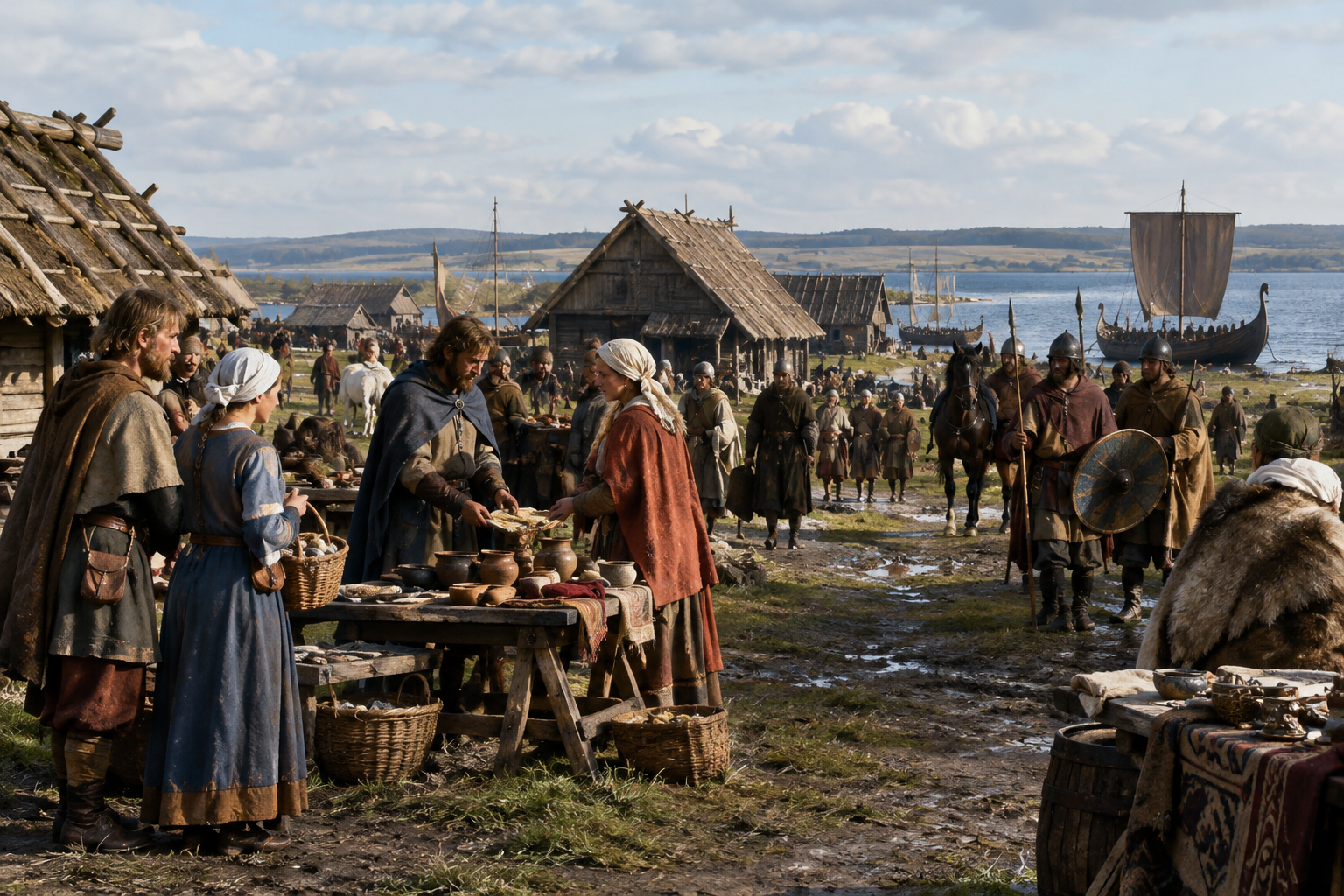
Some Y-DNA haplogroups announce themselves with a bang: royal tombs, famous dynasties, a neat map with arrows. Haplogroup I1a2a1a1a2 is more interesting than that. Its story is built from something messier and, for historians, more revealing: a scatter of men buried across Denmark, Sweden, Germany, the Low Countries, the Balkans, Hungary, England, Belgium, and Finland, over more than two and a half millennia. Put those finds together and you begin to see not a single tribe or nation, but a paternal line moving through the changing worlds of Bronze Age Scandinavia, Iron Age northern Europe, the Migration Period, Viking Age towns, and medieval kingdoms.
As always, a note of method matters. Y-DNA haplogroups trace one very narrow line of ancestry: the direct paternal line, father to son to son. They do not describe a person's whole ancestry, culture, language, or identity. And with a very specific branch like I1a2a1a1a2, we also need to be cautious not to pour the entire history of the broader haplogroup I1 straight into this finer subclade. Still, ancient DNA gives us an unusually good set of clues about where closely related paternal lines appear across time, and in this case those clues point strongly toward a northern European, especially Scandinavian and Germanic, historical setting.
The broader haplogroup I1 is widely associated in ancient DNA research with northern Europe, especially Scandinavia. For a branch as specific as I1a2a1a1a2, the safest approach is not to invent an exact point of origin, but to follow the evidence actually in hand. That evidence begins strikingly early in Denmark. One of the oldest supplied examples is CGG106515, from Nordic Bronze Age Denmark Strandlunden II Gerlev, dated 1265 BC. That matters because it places this paternal line, or one very close to it, in southern Scandinavia deep in later prehistory.
From there, the trail continues through Denmark in the Iron Age: CGG106734 from Germanic Tribe Iron Age Denmark Sjaelland Holbaek Fjord Trundholm Mose, dated 205 BC, and CGG107507 from Danii Tribe Denmark Sjaelland Vester Egesborg Vordingborg, dated 175 AD. Add CGG107416 from Nordic Tribe Denmark Southern Sjaelland Praesto Endegaarde, dated 375 AD, and a pattern begins to emerge: not a one-off burial, but repeated appearances in the Danish islands across centuries.
That is exactly the kind of pattern historians love. It suggests continuity in a region that later became central to the historical world of Danes, seaborne mobility, and the north European networks that reshaped post-Roman Europe.
If the Danish evidence gives us depth, the Migration Period gives us movement. This is where I1a2a1a1a2 becomes particularly vivid. The branch appears among burials tied to Gothic, Longobard, Thuringian, Frankish, Saxon, and other early medieval settings. That does not mean the haplogroup "belongs" to any one of those groups. It means that men carrying this paternal lineage were present inside the mobile and mixed societies of late antiquity and the early Middle Ages.
Consider the Balkan and Carpathian finds. There is I15549 from Gothic Period Serbia Timacum Kuline Ravna Village, dated 395 AD, and I15545 from Gothic Era Serbia Timacum Slog Necropolis, dated 480 AD. Nearby in Hungary appears A181016 from Gothic Kecskemet-Mindszenti Transtisza Hungary, dated 450 AD. Then come the Longobard-period burials in Pannonia: HMU069 from Scarbantia Hegyko Barbaricum Hungary and SZL041 and SZL028 from Savaria Szeleste Barbaricum Hungary, all dated 525 AD.
These are not just labels in a spreadsheet. They belong to a world in which post-Roman frontiers were unstable, armed retinues moved with families, federate groups entered imperial territory, and identities were assembled from politics as much as ancestry. That is why a haplogroup like this turns up in places that look, on the map, far from Denmark. Men move. Households move. Alliances move. Paternal lines move with them.
The same wider pattern appears farther west and north. OBM005 from Thuringii Tribe German Obermoellern, dated 500 AD, Btb71 from Merovingian Period Frankish Buettelborn Germany, dated 585 AD, CGG024694 from Saxon Settler Frisii Netherlands Hogebeintum, dated 413 AD, and SED014 from Anglo-Saxon Sedgeford England Norfolk, dated 600 AD show the same paternal branch appearing across the North Sea world.
By the Viking Age and high Middle Ages, the branch is still very much with us. In Denmark there is CGG105541 from Viking Age Denmark Odense Norrebjerg, dated 1000 AD. In Sweden we find VK337 from Viking Age Oland Sweden, dated 858 AD, VK357 from the same island dated 1053 AD, and gor164 from Viking Age Sweden Stockholm Gorla, dated 1050 AD. Then there is mbs022 from Medieval Sigtuna Sweden, dated 1100 AD, placing the lineage in one of Sweden's key early urban and royal centres.
The branch also appears in medieval continental towns: ST2819 and ST2889 from Medieval Belgium Sint-Truiden Groenmarkt, both dated 1090 AD. This is a useful reminder that paternal lineages do not stop at the point where the saga age ends and charters begin. They pass into the worlds of monasteries, market centres, fortified estates, and hereditary lordship.
Even the later sample PKN013 from Post Medieval Finland Tavastia Paelkaene, dated 1750 AD, is worth noting. It shows this paternal line still present in the north centuries later, part of the long northern European history of settlement, expansion, and regional continuity.
Discover Medieval Sint-Truiden
What, then, do we do with a later Scottish noble association such as Clan Bethune and Balfour House in Fife? The first thing is not to overstate it. A historical association with this haplogroup does not prove that every Bethune or every Balfour carried I1a2a1a1a2, nor does it establish a direct line from any ancient burial to a named medieval family. But it does place the haplogroup in a region whose history was shaped by precisely the kinds of north European connections the ancient DNA already suggests.
Balfour House in Fife is described as a laird's house with roots stretching back at least to the 14th century, when the Balfours were major local landholders. Over time the estate developed into a fortified residence, one that expressed both standing and insecurity in a turbulent Scottish landscape. The surviving structure is largely 17th century in character, with later alterations, and it stands close to the site of an earlier castle or tower associated with the family.
That detail matters because it places us in the real working world of lordship. This was not just a picturesque shell. It was the centre of landholding, kinship, labour, and authority. Like many Scottish residences of its kind, Balfour House preserves a medieval inheritance while showing how noble families adapted old defensive sites into something more domestic without entirely abandoning the grammar of fortification.
For readers interested in paternal ancestry, the attraction is obvious. A lineage seen in Bronze Age Denmark, Migration Period Hungary and Serbia, Anglo-Saxon England, Viking Age Sweden, and medieval Belgium sits comfortably within the wider north European background from which later Scottish paternal lines might also have been drawn. That is context, not proof, but it is historically meaningful context.
The real value of haplogroup I1a2a1a1a2 is that it lets us see continuity without simplicity. This is not the signature of one timeless people marching unchanged across history. Instead, it appears in prehistoric Scandinavia, among Iron Age northern communities, inside the mixed military and migratory worlds of late antiquity, in Viking Age Scandinavia, in medieval trading towns, and in later northern Europe. In other words, it belongs to history as history really was: mobile, entangled, and regional all at once.
Written genealogy can sometimes take us to named lairds, clans, and houses like the Balfours of Fife. Ancient DNA can take us somewhere different: to unnamed men such as CGG106515, I15549, SED014, or mbs022, whose lives were part of the deeper human background from which later families emerged. Shared haplogroups do not prove direct descent between them. But they do show how one paternal line can persist through enormous political and cultural change.
If you would like to place your own paternal ancestry into that larger story, MyTrueAncestry can help you compare your DNA with ancient individuals and historical populations. Those matches may not prove descent from a particular noble family or a single excavated skeleton, but they can offer a remarkable new way to explore where your deep ancestry fits within the archaeological record of Europe.






Comments