Haplogroup I1a2a1a1a1

– 6 min read


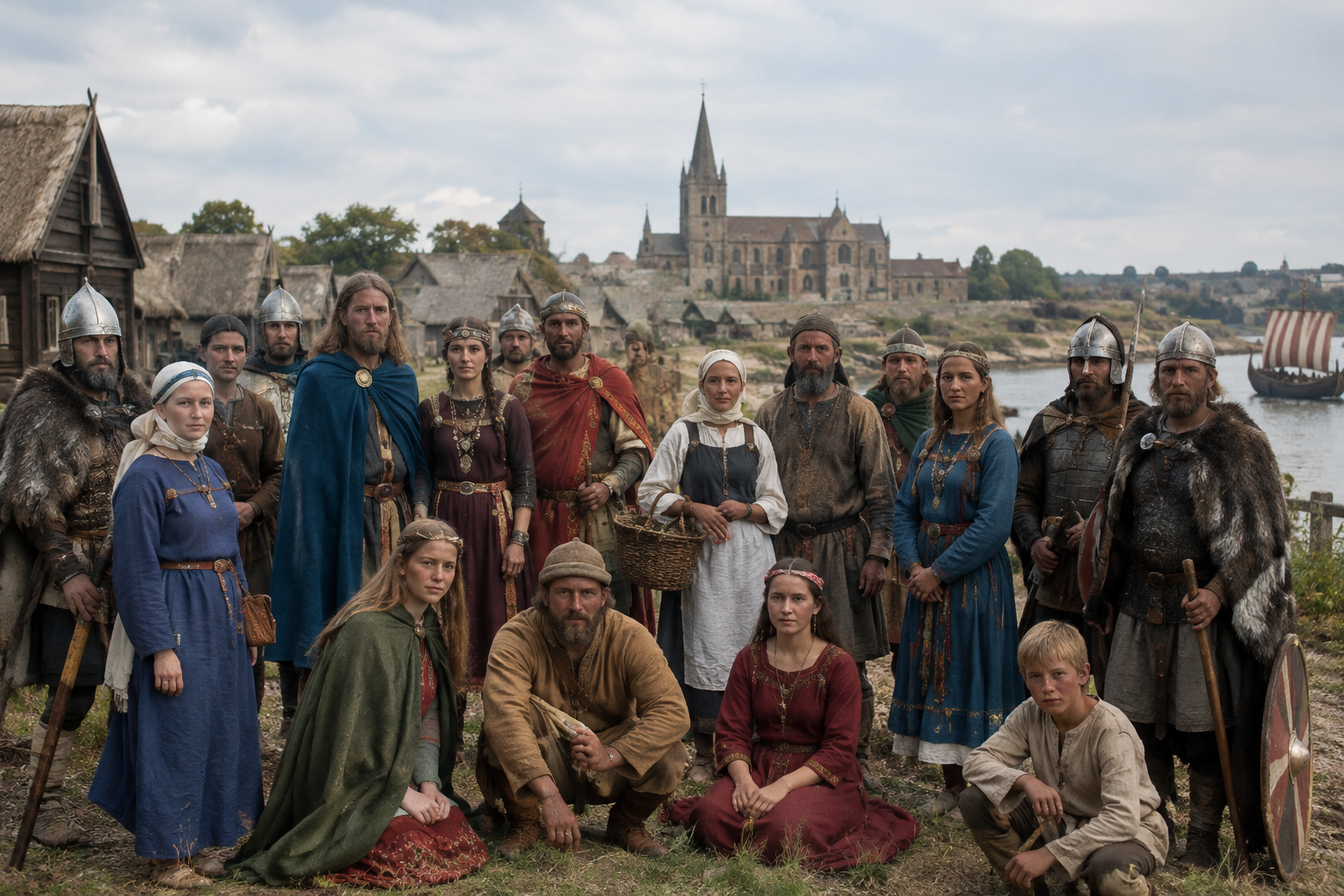
Some Y-chromosome lineages seem to sit quietly in the footnotes of history until ancient DNA drags them onto the main stage. Haplogroup I1a2a1a1a1 is one of those. It belongs to the wider Y-DNA family I1, a paternal lineage long associated in broad terms with northern Europe, especially Scandinavia and nearby regions. But the fascination here lies not in repeating the whole story of I1 as if every branch were identical. It lies in watching one narrower line appear, disappear, and reappear across graves, frontiers, kingdoms, and castles.
As ever with Y-DNA, a health warning is needed. A haplogroup traces only one direct paternal line: father to father to father. It does not describe a person's whole ancestry, culture, language, or identity. Nor does a shared haplogroup prove close kinship between two men separated by centuries. What it does offer is something more precise and, in its way, more tantalising: a thread. In the case of I1a2a1a1a1, the thread runs through Bronze Age and Iron Age northern Europe, through the Migration Period, into Viking and medieval worlds, and later into regions where noble houses such as the House of Schwerin made their mark.
The wider haplogroup I1 is generally understood as an old European paternal lineage with strong historical weight in Scandinavia and the Baltic-facing north. For a subclade as specific as I1a2a1a1a1, caution matters. We should not lazily assign to it every claim ever made about I1 as a whole. Still, the sample pattern supplied here points quite strongly toward a northern European and especially Scandinavian setting for at least part of its story.
That impression begins early. One notable sample is CGG106515, from Nordic Bronze Age Denmark Strandlunden II Gerlev, dated to 1265 BC. Another is CGG106734, from Germanic Tribe Iron Age Denmark Sjaelland Holbaek Fjord Trundholm Mose, dated to 205 BC. Add to these CGG107507 from Danii Tribe Denmark Sjaelland Vester Egesborg Vordingborg at 175 AD and CGG107515 from Danii Tribe Denmark Sjaelland Espe at 218 AD, and a geographical centre of gravity begins to emerge around Denmark and the western Baltic.
That does not prove Denmark as the unique homeland of this exact branch. Ancient population history is rarely so tidy. But it does suggest that men carrying close paternal relatives of this lineage were present in southern Scandinavia over a long span of time, from the Bronze Age into the Roman Iron Age.
Explore Denmark's deep genetic history
If Denmark gives us one anchor, the Migration Period gives us movement. Several of the most revealing samples sit in the uneasy centuries when Roman power faded in the west and new political worlds were being made across central and eastern Europe.
Consider I15549 from Gothic Period Serbia Timacum Kuline Ravna Village, dated to 395 AD, and I15545 from Gothic Era Serbia Timacum Slog Necropolis, dated to 480 AD. Whatever precise identity these men would have claimed for themselves, their archaeological context places this paternal line in a region shaped by Gothic-era mobility in the Balkans. This is exactly the sort of evidence that reminds us that paternal lineages travel with people, but not always with neat ethnic labels attached.
The same applies to A181015 and A181016 from Gothic Kecskemet-Mindszenti Transtisza Hungary, both dated to 450 AD, and to HMU069, SZL041, and SZL028 from Longobard Period Pannonia in Hungary, all dated to 525 AD. These finds place the lineage, or very close paternal kin to it, in the Carpathian Basin during a period of intense movement and regrouping. Men with northern-linked paternal lines appear in zones associated with Goths, Longobards, and other post-Roman populations.
Then there is OBM005 from the Thuringii Tribe German Obermoellern, dated to 500 AD. This is particularly interesting because it plants the lineage in central Germany, a region that later mattered greatly in the political rearrangements of the early medieval north. Again, no direct line to any later dynasty is proven. But the geography matters. A Y-line seen in Denmark, then in Migration Period Germany and the middle Danube, fits a broader historical landscape of Germanic-speaking mobility and settlement.
Read about Goths as a multi-ethnic community
By the Viking Age and the high medieval centuries, the line is still visible around the Baltic and North Sea world. VK337 from Viking Age Oland Sweden dated to 858 AD, VK357 from the same island dated to 1053 AD, gor164 from Viking Age Sweden Stockholm Gorla dated to 1050 AD, and CGG106777 from Viking Age Denmark Bogovej dated to 975 AD all strengthen the Scandinavian picture.
So does mbs022 from Medieval Sigtuna Sweden, dated to 1100 AD. Sigtuna was not some obscure farmstead; it was one of early medieval Sweden's important towns, a place of kingship, trade, and Christianity. A paternal line found there had entered a world of coinage, churches, markets, and royal politics.
The branch was not confined to Scandinavia. SED014 from Anglo-Saxon Sedgeford England Norfolk, dated to 600 AD, shows how a related paternal line also appears in early medieval England. That is no surprise in a broad historical sense: the North Sea linked southern Scandinavia, northern Germany, and eastern England for centuries. But here the genetics give us a man in the ground, not merely a story in Bede.
Further south, TAQ009 from Medieval Tarquinia Lazio Italy, dated to 960 AD, hints at another truth often forgotten in simplistic maps of haplogroups: medieval Europe was mobile. Soldiers, traders, settlers, and churchmen crossed long distances. A northern-associated paternal lineage in Italy is not some contradiction. It is medieval Europe behaving exactly as medieval Europe often did.
Discover Viking Age ancient DNA
That brings us to the later historical landscape of the House of Schwerin. Here one must be careful. The presence of this noble house in the supplied material does not prove that every Schwerin male belonged to haplogroup I1a2a1a1a1, nor that ancient individuals from Denmark or Pannonia were their direct ancestors. What it does provide is a wonderfully apt regional and historical context.
Schwerin Castle, standing on an island in Lake Schwerin, has a history older than the romantic palace visitors know today. The site reaches back to an early Slavic fort from around the first millennium before German rulers seized it in the 12th century and turned it into a seat of ducal power in Mecklenburg. That alone makes it a fitting monument for a haplogroup story shaped by population movement, frontier politics, and changing rulership.
The castle that now dominates the lake was mostly created between 1845 and 1857 in a grand historicist style inspired by the French Renaissance. Yet beneath that 19th-century confidence lies a much older tale: Slavic stronghold, German conquest, dynastic residence, modern state building. It later served state functions after monarchy ended, and today houses the state parliament of Mecklenburg-Western Pomerania.
In other words, Schwerin Castle is not genetic evidence. It is something just as useful for historical imagination: a reminder that regions do not stand still. The same northeastern German zone that later nurtured ducal houses had earlier been a meeting ground of Slavic and German powers, and before that part of the broader Baltic world in which lineages related to I1a2a1a1a1 were already visible.
Explore the Noble House of Schwerin
So what can we responsibly say about I1a2a1a1a1? Not that it belongs to one people forever. Not that it proves noble status. And certainly not that a modern tester with this haplogroup descends directly from a Viking in Oland, a Goth in Serbia, or a duke in Schwerin.
But we can say that this paternal branch sits convincingly inside a northern European story with deep Scandinavian connections and later appearances across the Migration Period and medieval world. From CGG106515 in Bronze Age Denmark to CGG107507 and CGG107515 among the Danii, from I15549 and I15545 in Gothic-era Serbia to HMU069, SZL041, and SZL028 in Longobard-period Pannonia, and onward to mbs022, gor164, VK337, and VK357 in medieval and Viking Age Scandinavia, the record shows both continuity and mobility.
That is the particular magic of ancient DNA. Written sources tend to preserve kings, bishops, and quarrelsome nobles. Genetics sometimes preserves the quieter continuity of male lines crossing centuries under many different banners. The result is not a fairy tale of perfect descent, but a more interesting history: messy, mobile, and real.
For readers interested in how such evidence illuminates northern and central Europe more broadly, MyTrueAncestry's coverage of Ancient DNA and Genetic Diversity in Post-Roman Central Europe offers a useful next step.
If your own Y-DNA belongs to a branch like I1a2a1a1a1, MyTrueAncestry can help place that paternal line beside real archaeological individuals and historical populations. These matches do not automatically prove direct descent or noble ancestry, but they can offer a striking new way to think about where one small part of your family story may once have stood.






Comments