Haplogroup I1a2a1a1a

– 6 min read


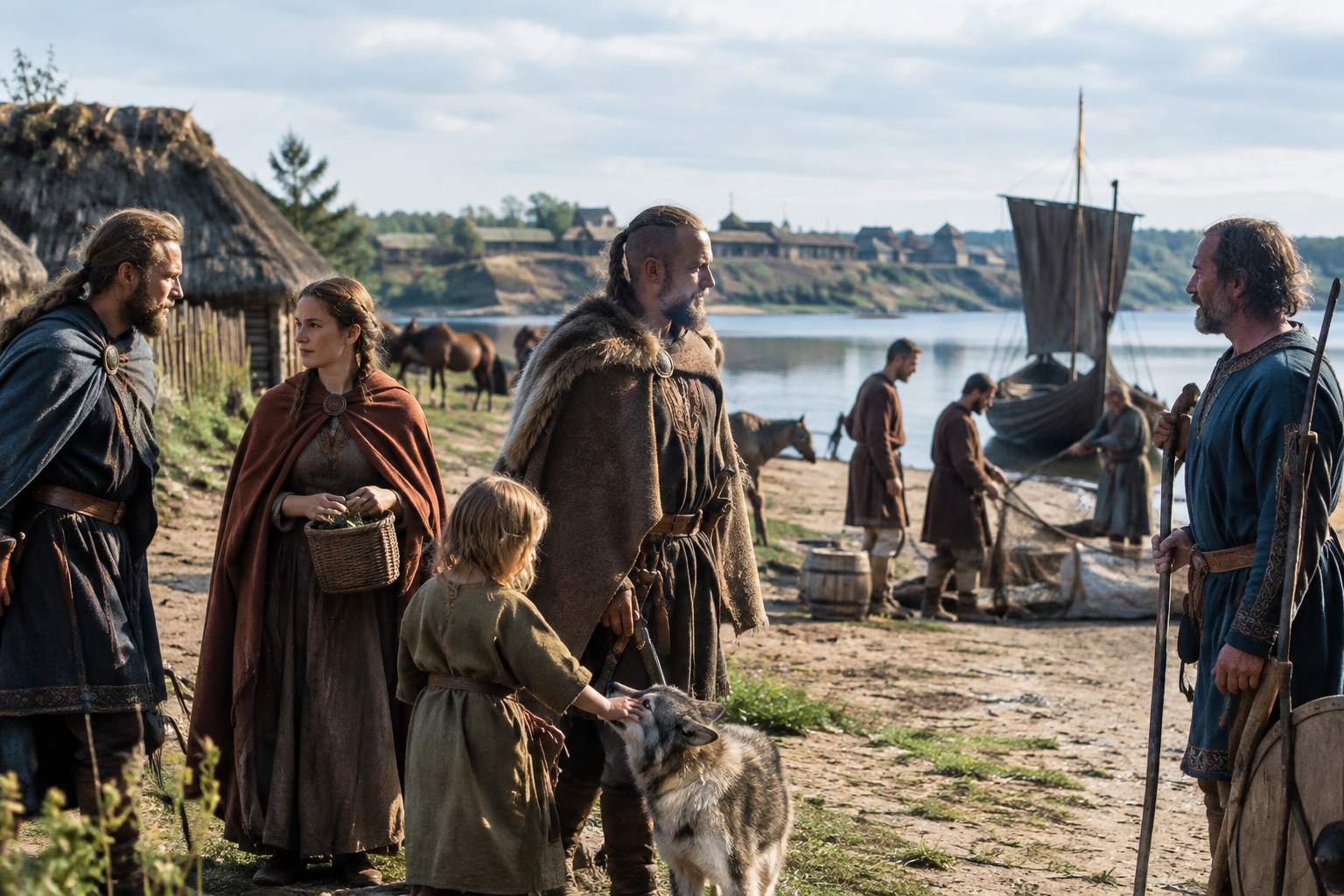
Some Y-chromosome lineages announce themselves with kings, dynasties, or famous graves. Haplogroup I1a2a1a1a is more interesting for a different reason. It appears not as a single theatrical episode, but as a long northern and central European story that can be glimpsed in burials from Bronze Age Denmark, Iron Age Zealand, Gothic and Longobard-era communities in the Carpathian Basin, Anglo-Saxon England, Viking Age Scandinavia, and medieval towns from Sigtuna to Sint-Truiden.
That is exactly what makes it valuable to historians. Y-DNA haplogroups trace one direct paternal line only: father to father to father across time. They do not describe a person's whole ancestry, language, culture, or identity. But when the same paternal branch appears again and again in ancient graves across wide stretches of Europe, it helps us reconstruct patterns of movement, settlement, and continuity that written sources alone could never fully capture.
I1a2a1a1a belongs within the broader haplogroup I1, a Y-chromosome lineage long associated in general terms with northern Europe, especially Scandinavia. For a specific downstream branch such as I1a2a1a1a, caution matters. We should not simply pour the entire history of all I1 lineages into this narrower subclade as if they were identical. Still, the ancient evidence supplied here strongly suggests that this branch, or closely related paternal lines, had an important presence in the Scandinavian world and in the Germanic-speaking networks that spread south and west during later prehistory and the first millennium AD.
The most striking pattern is geographical. Early appearances cluster around Denmark and southern Scandinavia, then later samples turn up in places touched by Migration Period mobility: Serbia, Hungary, Croatia, Germany, the Netherlands, England, Belgium, Italy, and Sweden. That does not prove one simple march of one people from one homeland. History is never so tidy. But it does fit a broader picture in which northern European paternal lineages were carried through many different communities, alliances, and migrations over centuries.
One of the earliest anchors in this dataset is CGG106515, from Nordic Bronze Age Denmark Strandlunden II Gerlev, dated to 1265 BC. That is important not because it lets us claim that the exact later branch was already fully formed in its medieval shape, but because it places this paternal tradition in southern Scandinavia deep in later prehistory. By the Bronze Age, Denmark was not some distant margin. It was a connected world of seaways, metal exchange, warrior display, and elite networks.
We then see a run of later Danish samples that make the Scandinavian association much harder to dismiss as coincidence. There is CGG106734 from Germanic Tribe Iron Age Denmark Sjaelland Holbaek Fjord Trundholm Mose at 205 BC, and then three early historic Zealand individuals linked to the Danii: CGG106721 from Kalundborg Simonsborg at 175 AD, CGG107507 from Vester Egesborg Vordingborg at 175 AD, and CGG107515 from Espe at 218 AD. Add CGG107416 from Southern Sjaelland Praesto Endegaarde at 375 AD, and a picture emerges of paternal continuity in the Danish islands across many centuries.
That continuity matters because it offers a plausible background for later expansions into the North Sea and continental worlds. It is not proof that every later carrier came directly from Zealand, but it gives the lineage a solid Scandinavian stage on which the later historical drama can unfold.
By late antiquity, the same paternal thread appears in regions shaped by the great rearrangements of the Roman frontier and the post-Roman world. In the Balkans and the Carpathian Basin we find I15549 from Gothic Period Serbia Timacum Kuline Ravna Village dated 395 AD, and I15545 from Gothic Era Serbia Timacum Slog Necropolis dated 480 AD. These samples are valuable because they place the lineage among communities operating in the Gothic horizon south of the Danube.
From Hungary come A181015 and A181016 from Gothic Kecskemet-Mindszenti Transtisza at 450 AD, as well as later Migration Period individuals RKF280 and RKO002 from Rakoczifalva at 650 AD. Between them sit Longobard-era burials: HMU069 from Scarbantia Hegyko Barbaricum Hungary at 525 AD, and SZL041 and SZL028 from Savaria Szeleste Barbaricum Hungary, also at 525 AD.
This is not one ethnicity in genetic uniform. Rather, it shows how a paternal lineage could travel through the mixed, mobile, and often militarized societies of the 4th to 7th centuries. Men bearing related Y-lines might be buried in communities labeled Gothic or Longobard by archaeologists, but those labels describe historical and material contexts, not pure biological tribes.
The westward spread is equally telling. CGG024694, a Saxon Settler Frisii Netherlands Hogebeintum sample dated 413 AD, places the lineage in the North Sea coastal zone. SED014, from Anglo-Saxon Sedgeford England Norfolk at 600 AD, shows it in early medieval England. OBM005, a Thuringii Tribe German Obermoellern sample dated 500 AD, and Btb71, a Merovingian Period Frankish Buettelborn Germany burial at 585 AD, demonstrate that this paternal branch was at home in the continental Germanic world as well.
Even R3660 from Migration Period Scitarjevo Croatia at 500 AD and TAQ009 from Medieval Tarquinia Lazio Italy at 960 AD hint at how far such lineages could travel once the Roman world and its successor kingdoms became deeply entangled.
If the Migration Period samples show movement, the later Scandinavian burials show durability. Viking and medieval individuals carrying this lineage appear in both Denmark and Sweden: CGG106777 from Viking Age Denmark Bogovej at 975 AD, CGG105541 from Viking Age Denmark Odense Norrebjerg at 1000 AD, VK337 from Viking Age Oland Sweden at 858 AD, VK357 from Viking Age Oland Sweden at 1053 AD, and gor164 from Viking Age Sweden Stockholm Gorla at 1050 AD. Then there is mbs022 from Medieval Sigtuna Sweden at 1100 AD.
These finds matter because they place the haplogroup not merely in migration stories but in settled Christianizing and urbanizing medieval Scandinavia. The lineage is not only on the move; it is also staying put, reproducing, and becoming part of ordinary regional continuity.
That same continuity reaches into medieval towns beyond Scandinavia. ST2819 from Medieval Belgium Sint-Truiden Groenmarkt at 1090 AD and CGG100679 from Medieval Denmark Tjrby Randers Municipality at 1325 AD show that by the High Middle Ages this paternal line had become woven into established urban and rural societies across northern Europe.
Discover Medieval Sint-Truiden DNA
How does all this connect to a Scottish clan such as Clan Falconer? Carefully. A historical association between a haplogroup and a clan is not proof that every Falconer male carried I1a2a1a1a, nor does it establish a documented line back to any ancient grave listed above. What it does provide is context.
The long record for this haplogroup across Scandinavia, the North Sea world, and Germanic-settled regions makes it historically plausible in the broader ancestry of populations that later fed into medieval and early modern Scotland. Scotland, after all, was never genetically sealed. It sat in a lively zone of contact with the North Sea, with Scandinavian influence particularly strong along coasts and islands, and with centuries of movement linking Britain to northern Europe.
For Clan Falconer, the great symbolic landscape is Dunnottar Castle, perched on its rocky headland near Stonehaven in northeast Scotland. It is one of those places where the physical setting does half the historical work before a document is even opened. A chapel may have stood there as early as the 7th century, and by the 13th century the site had become an important stronghold of the earls Marischal. Dunnottar saw sieges, raids, and royal visits, and in the 17th century entered Scottish legend when a small garrison concealed the Honours of Scotland from Cromwell's army, preserving the Scottish crown jewels. Later damage after Jacobite support left the cliff-top ruin that survives today.
A castle like Dunnottar does not prove a Y-line. But it does preserve the memory of the sort of regional world in which paternal lineages, family identities, and political loyalties accumulated over many generations. Genetics can show that a lineage had deep roots in the wider northern European world; castles and clan history show where later families turned those roots into local power, memory, and story.
The best way to understand I1a2a1a1a is not as a badge of a single people, but as a durable paternal branch that appears repeatedly in northern Europe and then in the connected worlds created by late prehistoric exchange, Migration Period upheaval, Viking expansion, and medieval settlement. Its ancient samples stretch from CGG106515 in Bronze Age Denmark to medieval burials in Scandinavia and western Europe. That is a substantial historical footprint.
But Y-DNA is only one line among countless ancestors. Sharing a haplogroup with an ancient individual does not mean he was your direct ancestor, and sharing a broad lineage with a noble family does not make anyone a proven descendant of that house. What ancient DNA does offer is something subtler and, in many ways, more exciting: a way to place your paternal line within real human landscapes populated by warriors, settlers, townsmen, migrants, and medieval families whose worlds can still be traced in graves, ruins, and chronicles.
If your own Y-DNA points toward a lineage like I1a2a1a1a, MyTrueAncestry can help you explore how that paternal branch fits into the deeper archaeological record. You may discover genetic similarities to ancient Scandinavians, Migration Period communities, or medieval populations discussed here. Those matches do not automatically prove direct descent or noble status, but they can open a remarkable window onto the worlds your distant paternal ancestors may once have inhabited.






Comments