Haplogroup I1a1b1g3b2

– 6 min read


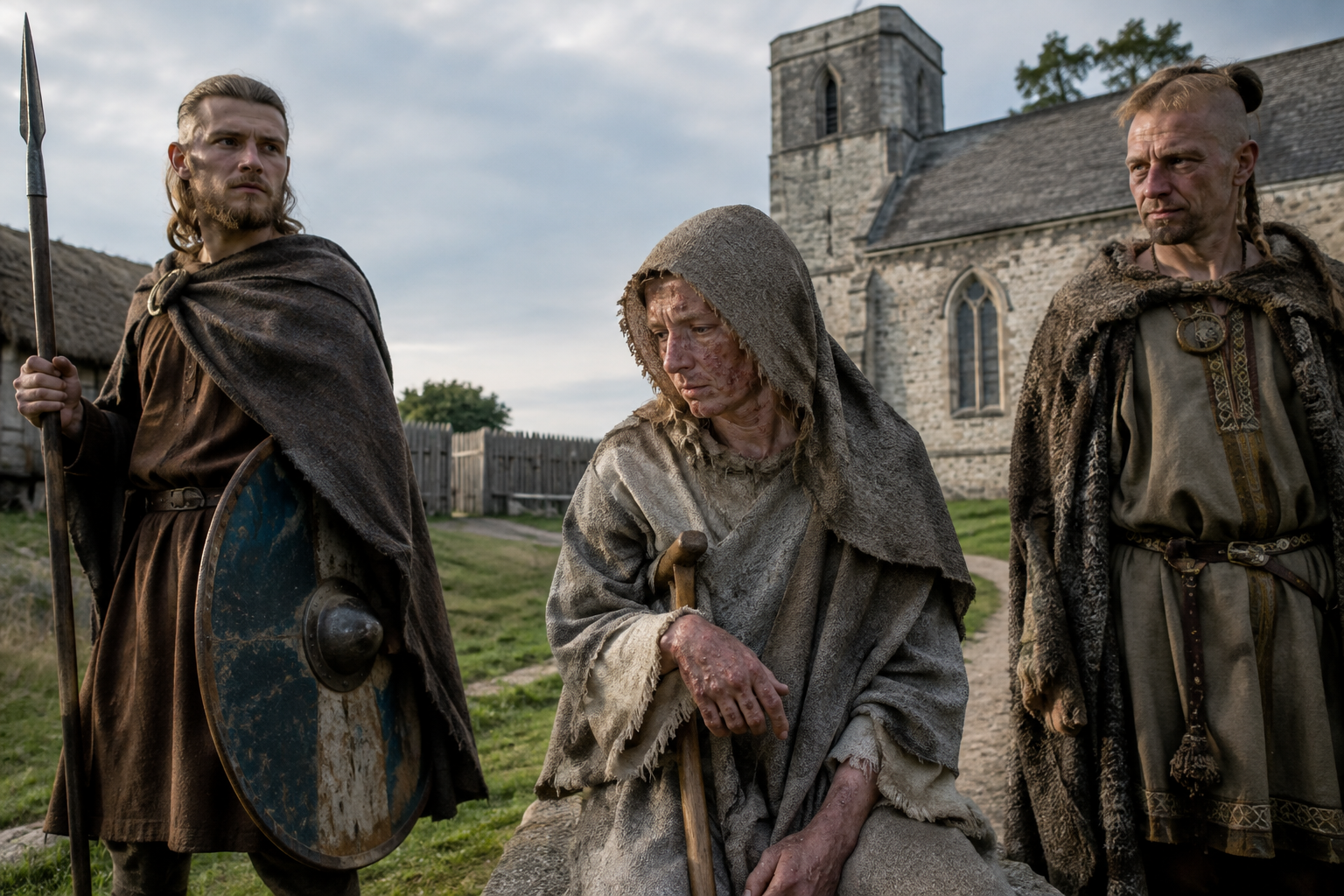
Some Y-chromosome lineages announce themselves with imperial fanfare. Others emerge more quietly, in scattered graves, hospital cemeteries, island burials, and family seats far removed from the men who first carried them. Haplogroup I1a1b1g3b2 belongs to that second category. It is a very specific paternal branch, and like many narrow subclades, its story is not written as a single grand migration but pieced together from broader northern European patterns, later historical movements, and the occasional ancient individual who lets us glimpse where that paternal line, or closely related branches, once appeared.
That is worth lingering over, because Y-DNA can be both wonderfully revealing and badly misunderstood. A Y haplogroup traces one direct paternal line only: father to father to father, back through time. It does not describe a person's whole ancestry, culture, language, or identity. Still, when a branch sits within the wider world of haplogroup I1, it immediately places us in a part of European history strongly associated with northern Europe, especially Scandinavia and the regions tied to later Germanic and Viking-age mobility. The trick is to keep one foot in genetics and the other in history, without pretending the two are the same thing.
Haplogroup I1a1b1g3b2 is a downstream branch within the wider I1 family of Y-DNA. Broadly speaking, I1 is best known from northern Europe and is especially associated in ancient and modern population studies with Scandinavia and the wider North Sea-Baltic world. That does not mean every I1 branch has the same history, nor that every appearance of I1 marks a "Viking" or a "Germanic" identity. But it does mean this haplogroup belongs in a paternal landscape that became historically important in Sweden, Denmark, Norway, and in populations shaped by movement across the Baltic and North Sea.
For a highly specific branch like I1a1b1g3b2, we must be cautious. The broad I1 story cannot simply be pasted onto this narrower subclade as if nothing changed along the way. Instead, what we can say responsibly is that this branch sits within a lineage family whose deeper history is tied to northern Europe, and whose later historical visibility often increases in the Iron Age and medieval periods when ancient DNA begins to catch more named societies in motion.
That is one of the great lessons of archaeogenetics: paternal lines often become historically visible not at their beginning, but at the moment people start burying their dead in ways that survive, or at the moment we have enough DNA to read them.
Explore How Ancient DNA Rewrote History
The supplied ancient samples sketch a striking map. One appears in Poland in a Gothic-associated setting, another in Viking Age Sweden, and another in medieval England. That spread does not prove a single continuous family tree, but it does place this paternal world squarely in the zones where northern and eastern European mobility mattered enormously.
Take PL076, listed as Gothic Tribe Poland Maslomecz Wielbark Year:250 AD ID:PL076. Maslomecz and the Wielbark cultural horizon have become central to discussions of late Iron Age and migration-period populations in what used to be called Barbaricum beyond the Roman frontier. The important point is not that a Y-line "proves" a Goth. It does not. But a sample like PL076 helps show the sort of mixed and mobile population landscape in which northern-linked paternal lineages could appear in eastern-central Europe during the Roman era. The old idea of neatly bounded tribes looks rather shaky once graves begin to speak genetically.
Then there is VK352, from Viking Age Oland Sweden Year:950 AD ID:VK352. Oland, lying off Sweden's southeast coast, was no remote backwater in the Viking Age. It sat in a maritime world of trade, raiding, diplomacy, and settlement stretching from the Baltic to the British Isles and beyond. A paternal lineage found there belongs to a world in which men, goods, allegiances, and languages moved with remarkable speed. If PL076 gives us a view into late antique mobility, VK352 gives us the North at one of its most outward-looking moments.
These two samples together do not prove that I1a1b1g3b2 itself moved in exactly the same way. But they do provide context for how related paternal branches could have circulated from the Baltic sphere into wider European history: through migration-period contacts, maritime exchange, warfare, settlement, and the ordinary business of men starting families far from their grandfathers' homes.
Read About the Maslomecz Goths
The most arresting sample of all may be MMW_H64: Medieval England Leprosy Victim Winchester St Mary Magdalen Year:1176 AD ID:MMW_H64. There is something salutary about this. When people imagine ancestry, they tend to picture warriors, kings, founders, and men in helmets on windy headlands. But ancient DNA is just as likely to recover the forgotten sick as the celebrated dead.
Winchester in the 12th century was an important English city with deep royal, ecclesiastical, and commercial connections. St Mary Magdalen was associated with care for people suffering from leprosy. So here, instead of a saga hero, we meet a medieval patient. Yet his Y-chromosome matters just as much historically. It reminds us that paternal lineages do not survive because history books thought them glamorous. They survive because real men lived, married, moved, suffered, and were buried.
The appearance of a related paternal branch in medieval England also fits a broader and well-established historical picture: the British Isles were shaped repeatedly by contacts across the North Sea, including Anglo-Saxon migration, Scandinavian settlement, and later medieval mingling. One grave cannot choose between those processes. But it does belong to the same historical geography.
Explore Early Medieval English DNA
What, then, do we do when a lineage like this brushes against later noble history? Carefully, is the answer.
The supplied family connection is Clan Hope, whose later seat at Hopetoun House near South Queensferry in West Lothian stands as one of Scotland's grandest aristocratic houses. Built from 1699 for the Hope family on lands they had held since the seventeenth century, and enlarged in the eighteenth century by architects including William Bruce and William Adam, it became a statement of status, wealth, and cultivated taste. Its fine interiors, designed landscapes, and commanding view over the Firth of Forth are all part of that message.
But the house also tells a subtler story. Hopetoun is not a medieval fortress clinging to a contested border. It is an early modern aristocratic residence, shaped by the union era, landed income, and the political rise of the Hope family, who became Earls and later Marquesses of Linlithgow. In other words, by the time we meet the Hopes securely in this setting, we are looking at the long afterlife of Scottish noble identity in a Britain already transformed by state formation, empire, and changing estate life.
That makes Hopetoun House an intriguing companion to a Y-haplogroup discussion. Not because the building proves anything genetic - it does not - but because it anchors the later historical geography of paternal inheritance. Surnames, estates, titles, and Y-chromosome lineages all move down male lines in different ways, and with many interruptions. Adoption, illegitimacy, surname changes, and branch extinction complicate every neat diagram. So any association between a noble family and a haplogroup should be treated as contextual unless documented by specific testing.
Still, there is a pleasing historical symmetry here. A paternal lineage nested in the wider northern European I1 world appears in ancient samples from Poland, Sweden, and England; later, we meet a Scottish noble house overlooking the Forth, that great watery corridor connecting Scotland to the North Sea. Geography, if not genealogy, keeps nudging us in the same direction.
Discover the History of Clan Hope
Haplogroup I1a1b1g3b2 is best understood as a narrow paternal twig on a much larger northern European tree. Its significance lies not in offering a fairy-tale pedigree, but in showing how one direct male line can be placed in relation to wider historical processes: Baltic mobility, migration-age population mixtures, Viking Age seafaring, and medieval North Sea worlds.
The samples PL076, VK352, and MMW_H64 are especially valuable because they humanize that picture. One comes from a Gothic-associated community in Poland around 250 AD. One comes from Viking Age Oland around 950 AD. One comes from a leprosy burial context in Winchester in 1176 AD. They are not stepping stones in a proven family pedigree. They are evidence that related paternal worlds existed across centuries in places tied together by migration, exchange, and settlement.
That, in the end, is why Y-DNA remains so historically compelling. Written genealogy usually begins late and privileges the successful. Ancient DNA reaches further back and often finds the obscure. When the two are set beside each other - graves in Poland, Sweden, and England on the one hand, and a great Scottish house above the Forth on the other - the past becomes larger, stranger, and more interesting.
If this haplogroup appears in your own results, MyTrueAncestry can help you explore those deeper connections to ancient individuals and historical populations. Not as proof that you descend from a particular Gothic warrior, Viking mariner, or noble Scottish line, but as a way of placing one paternal thread of your ancestry into the much bigger story of Europe's past.






Comments