Haplogroup I1a1b1g3

– 6 min read


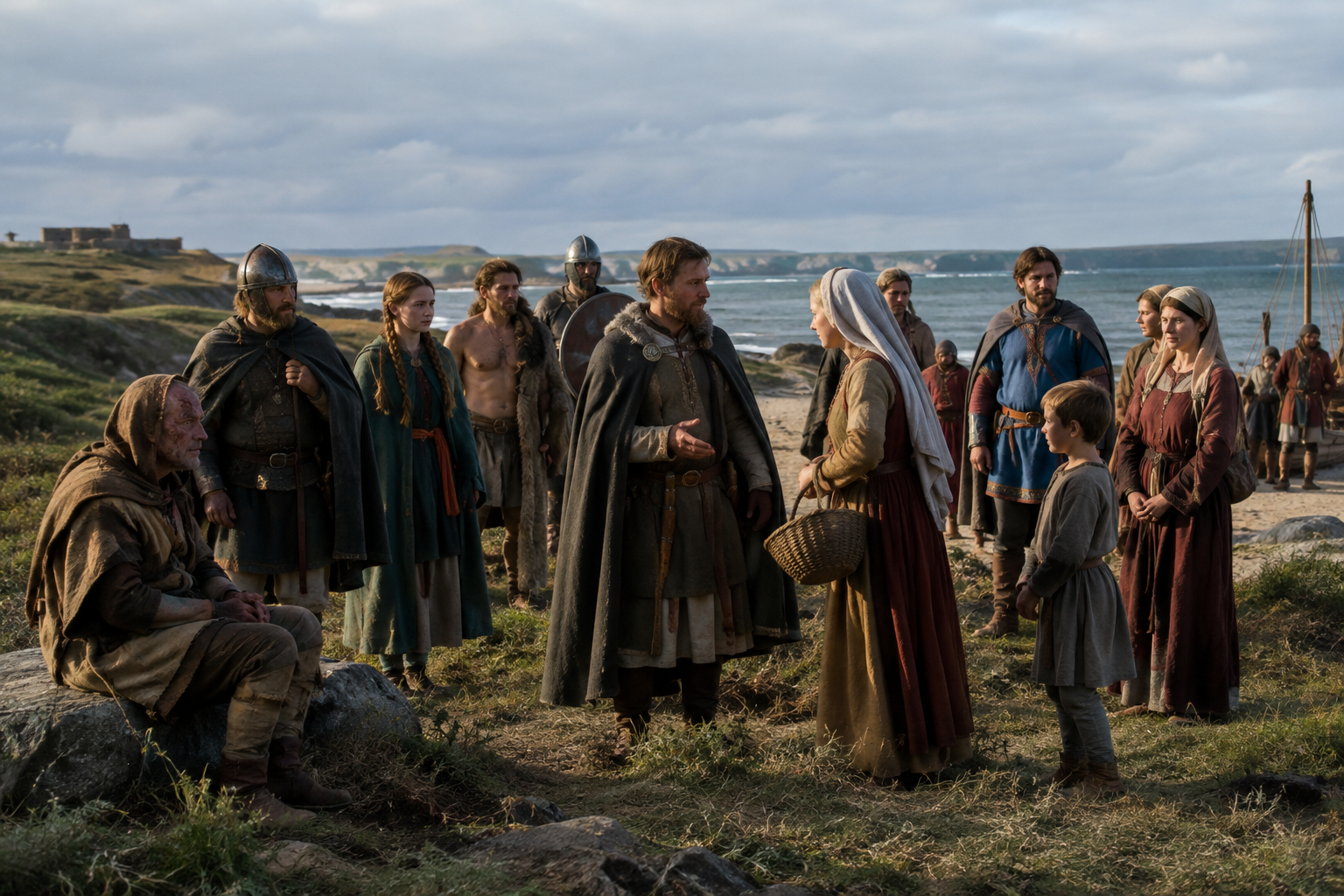
Some Y-chromosome lineages announce themselves in kings' tombs or famous battles. Others appear in a more interesting way: scattered across graves, ports, monasteries, migration-period cemeteries, and even among the dead of a hospital for leprosy. Haplogroup I1a1b1g3 belongs to that second kind of story. It sits within the wider I1 branch of Y-DNA, a paternal lineage long associated in broad terms with northern Europe, especially Scandinavia and regions shaped by North Sea and Baltic movement. But the narrower subclade itself has to be handled more carefully. A specific branch like I1a1b1g3 is not the same thing as the whole of I1, and its history has to be reconstructed from where it actually turns up.
That is where ancient DNA becomes so useful. Y-DNA traces one direct paternal line only - father to father to father - and so it never describes a person's full ancestry. Even so, it can illuminate patterns that written records cannot: the movement of men across frontiers, the persistence of lineages in certain regions, and the way one paternal branch can show up in remarkably different settings over many centuries. For I1a1b1g3, the picture suggested by the supplied samples is one of northern and north-central European connections, with a story that reaches from Neolithic Sweden to Viking Age Scandinavia, Migration Period central Europe, Anglo-Saxon and post-Roman Britain, and later historical Scotland.
The broad parent haplogroup I1 is generally linked with northern Europe, and that larger background matters here, though with an important warning: we should not simply pour the whole history of I1 into one downstream twig and pretend they are identical. What we can say, from the evidence provided, is that I1a1b1g3 appears in a strikingly northern arc. There is an early data point in Neolithic Sweden Albacksbacken Maglarp Year:1800 BC ID:CGG105926, and later appearances in Denmark, Sweden, Saaremaa, Germany, Britain, Hungary, Italy, and the Low Countries. That does not prove a single neat migration route. It does suggest that this paternal branch, or close related branches, moved in the same broad worlds later tied together by Baltic and North Sea networks.
One of the most suggestive early finds is CGG107443, from the Danii Tribe Denmark Northwest Sjaelland Asnaes Year:175 AD. Even that label needs care - archaeological tags and genetic lineages are not interchangeable - but the combination of Denmark, an early date, and a Scandinavian-associated paternal branch fits neatly into the larger pattern. By the Roman Iron Age, lineages of this kind were already present in regions that would later feed into the great movements of the Migration Period and Viking Age.
Explore Denmark's Deep Genetic Past
If you want to see how a Y-lineage travels through history, it helps to stop imagining arrows on maps and start with the dead themselves. Here the record is unusually vivid. In Poland, PL076 comes from Gothic Tribe Poland Maslomecz Wielbark Year:250 AD. Maslomecz has become well known precisely because it shows that so-called Gothic communities were not biologically uniform blocks. A lineage like this in that setting does not "prove" Gothic ethnicity. What it does show is that men carrying this paternal branch were present in the cultural world of late Iron Age Barbaricum.
Then the story shifts south and west into the unstable centuries after Rome. In the Carpathian Basin and neighbouring regions we find Bal_111, Bal_111m, and Bal_111x from Post Roman Empire Pannonia Hungary Balatonszemes Year:475 AD, followed by SZL026 from Longobard Period Pannonia Savaria Szeleste Barbaricum Hungary Year:525 AD and RKF183 from Migration Period Hungary Rakoczifalva Year:650 AD. Add Alh_141 from Merovingian Period Bavaria Altheim Germany Year:600 AD and To_Lav_T2US16 from Dark Ages Italy Torino Lavazza Year:550 AD, and you begin to see the line threading through precisely the zones where post-Roman armies, retinues, settlers, and local populations met each other.
This is not evidence for one tribe marching intact from Scandinavia to Italy. It is something better, and more realistic: evidence that a paternal lineage found in northern Europe also appears in the mixed and mobile societies of the Migration Period. In that respect, I1a1b1g3 belongs to the great historical muddle that made medieval Europe.
Read About the Maslomecz Goths
The British evidence is especially interesting because it places this haplogroup in several quite different early medieval settings. I16509 comes from the Kingdom of Mercia England Wolverton Buckinghamshire Year:635 AD. I16383 belongs to the Kingdom of Dumnonia Britain Cornwall Widemouth Bay Year:700 AD. And later there is MMW_H64, a Medieval England Leprosy Victim Winchester St Mary Magdalen Year:1176 AD.
That is a remarkable trio. Mercia suggests the Anglo-Saxon political world of early medieval England. Dumnonia points to the far southwest, a region with its own post-Roman character. Winchester's St Mary Magdalen hospital reminds us that haplogroups are not borne only by warriors and nobles but by ordinary, and sometimes very unlucky, people. One paternal line can sit beneath the shields of a migration-period retinue, the household of an English kingdom, and the bones of a sick man buried in medieval Hampshire.
The same maritime horizon appears again in later northern samples: VK315 from Viking Age Rantzausminde Grav Funen Denmark Year:875 AD, VK352 from Viking Age Oland Sweden Year:950 AD, als007 from Viking Age Sweden Uppland Alsike Year:975 AD, and VK507 from Vendel Age Saaremaa Salme I Year:725 AD. There is also DUN005 from Saxon Lower Saxony Germany Dunum Year:840 AD, showing that the branch was not confined to Scandinavia proper but belonged to the broader North Sea world.
Explore Anglo-Saxon DNA in England
By the time we reach the historical world of the Scottish aristocracy, genetics and genealogy must be kept in their proper lanes. The supplied association with Clan Primrose does not prove that every Primrose male belonged to I1a1b1g3, nor that an ancient Scandinavian or Anglo-Saxon sample can be marched straight into the Primrose family tree. What it does provide is a richly historical setting in which to think about how old paternal lineages can persist, divide, and reappear in later regional elites.
The family seat, Dalmeny House near Edinburgh, was built between 1814 and 1817 for Archibald Primrose, the 4th Earl of Rosebery. It is described as one of the earliest and grandest examples of the Gothic Revival in Scotland, designed by William Wilkins. As so often with aristocratic houses, the building itself is comparatively late, while the estate stands on land with much deeper roots stretching back into medieval history.
That makes Dalmeny House an apt emblem for a Y-DNA discussion. The visible structure is modern by medieval standards, but what it represents is continuity: possession, memory, lineage, and the careful cultivation of the past. The estate remained the seat of the Earls of Rosebery and became especially associated with Archibald Primrose, the 5th Earl of Rosebery, later Prime Minister in the 1890s. Its art, furniture, and Napoleon relics speak of aristocratic taste; its older territorial roots speak of something more durable - how families anchor themselves in landscapes and then wrap those landscapes in history.
In that sense, the Primrose connection works best not as a claim of proven descent from any one ancient sample, but as a reminder that the lands around the Firth of Forth sit within the same wider northern world that ancient DNA keeps revealing: a world of Scandinavian contacts, British kingdoms, seaborne movement, and long regional continuity.
Discover the History of Clan Primrose
The real value of haplogroup I1a1b1g3 is not that it hands us a fairy-tale pedigree. It does something more useful. It shows a paternal branch appearing in Neolithic Sweden, Roman Iron Age Denmark, Gothic-period Poland, post-Roman Hungary, Merovingian Bavaria, Dark Ages Italy, Anglo-Saxon and post-Roman Britain, Viking Age Scandinavia, and even a seventeenth-century Swedish shipwreck sailor, kro016 from the Stora Kronan Shipwreck Battle of Oland Sweden Year:1676 AD. That is not a single people. It is a long record of movement, survival, and regional entanglement.
So if your own Y-DNA falls within this lineage, the lesson is not that you are "really Gothic" or "really Viking" or secretly descended from the Earls of Rosebery. The lesson is better than that. Your direct paternal line may belong to a branch that travelled through some of the most important connected zones of European history: Scandinavia, the Baltic, the North Sea, early medieval Britain, and the post-Roman frontier worlds of central Europe.
MyTrueAncestry lets you place that one paternal thread beside ancient individuals and archaeological populations, and that is where the excitement lies. Not in false certainty, but in seeing how your DNA may intersect with the real human record of graves, kingdoms, migrations, and ancestral seats like Dalmeny House.






Comments