Haplogroup I1a1b1e

– 6 min read


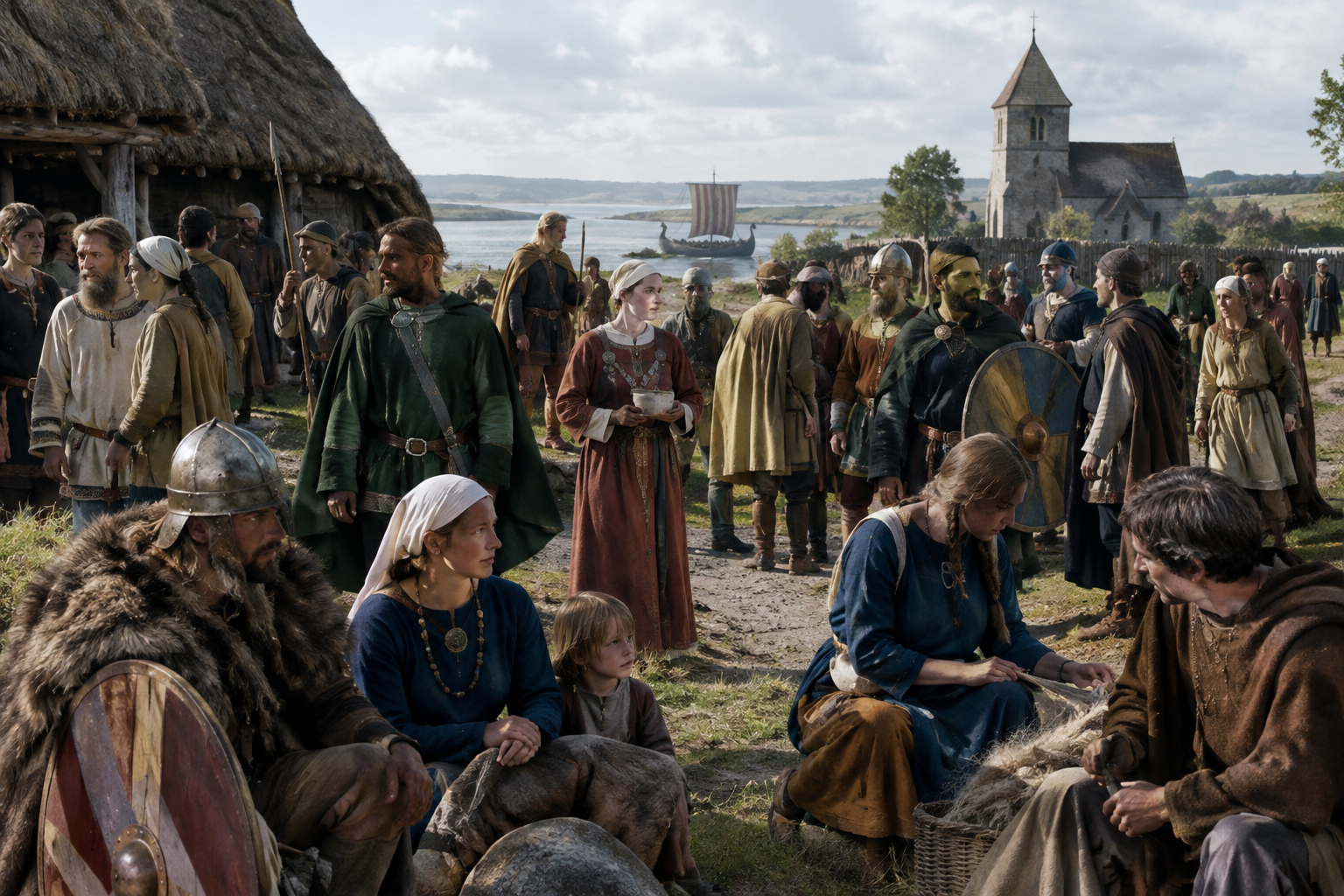
Some Y-chromosome lineages announce themselves with a neat, simple story. Haplogroup I1a1b1e does not. What makes it interesting is precisely that it appears in the sort of places where early medieval Europe was being made and remade: post-Roman Pannonia, Merovingian Bavaria, Viking Age Scandinavia, Anglo-Saxon and post-Roman Britain, and later medieval towns around the North Sea. This is not a haplogroup that belongs to one kingdom, one language, or one grand historical label. It belongs instead to movement, settlement, and continuity across a very wide northern European world.
Like all Y-DNA haplogroups, I1a1b1e traces only one line of ancestry: the direct paternal line, father to son across generations. It does not describe a person's whole ancestry, still less their culture or identity. Even so, paternal lineages can be remarkably useful historical clues. In this case, the ancient DNA record suggests a branch within the wider I1 family that was present in Scandinavia and also travelled widely through the migration and medieval periods. The result is less a family tree than a map of male-line history drawn across ships, graves, kingdoms, and castles.
The wider haplogroup I1 is generally associated with northern Europe, especially Scandinavia, and that broad background matters here. But caution is essential: the narrower branch I1a1b1e should not simply be handed the entire history of I1 as if nothing changed between parent and child clades. What the evidence supports is that this branch sits within a paternal family of lineages that became historically important in the North and then appears, through ancient samples, in several zones connected by migration, warfare, trade, and settlement.
One especially striking early clue is the sample CGG105926 from Neolithic Sweden Albacksbacken Maglarp, dated 1800 BC. A single prehistoric sample does not prove that the later medieval distribution was already fixed, but it does remind us that some paternal lines later visible in historic Scandinavia may have deep roots there. By the Iron Age and Roman-era North Sea world, the picture becomes more recognisably historical: CGG107443 from the Danii Tribe Denmark Northwest Sjaelland Asnaes, dated 175 AD, and CGG107762 from the Iron Age Netherlands Outlier Valkenburg Marktveld, also 175 AD, hint at a paternal presence on both sides of the North Sea sphere.
That matters because this was never a sealed Scandinavian box. Denmark, the southern Scandinavian peninsula, the North Sea coast, and the lower Rhine were tied together long before the Vikings. If you want a broader look at how ancient DNA reshapes such long stories, MyTrueAncestry readers may enjoy this overview of the field.
Then comes the turbulent half-millennium after Rome, and here I1a1b1e becomes especially revealing. In the Carpathian Basin and adjacent regions, the lineage turns up in contexts shaped by the collapse of imperial order and the arrival of new military and political groups. The Balatonszemes samples from Post Roman Empire Pannonia Hungary, dated 475 AD and identified as Bal_111, Bal_111m, and Bal_111x, sit right at that hinge of eras. Nearby and slightly later is SZL026 from Longobard Period Pannonia Savaria Szeleste Barbaricum Hungary, dated 525 AD, followed by RKF183 from Migration Period Hungary Rakoczifalva, dated 650 AD.
These are not just dots on a map. They belong to a zone where Roman provincials, incoming groups, local communities, and mobile war bands all overlapped. A haplogroup appearing here need not mean a single "people" moving intact from one homeland to another. It may instead reflect the way male lines were carried in confederations, retinues, settlements, and mixed communities. That is one of the great lessons of ancient DNA: early medieval identities were often more entangled than older nationalist histories liked to imagine.
The same pattern appears farther west. In Merovingian Period Bavaria Altheim Germany, both Alh_236 and Alh_141 are dated 600 AD. In Dark Ages Italy Torino Lavazza, To_Lav_T2US16 is dated 550 AD. These finds suggest that this paternal branch was present in the networks linking central Europe, former Roman provinces, and emerging post-Roman kingdoms.
For readers interested in this unsettled frontier between Rome and the so-called barbarians, this related article gives a useful wider frame.
Read the German Frontier Story
Britain is where the story becomes particularly vivid. Two early medieval samples show this paternal branch in very different British settings: I16509 from the Kingdom of Mercia England Wolverton Buckinghamshire, dated 635 AD, and I16383 from the Kingdom of Dumnonia Britain Cornwall Widemouth Bay, dated 700 AD. One lies in an Anglo-Saxon kingdom in the English midlands; the other in the southwest, in a region often associated with post-Roman British continuity.
That contrast is precisely the point. Haplogroups do not obey tidy ethnic frontiers. The same paternal branch can appear in settings later described as Anglo-Saxon, British, Scandinavian, or continental. What that proves is not direct kinship between these men, but that the male-line history of Britain after Rome was bound up with wider North Sea mobility.
The continental side of that same world is visible in DRU011 from Carolingian Drantum Lower Saxony Germany, dated 750 AD, and DUN005 from Saxon Lower Saxony Germany Dunum, dated 840 AD. Lower Saxony was one of the great departure and contact zones of early medieval northern Europe. Add to that the Scandinavian and Baltic evidence - VK315 from Viking Age Rantzausminde Grav Funen Denmark dated 875 AD, als007 from Viking Age Sweden Uppland Alsike dated 975 AD, fjk534 from Viking Age Fjalkinge Sweden dated 975 AD, VK404 from Viking Age Skara Varnhem Sweden dated 1050 AD, and VK507 from Vendel Age Saaremaa Salme I dated 725 AD - and a clear North Sea-Baltic pattern begins to emerge.
Even later, mbs072 from Medieval Sigtuna Sweden dated 1100 AD, CGG100498 from Medieval Jutland Denmark Vor Frue Kirkegard Aalborg dated 1400 AD, and kro016 from the Stora Kronan Shipwreck Battle of Oland Sweden dated 1676 AD show the branch persisting into urban medieval and early modern Scandinavian settings.
If you want to pursue that North Sea story further, this article is a natural companion.
What, then, do we do with a later noble house such as the House of Hastings and its association with Loudoun Castle in Ayrshire, Scotland? The answer is: we place it carefully in the same historical landscape, but we do not pretend that a broad haplogroup match proves the genealogy of a medieval aristocratic family.
Loudoun Castle has a history as layered as any paternal lineage. The site began with an earlier stronghold linked to the Campbell family before the present structure was built in the early 19th century as a grand baronial mansion for the Earls of Loudoun. It looked medieval, but in fact the surviving castle was a romantic revival creation, shaped by aristocratic taste rather than feudal necessity. Later came decline, fire damage in 1942, reuse within a theme park complex, and eventual dereliction. Today it stands as a ruin - not a fortress in the old sense, but a memorial to noble reinvention and loss.
That makes Loudoun an unexpectedly apt companion to an article on Y-DNA. Castles, like haplogroups, can tempt us into over-simple stories of permanence. Yet both are more complicated. Noble houses changed through marriage, inheritance, illegitimacy, adoption of arms, political advancement, and the extinction or replacement of male lines. A family's historical association with I1a1b1e may be suggestive in a broad regional sense, but it does not prove that every Hastings male bore that branch, nor that any particular ancient individual was an ancestor of the family.
Still, there is a meaningful connection of context. Southwestern Scotland stood within the larger North Sea world discussed above, shaped by centuries of contacts with Scandinavia, England, and the Continent. Ancient paternal lineages seen in Denmark, Sweden, northern Germany, and Britain are part of the background against which later medieval and early modern noble houses emerged. Genetics does not replace the written record of such families; it gives the older regional population history behind it.
Readers who want the dynastic side of that story can follow it further here.
Discover the House of Hastings
I1a1b1e is historically interesting not because it unlocks a single tribe or noble pedigree, but because it keeps appearing where historians most need nuance: in Scandinavia, along the North Sea rim, in migration-period central Europe, and in early medieval Britain. Its ancient samples suggest both northern continuity and remarkable mobility. They show men buried in very different worlds - Neolithic Sweden, Iron Age Denmark, post-Roman Hungary, Merovingian Bavaria, Saxon Germany, Viking Age Sweden, medieval Denmark, and Britain from Mercia to Cornwall - carrying lines within the same paternal branch.
That is exactly what Y-DNA does best. It narrows our gaze to one male line, then forces us to think more broadly about movement, settlement, and historical geography. It cannot tell us everything about identity. It cannot certify noble descent on its own. But it can show that the paternal past of Europe was shared across borders that later centuries would treat as fixed.
If your own Y-DNA belongs somewhere near this branch, or if your autosomal DNA connects you to the same regions and populations, MyTrueAncestry can help you compare your results with ancient individuals and archaeological cultures. Those matches do not by themselves prove direct descent from a particular warrior, king, or noble house - but they can open a fascinating window onto the worlds your ancestors once inhabited.






Comments