Haplogroup I1a1b1b1c

– 6 min read


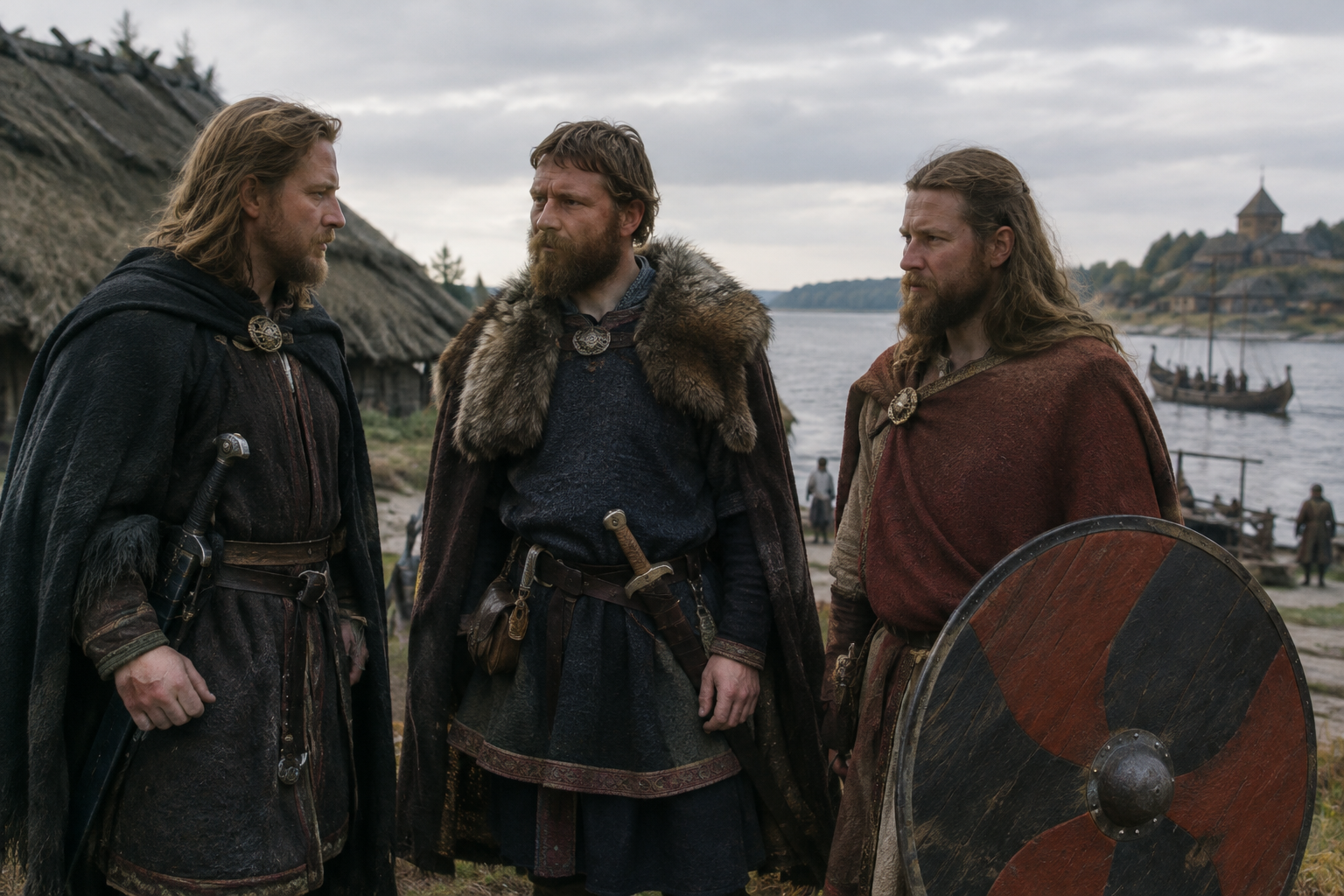
Some Y-chromosome lineages announce themselves loudly in history, appearing again and again in famous burials, royal pedigrees, and well-studied migration horizons. Others are more elusive. Haplogroup I1a1b1b1c belongs to that second category: a very specific paternal branch whose importance lies not in grandiose certainty, but in the way it helps us follow a northern European male line through the shifting worlds of Goths, Vikings, and later Scandinavian nobility.
That is worth pausing over. A Y-DNA haplogroup traces one narrow line of descent: father to son to son to son. It does not describe a person's full ancestry, culture, language, or identity. But when ancient DNA places related paternal branches in real graves, in real landscapes, at real moments of upheaval, it gives us something precious. It lets us watch one thread of male-line history move across centuries that written records can barely illuminate.
Haplogroup I1a1b1b1c sits within the broader Y-DNA haplogroup I1, a lineage long associated in genetic studies with northern Europe, especially Scandinavia and surrounding regions. That broader background matters, but it must be handled carefully. We should not simply pour the entire history of I1 into this narrower branch as if every subclade marched in lockstep. Specific subclades often reflect later expansions, local founder effects, and regional histories of their own.
Even so, the setting is suggestive. When we see a branch like I1a1b1b1c appear in material tied to the Gothic world in Poland and then in Viking Age Staraya Ladoga, we are looking at a paternal signal moving through the Baltic and eastward-facing networks that linked Scandinavia, the southern Baltic coast, and the river routes of early Rus. This is not proof of one single tribe, one ethnicity, or one dynasty. It is evidence that related male lines participated in those worlds.
Readers interested in the larger archaeological background to northern paternal lines may also enjoy this broader introduction to ancient DNA itself and the methods that made such discoveries possible.
Explore Ancient DNA and Archaeogenetics
The earliest supplied clue is PL070, described as Ancient Individual:Gothic Tribe Poland Moroczyn Wielbark Year:250 AD ID:PL070. That brief line carries quite a lot of history. The Wielbark cultural sphere, associated by many archaeologists with communities linked to the Goths, occupied parts of what is now Poland during the Roman Iron Age. It belonged to a frontier zone: not inside the Roman Empire, but deeply entangled with it through trade, prestige goods, war, and migration.
Moroczyn, in this context, is important not because it proves modern people descend from a named Gothic warrior, but because it places a paternal lineage related to our haplogroup in a region central to debates about Gothic ethnogenesis and mobility. For generations, historians argued over whether the Goths were migrants from Scandinavia, local confederations, or some mixture of both. Ancient DNA has not ended that argument, but it has made it subtler. The picture now looks less like a single folk migration and more like a historically mobile, socially mixed community.
That is why PL070 matters. He is not a slogan about "the Goths." He is a man buried in a world where identities were being made and remade along the Baltic edge of Rome's horizon.
If you want to go deeper into that debate, this related article looks directly at how ancient DNA complicates the old image of the Goths as a simple, uniform people.
Read About Goths as a Multi-Ethnic Community
Fast forward several centuries and the setting changes dramatically. We meet VK221, listed as Ancient Individual:Viking Age Staraya Ladoga Year:911 AD ID:VK221, and VK219, listed as Ancient Individual:Viking Age Staraya Ladoga Year:992 AD ID:VK219.
Staraya Ladoga is one of those places that ought to be far better known outside specialist circles. It sat at a crucial northern gateway between the Baltic and the river systems leading toward Novgorod, the Volga, and Byzantium. In other words, this was not a sleepy outpost. It was one of the great contact zones of the Viking Age, where Scandinavian, Finnic, Slavic, and steppe-facing connections overlapped.
The presence of related paternal signals here fits a historical pattern long visible in archaeology: Scandinavian-linked movement eastward was not only about raiding in the west. It was equally about trade, military service, settlement, and political formation in the east. A lineage like I1a1b1b1c appearing in Staraya Ladoga does not make every carrier a "Viking" in the simplistic modern sense, but it does place that paternal branch squarely in the world of Norse expansion and Baltic-Rus exchange.
And note the dates. VK221 at 911 AD and VK219 at 992 AD suggest not a single isolated event, but a continued presence in that milieu across the 10th century. That kind of repeated appearance is precisely what makes ancient Y-DNA valuable: not because it delivers neat nationalist labels, but because it shows persistence within historically important corridors of movement.
For readers curious about the larger genetic setting of this eastern-facing Viking world, this article offers an excellent companion piece.
Here we must be disciplined. The supplied evidence does not allow us to claim an unbroken documented chain from PL070 to VK221 or VK219, still less from those ancient men to any later noble house. But it does allow a historically interesting observation. The geographic arc from the southern Baltic to Ladoga is exactly the sort of corridor through which northern paternal lines could travel in late antiquity and the early medieval period.
That arc also reminds us that paternal continuity and cultural change are not opposites. A male line can persist while languages shift, political loyalties change, and communities absorb newcomers. The same Y-lineage may appear in people who would have understood themselves very differently from one another. That is one of the most salutary lessons of archaeogenetics.
The later historical association supplied here is Riddarhuset Loewenhielm. Even in its slightly garbled form, the context is clearly Swedish. Riddarhuset, the House of Nobility in Stockholm, is one of the great institutional storehouses of Swedish aristocratic memory, where noble families were formally recorded, ranked, and commemorated. The name Loewenhielm belongs to that early modern and modern Scandinavian world of ennoblement, service to the crown, and genealogical self-consciousness.
That matters because haplogroups often come alive for readers not in prehistory, but in the threshold between medieval and documented family history. A noble house such as the Loewenhielm family stands in a region where I1 lineages have deep historical relevance. Yet caution is essential: a historical association with a haplogroup article does not prove that every man of the family carried this exact subclade, nor that the family descends in a direct documented male line from the ancient individuals above.
What we can say is more interesting than a forced claim. The Loewenhielm family belongs to the same broad Scandinavian historical landscape in which lineages like I1a1b1b1c make sense: a landscape shaped by Baltic exchange, military mobility, royal service, and the long afterlife of Viking Age and medieval population structures.
Readers who enjoy seeing how noble history and DNA storytelling intersect in Sweden should have a look at this family profile.
Explore the Loewenhielm Family
There is an almost comic honesty in the supplied castle note: "Please share the location you want described and I will give you a one paragraph history in plain ASCII with no commas." In other words, no actual castle description has been provided. So we should resist the temptation to invent one. There is no responsible basis here for attaching I1a1b1b1c to a specific Loewenhielm seat, fortress, manor, or ancestral stronghold.
Still, the absence tells its own story. Noble memory is often preserved in institutions, heraldry, estates, and architecture, while genetic memory is preserved in chromosomes and bones. The two are not the same archive. A castle can commemorate a family. A Y-chromosome can trace one paternal line. Only when both kinds of evidence are properly documented do they meet securely. Most of the time, they stand beside one another rather than collapsing into one neat answer.
That is why MyTrueAncestry-style interpretation works best when it keeps both excitement and restraint in view. A haplogroup can place you in a historical landscape without pretending to hand you a signed deed to a castle.
For another Swedish case where genetics, family memory, and burial evidence meet in a later historical setting, this article is well worth reading.
Explore Medieval Swedish DNA and Burials
So what does I1a1b1b1c reveal? Not a simple tribal label. Not a guaranteed noble pedigree. Not a complete portrait of ancestry. What it reveals, rather, is a paternal thread running through some of the most historically charged zones of northern and eastern Europe: the Gothic horizon of Roman-period Poland, and the Viking Age crossroads of Staraya Ladoga.
That is already a remarkable span. Through samples like PL070, VK221, and VK219, we see how ancient DNA turns abstractions into people. We move from textbook words such as "Gothic" and "Viking" to excavated men with dates, places, and lineages. And when later Scandinavian noble associations such as Loewenhielm enter the frame, they do so not as proof of direct descent, but as part of the longer northern historical setting in which these paternal lines endured.
If your own Y-DNA falls within a related branch, that does not mean you are a Goth, a Varangian, or a Swedish nobleman reborn. But it may mean that one thin line of your ancestry once belonged to the same broad world of Baltic mobility, Scandinavian expansion, and northern European continuity that these ancient burials illuminate.
Upload your DNA to MyTrueAncestry to explore whether your results show connections to ancient individuals, archaeological cultures, and historical populations like those discussed here. Ancient DNA matches can offer a vivid new perspective on the past, even when they do not prove direct descent from a specific person or noble family.






Comments