Haplogroup I1a1b1b

– 6 min read


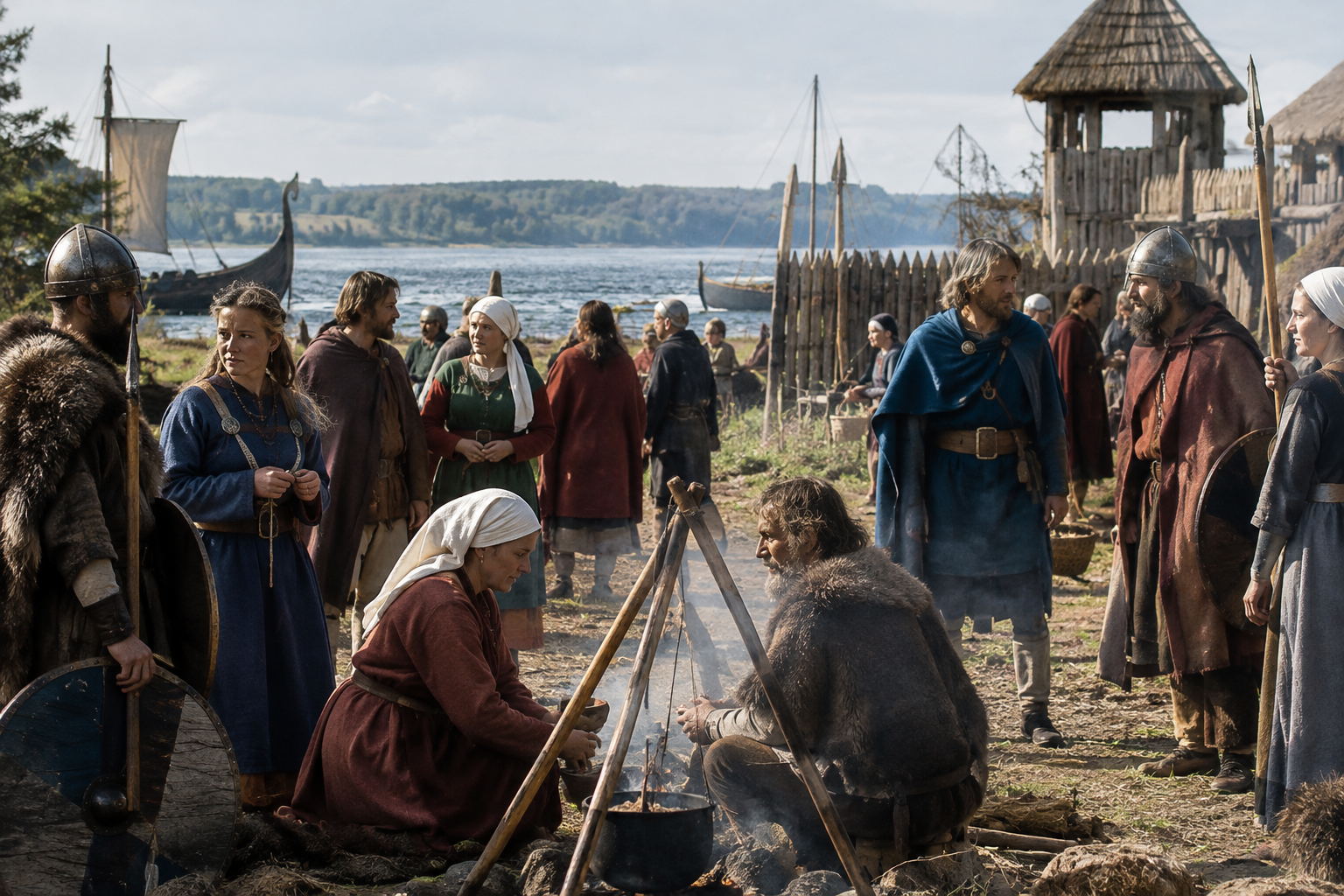
Some Y-chromosome lineages behave rather like old place-names. They survive political collapse, language shifts, religious change, and the rise and fall of kingdoms. Haplogroup I1a1b1b belongs to that kind of story. It sits within the wider Y-DNA haplogroup I1, a paternal lineage long associated in broad terms with northern Europe, especially Scandinavia and the lands around the North Sea. But the interesting part is not a lazy slogan about "Viking DNA." It is the way ancient samples let us watch related paternal branches appear in different times and settings: Neolithic Sweden, Iron Age Denmark, Gothic-period Poland, Merovingian Bavaria, post-Roman Hungary, Anglo-Saxon England, and medieval Scandinavia.
That is exactly why Y-DNA matters. It traces one direct paternal line only: father to father to father. It does not describe a person's whole ancestry, nor does it make someone automatically a Goth, a Dane, a Viking, or a Border noble. Still, when enough ancient evidence accumulates, a paternal lineage can illuminate movements and continuities that written history only half remembers. For I1a1b1b, the pattern suggested by the supplied evidence is of a northern European paternal tradition that appears early in Scandinavia and later turns up across the migration routes of Germanic-speaking and North Sea populations.
For a subclade as specific as I1a1b1b, caution is essential. We should not simply pour the entire history of all I1 into this narrower branch. Even so, the supplied ancient samples place this lineage in a remarkably Scandinavian-centered frame. One of the oldest clues is CGG105926 from Neolithic Sweden Albacksbacken Maglarp, dated to 1800 BC. That does not prove that the exact later distribution of I1a1b1b was already fixed in the Neolithic, but it does show that paternal lines in this part of the I1 story were present in southern Scandinavia deep in prehistory.
From there, the evidence begins to spread around the Baltic and North Sea. We see CGG107443 in Danii Tribe Denmark Northwest Sjaelland Asnaes at 175 AD, and CGG105936_CGG105937 in Iron Age Sweden Trelleborg at 275 AD. These samples help anchor the haplogroup in the Scandinavian world before the great written-age raids and kingdoms. They belong to the period when local chiefdoms, maritime links, and military retinues were shaping the societies that later observers would label Danes, Swedes, and other northern peoples.
Then the trail becomes much more dramatic. A particularly striking sample is PL070 from Gothic Tribe Poland Moroczyn Wielbark, dated to 250 AD. It appears in the orbit of the Wielbark cultural world often discussed in relation to Gothic movements. No single Y-haplogroup can define the Goths, who were almost certainly a mixed and changing population, but PL070 is a fine reminder that paternal lines associated with northern Europe were present in communities operating far from Scandinavia itself.
The Migration Period and post-Roman centuries supply an even broader spread. In the Carpathian Basin we find SZL026 from Longobard Period Pannonia Savaria Szeleste Barbaricum Hungary at 525 AD, and the trio Bal_111, Bal_111m, and Bal_111x from Post Roman Empire Pannonia Hungary Balatonszemes at 475 AD. Nearby in a later context sits RKF183 from Migration Period Hungary Rakoczifalva at 650 AD. Here one sees the old Roman frontier world giving way to mobile federate groups, successor societies, and mixed frontier communities. This is not a neat migration arrow on a map. It is people moving, settling, serving, marrying, fighting, and burying their dead in new lands.
Central Europe also features strongly. The Merovingian-era burials Alh_236 and Alh_141 from Bavaria Altheim Germany, both dated to 600 AD, and DRU011 from Carolingian Drantum Lower Saxony Germany at 750 AD, followed by DUN005 from Saxon Lower Saxony Germany Dunum at 840 AD, show this paternal branch in regions deeply involved in the making of early medieval Europe. These are lands where Roman provinces had ended, but new kingdoms, duchies, and church networks were taking shape.
Read About Goths as a Multi-Ethnic Community
The Scandinavian and Viking-age evidence is especially rich. There is VK315 from Viking Age Rantzausminde Grav Funen Denmark at 875 AD, CGG100683 from Viking Age Denmark Jutland Tjaerby Randers at 1050 AD, fjk534 from Viking Age Fjalkinge Sweden at 975 AD, als007 from Viking Age Sweden Uppland Alsike at 975 AD, and VK404 from Viking Age Skara Varnhem Sweden at 1050 AD. Further east, VK221 and VK219 from Viking Age Staraya Ladoga, dated to 911 AD and 992 AD, point toward the eastern trading and raiding worlds that linked Scandinavia to the river routes of Rus.
One should also notice the outposts. VK507 from Vendel Age Saaremaa Salme I at 725 AD comes from a famous martial Baltic context. VK257 from Viking Invader Ridgeway Hill England at 998 AD plants this paternal line in one of the starkest archaeological settings of Viking violence in England. And yet the same haplogroup turns up not only in warriors and migrants but also in settled medieval towns, such as mbs072 from Medieval Sigtuna Sweden at 1100 AD and CGG100498 from Medieval Jutland Denmark Vor Frue Kirkegard Aalborg at 1400 AD.
The British samples are especially suggestive for readers interested in family history. I16509 from Kingdom of Mercia England Wolverton Buckinghamshire at 635 AD and I16383 from Kingdom of Dumnonia Britain Cornwall Widemouth Bay at 700 AD show that this paternal branch, or a close line within its cluster, was present in early medieval Britain in more than one region. That matters because Britain after Rome was not a simple ethnic chessboard. It was a zone of migration, settlement, local survival, and maritime contact. A northern paternal lineage in Mercia is hardly surprising; one in Dumnonia is a useful reminder that coasts connect as much as they divide.
The same broad point applies to the Iron Age Netherlands Outlier Valkenburg Marktveld sample CGG107762 dated to 175 AD, and to VEM057 from Early Medieval Croatia Velim-Velistak at 775 AD, or To_Lav_T2US16 from Dark Ages Italy Torino Lavazza at 550 AD. These finds do not mean that I1a1b1b "belonged" to one people. They show instead that paternal lines linked to northern Europe could travel astonishing distances in the Roman and post-Roman worlds, ending up in Italy, the Balkans, the Carpathian Basin, and Britain.
If you want a wider look at how these complicated post-Roman populations formed, the community article on Britain after Rome is well worth exploring alongside these samples.
Explore Post-Roman Britain DNA
That brings us, by a long historical road, to the Anglo-Scottish frontier and Clan Carruthers. The supplied family context centers on Mouswald Tower in Dumfriesshire, a late medieval fortified tower house tied to the powerful Carlyle family. Records place the estate by the 14th century, while the tower itself was probably built or rebuilt in the 16th century. It was one of those hard, compact Border residences that were half home, half warning to the neighbourhood.
This is exactly the sort of place where one ought to resist romantic nonsense. A shared haplogroup does not prove that the Carruthers, the Carlyles, every tenant, or every fighting man of Dumfriesshire belonged to one paternal line. Medieval and early modern families were never genetically uniform. Adoption, illegitimacy, remarriage, cadet branches, and plain old demographic chance see to that. But Mouswald Tower still matters in this story because it stands in a region shaped by centuries of North Sea and frontier history. The western Border country absorbed influences from Brittonic kingdoms, Anglo-Saxon expansion, Norse maritime worlds, and later Scottish and English state formation.
The tower's history suits that landscape. The Carlyles were entangled in Border warfare, feuding, and shifting loyalties. By the later 16th century their fortunes declined, and after the pacification of the Borders under James VI and I, the old stronghold lost much of its purpose. It fell into ruin, though its surviving fragments still speak of a harsh political environment in which kinship, landholding, and defense were inseparable.
For a reader carrying I1a1b1b today, the point is not that Mouswald Tower proves noble descent. It does not. The point is that genetics and history sometimes converge on the same landscapes. A haplogroup found in ancient Scandinavia, early medieval England, and Viking contexts belongs very comfortably in the wider background of the North Sea and Border worlds from which many later British clans emerged.
So what does haplogroup I1a1b1b reveal? First, it points toward a paternal history with strong northern European associations, especially in the Scandinavian and North Sea zone. Second, the ancient DNA evidence shows that related lineages were not confined there. They appear in Gothic, Lombard, Merovingian, Saxon, Viking, and medieval settings across a broad swathe of Europe. Third, it reminds us that written genealogies usually reach back only so far, while ancient DNA lets us glimpse much older patterns of continuity and movement.
What it cannot do is certify ethnicity, confer a coat of arms, or prove descent from a warrior at Salme, a settler at Sigtuna, or a family at Mouswald Tower. But it can place your direct paternal line in a very old historical conversation, one that runs from prehistoric Scandinavia to the kingdoms, raiders, frontiers, and fortified houses of medieval Europe.
If you would like to explore the clan side of that later story in more detail, the community article on Clan Carruthers makes a natural companion to the broader genetic background discussed here.
Upload your DNA to MyTrueAncestry to see whether your results show connections to ancient individuals, archaeological cultures, and historical populations like those discussed here. Such matches can offer remarkable clues about deep ancestry, even when they do not prove direct descent from a particular ancient person or noble family.






Comments