Haplogroup I1a1b1a4a2f1a1a7a

– 6 min read


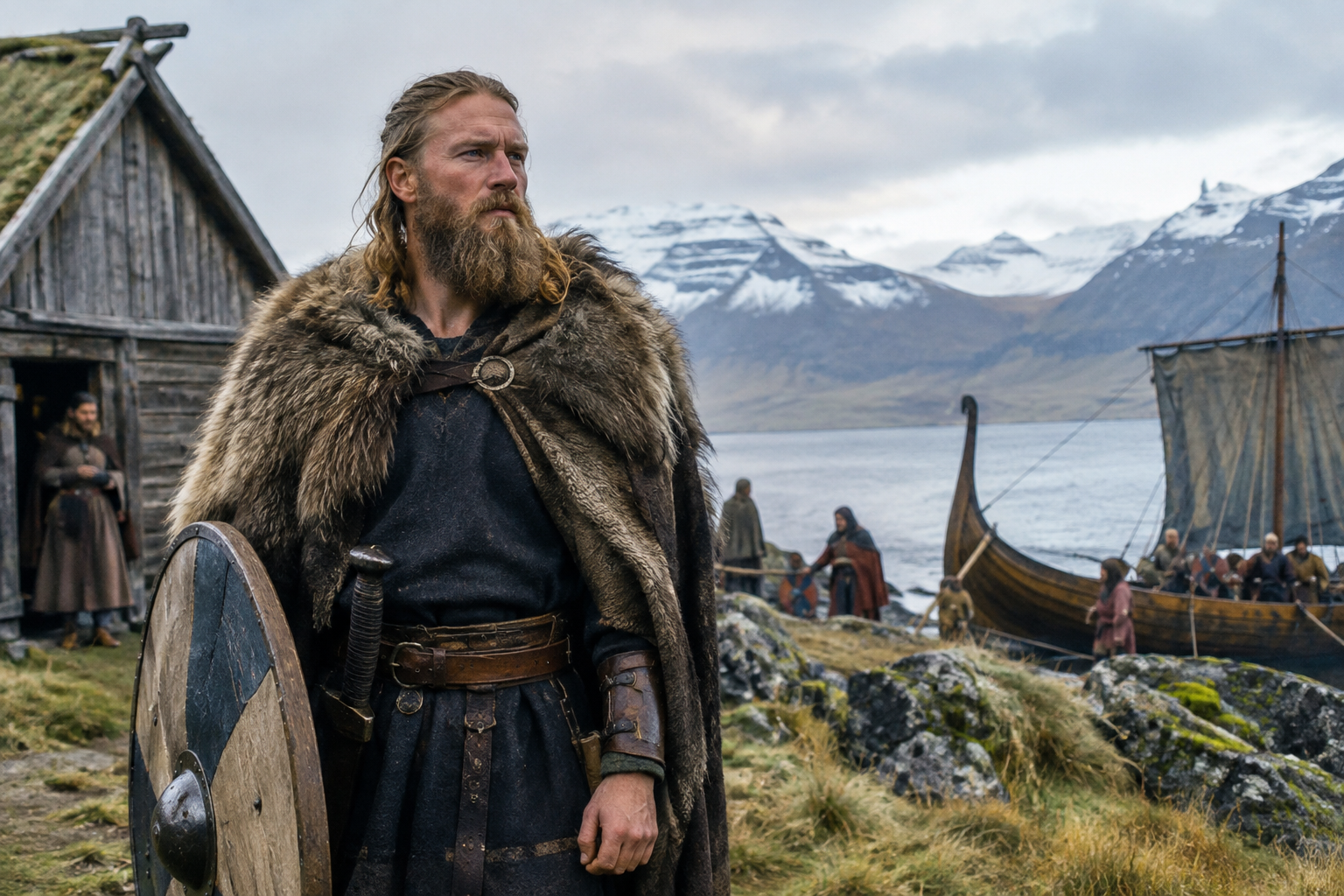
Some Y-chromosome lineages announce themselves with a bang. Others appear more quietly: a branch here, a burial there, a medieval clan tradition in one corner of the map and an ancient seafaring skeleton in another. Haplogroup I1a1b1a4a2f1a1a7a belongs to that second category. It sits deep within the wider I1 family, a paternal lineage long associated with parts of northern Europe, especially Scandinavia. That alone makes it interesting, because once we begin following such a branch through time, we are not looking at "a people" in any simple sense, but at one thread of male-line ancestry moving through changing worlds.
That is worth stressing at the outset. A Y-DNA haplogroup traces only one direct paternal line: father to father to father. It does not describe a person's total ancestry, identity, language, or culture. But even so, these paternal lines can be extraordinarily revealing. They let us ask where a lineage appears in ancient burials, how it may have travelled, and why a branch found among Scandinavian populations might later matter in places as far-flung as Iceland or the western Highlands of Scotland.
The very long name I1a1b1a4a2f1a1a7a tells us that this is not a broad, ancient umbrella category but a highly specific downstream branch. In other words, we should be careful. The history of the larger haplogroup I1 cannot simply be pasted wholesale onto this narrow subclade. What we can say responsibly is that I1 is a well-known northern European Y-DNA lineage, especially important in Scandinavia, and that increasingly fine-grained branches like this one help geneticists reconstruct later episodes of regional diversification and movement.
That broader I1 background places this haplogroup in a landscape shaped by post-Ice Age settlement, later Scandinavian population formation, and the maritime mobility of the Viking Age. Some of the deeper ancestry behind I1 reaches back into prehistoric northern Europe, but for a narrow branch such as this one, the most historically meaningful evidence often comes much later, when ancient DNA starts turning up in burials that can be tied to named societies and dated events.
For readers interested in the bigger prehistoric setting of northern Europe before the Viking world fully emerged, this community article offers a useful backdrop.
Explore Early Denmark and Ancient DNA
The most vivid anchor supplied here is HSJ-A1, described as Ancient Individual: Norwegian Viking Iceland Year:950 AD ID:HSJ-A1. Even in that brief label, there is a whole historical drama. A Norwegian Viking in Iceland around 950 AD means we are standing in the middle of the North Atlantic expansion, when Scandinavian settlers, sailors, and their families were creating new communities beyond mainland Norway.
Iceland was not some vague edge of the world in this period. It was a deliberate colonial project of the Viking Age, linked by ship routes, law, kinship, and trade to Norway and the wider Norse diaspora. A sample such as HSJ-A1 matters because it places this paternal branch, or a closely relevant lineage in that vicinity, in exactly the kind of setting where Scandinavian male lines spread into new territories.
That does not prove that every later bearer of this haplogroup descends from one Icelandic settler, nor that HSJ-A1 is anyone's direct ancestor. Ancient DNA does not work like a family romance novel. But it does show that this lineage belonged to real men moving in real historical networks: ships crossing cold seas, farms being claimed, and Scandinavian identities being remade in Atlantic islands.
If you want a wider view of that Norse expansion beyond Iceland itself, the Greenland story makes an excellent companion piece.
Read About the First Viking Settlers of Greenland
Once you have a Scandinavian-associated paternal line in the Viking Age North Atlantic, western Scotland naturally comes into view. Not because DNA obliges us to draw a straight line from one burial to one clan, but because the seaways between Norway, the Hebrides, Argyll, and the Irish Sea were among the great thoroughfares of the medieval north. The western Highlands were not isolated from Scandinavia; at times they were deeply entangled with it.
This is where the supplied historical material on Clan MacIntyre becomes especially evocative. The clan is associated here with Ardchattan Priory, on the shore of Loch Etive in Argyll. Founded around 1230 as a Valliscaulian house, Ardchattan became an important religious center in medieval western Scotland, tied to local lords and the Lords of the Isles. It was not simply a monastery in the narrow sense. It was also a place of burial, hospitality, counsel, and local memory.
And what a setting it was. Loch Etive cuts inland like a sea-road, and anyone who knows western Scottish history will recognize how often water, not road, was the real route of power. A priory there stood in a region shaped by Gaelic lordship, Norse influence, ecclesiastical patronage, and shifting alliances. Tradition even holds that Robert the Bruce held a council at Ardchattan before the Battle of Pass of Brander in 1308. Whether one arrives at the priory through written history, clan tradition, or landscape archaeology, it belongs to a frontier world where identities were layered rather than simple.
That is precisely the kind of region where a northern paternal lineage could persist, reappear, or be absorbed into later medieval society. A shared broad haplogroup is not proof that a clan founder and a Viking settler were closely related. But geographically and historically, the connection is plausible as context: Scandinavian-linked male lines were part of the human mixture of the North Atlantic and western Scottish world.
Readers curious about the clan itself can follow that thread further here.
Discover the Story of Clan MacIntyre
Ardchattan Priory is especially useful for thinking about the difference between genetics and genealogy. The buildings that survive today, partly ruined after the end of monastic life following the Scottish Reformation, cannot tell us anyone's haplogroup by themselves. Stones are not chromosomes. Yet sites like this preserve something equally valuable: the social world in which paternal lines mattered, whether through inheritance, lordship, burial rights, or clan memory.
In medieval Scotland, a place of burial was also a place of statement. To be remembered in a priory church or its grounds was to belong to a known local order of kinship and status. So although we must not claim that Clan MacIntyre as a whole is genetically defined by this haplogroup, Ardchattan provides the right historical stage for understanding how male-line descent could acquire political and cultural importance long after the Viking Age itself.
Its later history sharpens the picture rather beautifully. After the Reformation in the 16th century, monastic life ended and the site passed into private hands. Parts of the church and claustral buildings survived as a burial ground and estate feature. That continuity of use matters. Even as institutions changed, the landscape kept holding memory. In that sense, ruins can be rather stubborn historical witnesses.
For another angle on Scottish population history and continuity, this article offers useful context from genetics rather than clan tradition alone.
Explore Scottish Genetic History
So what do we actually learn from I1a1b1a4a2f1a1a7a? First, that highly specific Y-DNA branches are most meaningful when placed inside larger regional histories. In this case, the broad I1 background points us toward northern Europe and especially Scandinavia. Second, the ancient individual HSJ-A1 provides a concrete Viking Age setting in Iceland around 950 AD, showing this paternal world in motion across the North Atlantic. Third, the later historical setting of Argyll and Ardchattan Priory reminds us how such lineages could persist within medieval societies that were shaped by both local continuity and older seaborne connections.
But there are limits, and they matter. A haplogroup cannot by itself prove descent from a specific Viking, a Scottish chief, or a noble family buried at a priory. It cannot tell you what language your paternal ancestors spoke at every point, nor whether they thought of themselves as Norse, Gaelic, Scottish, or something in between. What it can do is place your direct paternal line in a map of ancient and medieval human movement that written records alone rarely capture.
That is why ancient DNA is so compelling. It does not replace archaeology, history, or genealogy. It sits beside them, sometimes confirming, sometimes complicating, always asking us to look again. A branch like I1a1b1a4a2f1a1a7a is not the whole story of a person, but it can be a remarkably sharp clue to one line of that story.
If you want to see whether your own DNA shows links to ancient individuals like HSJ-A1 or to the wider populations of the Viking Age and medieval north, MyTrueAncestry lets you explore those comparisons for yourself. The results may open a fascinating window onto your past, even when they do not prove direct descent from any one historical figure or clan.






Comments