Haplogroup I1a1b1a4a2e1a

– 5 min read


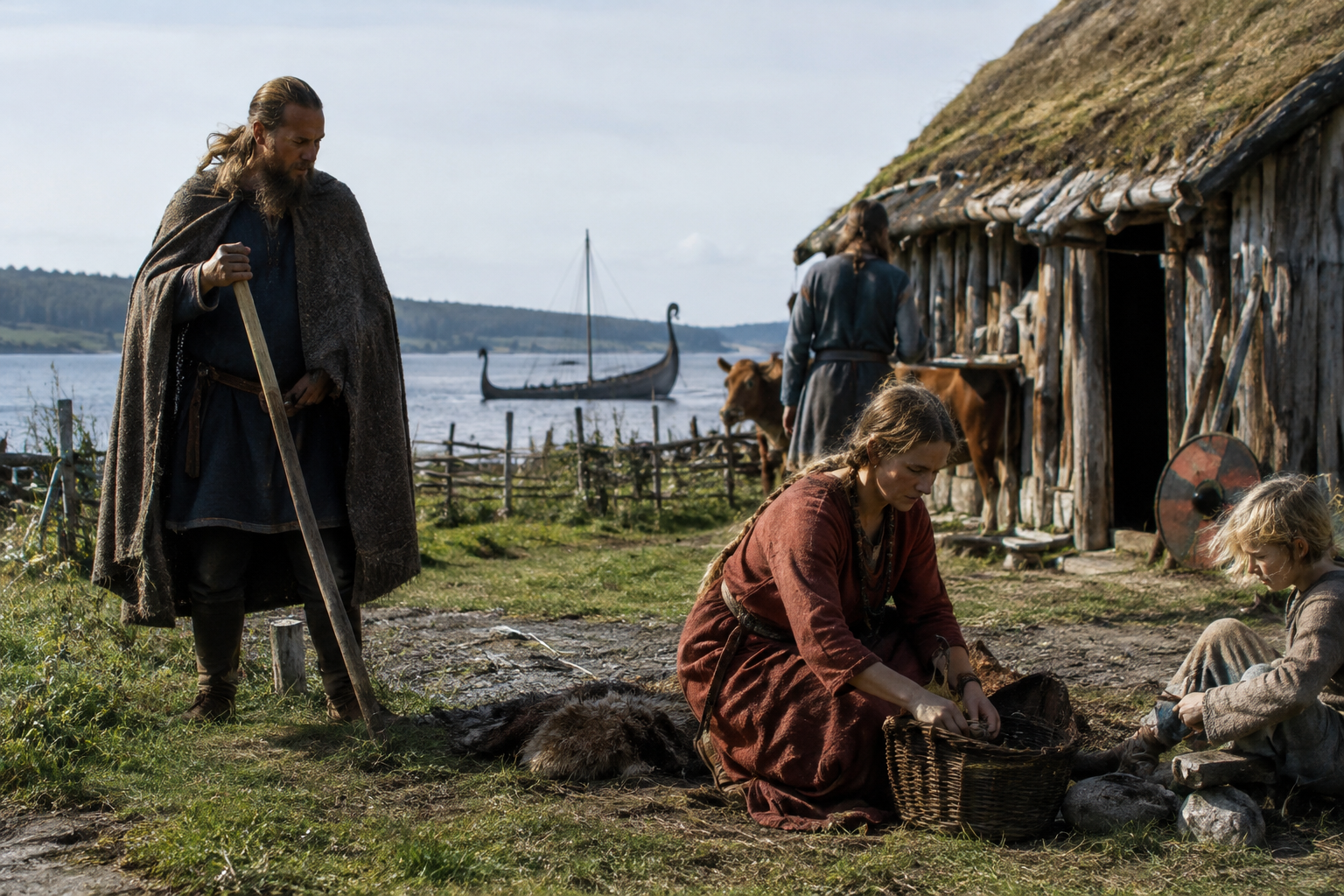
At Bodkergarden in Denmark, one Viking Age man has become a useful anchor for thinking about the Y-DNA haplogroup I1a1b1a4a2e1a. The individual is recorded as VK291, dated to around AD 850, and placed squarely in the Scandinavian world at the height of the Viking Age. That matters because this is not a legendary figure, nor a saga hero polished by later storytelling, but an excavated person from a real burial context whose paternal line can be compared with wider patterns in northern Europe.
The first thing to say plainly is that Y-DNA tracks one direct paternal line only: father to son to son across generations. It does not capture a whole ancestry, a language, or an ethnic identity by itself. Even so, a lineage like I1a1b1a4a2e1a becomes historically interesting when it turns up in a site like Bodkergarden, because the broader haplogroup I1 is strongly associated with northern Europe and appears repeatedly in discussions of Scandinavian and Germanic population history.
VK291 is valuable less because of elite glamour and more because of context. Denmark around AD 850 was part of a busy and often turbulent North Sea world: ships, exchange, raiding, migration, political consolidation, and the gradual reshaping of local societies into larger kingdoms. A male line found in this setting belongs to a period when Scandinavian populations were not sealed off, but deeply entangled with Britain, the Baltic, the Frankish world, and beyond.
That makes a Bodkergarden burial a particularly sensible place to begin. When we find a branch like I1a1b1a4a2e1a associated with a Viking Age Danish individual, we are looking at a paternal line embedded in one of the best documented mobility zones of early medieval Europe. The archaeological importance lies not in turning one man into a symbol of all Vikings, but in placing a specific lineage within a society whose movements changed the demography of large parts of Europe.
A broad ancient DNA research effort on Viking Age populations, available at https://www.biorxiv.org/content/10.1101/703405v1, helped frame exactly this larger question: how much diversity there was within Viking Age Scandinavia, and how paternal and genome-wide ancestry related to the historical expansion of Norse-speaking peoples.
The haplogroup in this article is not simply I1, but the much narrower branch I1a1b1a4a2e1a. That distinction is crucial. The parent haplogroup I1 has a long and complex history in northern Europe, but it would be careless to pour all of that history directly into one tiny downstream branch without branch-specific evidence.
So the responsible reading runs like this: VK291 shows that a paternal line associated here with I1a1b1a4a2e1a was present in Viking Age Denmark. That does not mean every carrier of this branch descends from Vikings in the simple storybook sense, nor that the branch itself was born in the Viking Age. It means that one documented bearer stood within that world, and that this is a historically meaningful point of contact between a modern Y-line and an excavated early medieval Scandinavian man.
There is also a methodological point worth making. Ancient Y-DNA assignments often vary in resolution depending on DNA preservation and analytical coverage. With some ancient individuals, researchers can place a sample deep into a branch; with others, only the broader parent lineage is secure. In public genealogy, that distinction is often blurred. Archaeology is less forgiving, and rightly so.
To understand why a Danish Viking Age sample matters, one has to zoom out a little. Denmark was not an empty launchpad waiting for the Viking Age to begin. It had already seen thousands of years of demographic change: Mesolithic foragers, Neolithic farmers, later steppe-linked ancestry, and the long Bronze and Iron Age developments that produced the social landscape inherited by early medieval Scandinavians.
This longer perspective matters because a Viking burial is never just "a Viking." He is also the heir to much older population processes in southern Scandinavia. The paternal line seen in VK291 sits atop those deeper layers of settlement and mixture. If you want the archaeological background to that older Danish story, the Mesolithic-to-Neolithic transition is especially important in showing how dramatically populations and lifeways changed long before the first longships appeared.
For the broader I1 picture, that deeper Scandinavian setting is often more useful than romantic images of raiders and kings. Haplogroups survive because lineages pass through ordinary communities as well as exceptional moments. A branch found in Viking Age Denmark may reflect regional continuity as much as expansion, and in practice usually some combination of both.
The wider haplogroup I1 is often discussed alongside the history of Germanic-speaking populations. That connection needs careful wording. A Y-chromosome lineage does not "equal" a language. Yet when repeated genetic patterns overlap with regions central to early Germanic speech communities, the comparison becomes historically useful, especially when combined with archaeology and settlement history.
Southern Scandinavia occupies a starring role in many discussions of the emergence and spread of Germanic languages. Denmark, in particular, was both a homeland and a corridor: rooted in local societies, but open to maritime movement. A paternal lineage documented there in the Viking Age therefore belongs to a region that mattered not just politically, but linguistically. That does not prove what language VK291 himself spoke, though the odds are hardly mysterious; it shows that his lineage sat inside one of the principal theatres of early Germanic history.
Germanic languages and ancient genomics
This is one reason Scandinavian Y-line evidence attracts so much attention. When paternal branches are recovered from places like Denmark, they can illuminate how local male lines participated in larger historical processes: settlement expansion, military retinues, colonising ventures, and the quieter business of family continuity across centuries.
One authenticated Danish Viking Age lineage also points outward. By the ninth century, men from Denmark and the wider Scandinavian world were moving into England, Ireland, the Scottish islands, the Frankish coast, and the North Atlantic. Some came as raiders, some as traders, some as settlers, and many likely shifted between those roles depending on circumstance and season.
That does not mean I1a1b1a4a2e1a can be mapped neatly onto every later Scandinavian-derived population. But it does mean that a branch present in Denmark around AD 850 belongs to the right historical setting for later dispersal through Viking Age movement. In genealogical terms, that is often the most meaningful point: not a fantasy of a named hero, but a real paternal line documented in a society known for remarkable reach.
The same outward-looking frame helps explain why Scandinavian-linked paternal signatures appear in later populations around the North Sea. They need not always reflect one dramatic migration event. Sometimes they reflect repeated contact over generations, exactly the sort of process Viking Age archaeology keeps revealing.
North Sea migrations to Britain
For this haplogroup, the most solid ancient foothold in the material here is VK291 from Bodkergarden, Denmark, around AD 850. That is already quite a lot. It places the branch in the documented Scandinavian world of the Viking Age, and specifically in Denmark, one of the great centres of early medieval northern European change.
So if you belong to I1a1b1a4a2e1a, the strongest evidence in this case does not promise descent from a particular dynasty or saga name. It offers something better grounded: a direct paternal connection to the sort of male lineage that was present in Viking Age Denmark, in a society that helped reshape the North Sea world.






Comments