Haplogroup I1a1b1a1e1a

– 6 min read


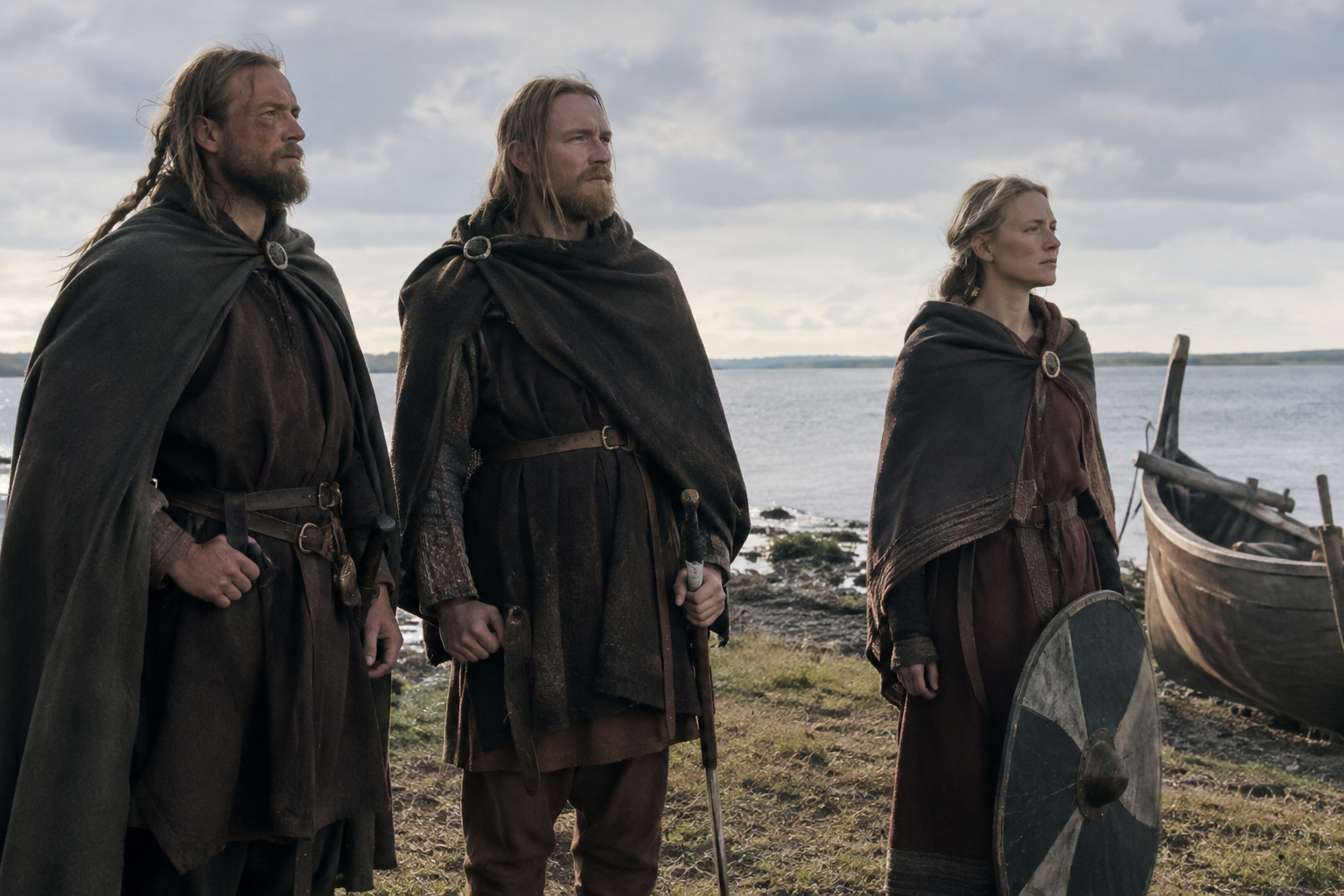
Some Y-chromosome lineages are easy to place in the grander map of European history. Others are more like finding a familiar family name scratched on a shard of pottery: recognisable, suggestive, but meaningful only when set back into its proper landscape. Haplogroup I1a1b1a1e1a belongs to that second category. It is a very specific paternal branch, deep within the wider Y-DNA tree, and its interest lies not in extravagant claims but in how it helps us think about continuity, mobility, and the long male-line histories of northern Europe.
Y-DNA haplogroups trace one narrow line of descent: the direct paternal line, passed from father to son. They do not describe a person's whole ancestry, culture, language, or identity. But they are still remarkably useful. In the case of this branch, the evidence supplied here points us toward Scandinavia and the Baltic world in the centuries around the Viking Age, before bringing us into the much later world of Norman England and the stone power of Hedingham Castle. That is not a proof of direct descent from any ancient burial to any noble house. It is something more historically interesting: a reminder that genetics, archaeology, and medieval records often illuminate the same regions across very different timescales.
This subclade sits within the broader haplogroup I1, a well-known northern European Y-chromosome lineage with a strong historical presence in Scandinavia and surrounding regions. For broad background, that matters. For precision, caution matters even more. We should not simply pour the whole history of I1 into the much narrower vessel of I1a1b1a1e1a. A downstream branch represents only one twig on a larger paternal tree, and its own historical path may have been more local, more recent, or more unevenly distributed than that of its parent lineage.
Even so, the supplied ancient evidence is revealing. All three samples connected here come from the Scandinavian and Baltic sphere in the late 7th and 8th centuries. That immediately places this lineage in a region that was, at the time, anything but isolated. Denmark, the islands of the Baltic, and the sea-lanes toward eastern Sweden and Estonia formed a world of travel, raiding, exchange, and local power long before the classic Viking raids on England became famous.
If you would like a broader look at how ancient DNA changed the study of paternal and population history more generally, this MyTrueAncestry article is a useful companion.
The most concrete clues for this haplogroup come from Denmark and Saaremaa. That is historically apt. These were not fringe places. Sealand in Denmark was part of a densely connected early medieval landscape of farms, local elites, ritual sites, and maritime routes. Saaremaa, the large island in present-day Estonia, sat on Baltic routes that linked Scandinavia, the eastern Baltic, and beyond. In other words, these samples belong to a world in motion.
Two of the supplied individuals come from Hundstrup, Sealand, Denmark: VK296, dated to 680 AD, and VK297, dated to 750 AD. Even without over-interpreting them, they suggest that the paternal line represented by I1a1b1a1e1a was present in Denmark across more than one generation and across the threshold into the early Viking Age. That is useful because it ties this branch not to an abstract map, but to actual men living in a Danish setting before the Viking world fully erupts into written history.
The third sample, VK511, comes from Vendel Age Saaremaa Salme II XXVIII and is dated to 725 AD. Salme is one of those discoveries that makes ancient DNA feel thrilling without any need for melodrama. The site is bound up with the martial and maritime culture of the Baltic world. A sample like VK511 does not prove a simple ethnic label, but it does show that this paternal line appears in a context deeply connected with the seaborne networks of the period.
Together, Hundstrup and Salme suggest a plausible historical setting for this branch: a northern lineage present in the Scandinavian-Baltic zone during the centuries when regional warrior elites, shipping networks, and expanding horizons were reshaping Europe.
Readers interested in that wider Scandinavian transition may also enjoy this piece on Viking Age population history.
Ancient DNA is at its best when it restores real people to the historical record. VK296 and VK297 were not "haplogroups walking about." They were individuals in early medieval Denmark, part of households, communities, and local landscapes now mostly lost except through archaeology. VK511 belonged to a Baltic setting where the sea mattered as much as land. Their Y-DNA helps track paternal continuity, but not personal identity in full.
Just as importantly, shared haplogroups are not the same thing as documented kinship. Two men can share a branch of Y-DNA and yet be separated by many centuries and many thousands of other ancestors. So while these samples help anchor I1a1b1a1e1a in a northern European setting, they do not by themselves prove descent into any later medieval family.
Still, there is a geographical logic here worth noticing. Ancient paternal lines can persist in regions over very long periods, even while languages change, kingdoms rise and fall, and elites reinvent themselves. That is why ancient DNA has become such a powerful complement to written history: it gives us another way of seeing long-term regional continuity beneath the noise of politics.
For another regional case study from the same broad northern world, this article on early medieval Finland is well worth exploring.
The noble association supplied for this article brings us to the House of De Vere and to Hedingham Castle in Essex. At first glance, the leap from Viking Age Denmark and Saaremaa to a Norman great family in England may look abrupt. In fact, it brings us into one of the central historical facts of medieval northwest Europe: the North Sea and Channel worlds were deeply entangled.
The de Veres were established in England after the Norman Conquest, and Hedingham Castle became their seat. Its great stone keep, built in the early 12th century, was an unmistakable statement of aristocratic authority. Like so many Norman strongholds, it was less a lonely fortress than a declaration in masonry: land had changed hands, power had been reordered, and a new ruling class meant to be seen.
Hedingham was later drawn into the struggles of medieval England, including the revolt of 1216, when it was besieged by forces supporting Prince Louis of France. Yet the keep survived, and survives still as one of the best preserved Norman towers in the country. That survival matters because castles are historical memory made stone. They preserve the visibility of families long after documents fragment and bloodlines branch in unpredictable ways.
What, then, is the responsible connection to the haplogroup? Not that the ancient men from Hundstrup or Salme were ancestors of the de Veres. We cannot say that. Nor should we assume that every member of the House of De Vere shared one paternal signature. Rather, the connection is contextual. A northern European Y-lineage attested in the Scandinavian-Baltic world belongs to the same broad historical arena that, over centuries, fed into the populations of England shaped by migration, conquest, and elite formation.
For readers interested in the de Veres themselves, MyTrueAncestry has a dedicated article on the family.
Haplogroup I1a1b1a1e1a is historically interesting precisely because it is so specific. It narrows our focus. Instead of talking vaguely about "Viking ancestry" or "northern blood," we are forced to look carefully at dated burials, real places, and the difference between broad patterns and exact genealogies.
The three ancient samples supplied here place this branch in the late 7th- and 8th-century north: VK296 and VK297 in Hundstrup, Sealand, Denmark, and VK511 in Vendel Age Saaremaa Salme II XXVIII. The De Vere association places us much later in medieval Essex, at Hedingham Castle, in the world of Norman aristocratic power. Between them lies the whole complicated business of European history: continuity and disruption, sea travel and settlement, conquest and local persistence.
That is what Y-DNA does so well when handled properly. It does not flatten history into a slogan. It gives us one narrow but durable line through it.
If the Norman and post-Conquest side of this story appeals to you, this related article offers a broader genetic look at that era in England.
If you carry a paternal line like I1a1b1a1e1a, ancient DNA can help place that lineage in a much larger historical setting, from early medieval Denmark and Baltic seafaring worlds to the later landscapes of castles and noble houses. MyTrueAncestry lets you explore those ancient connections through archaeological DNA comparisons, while keeping an important distinction in view: genetic similarity to ancient individuals or populations can be historically fascinating without proving direct descent from a particular warrior, king, or noble family.






Comments