Haplogroup I1a1b1a1c2a
– 5 min read


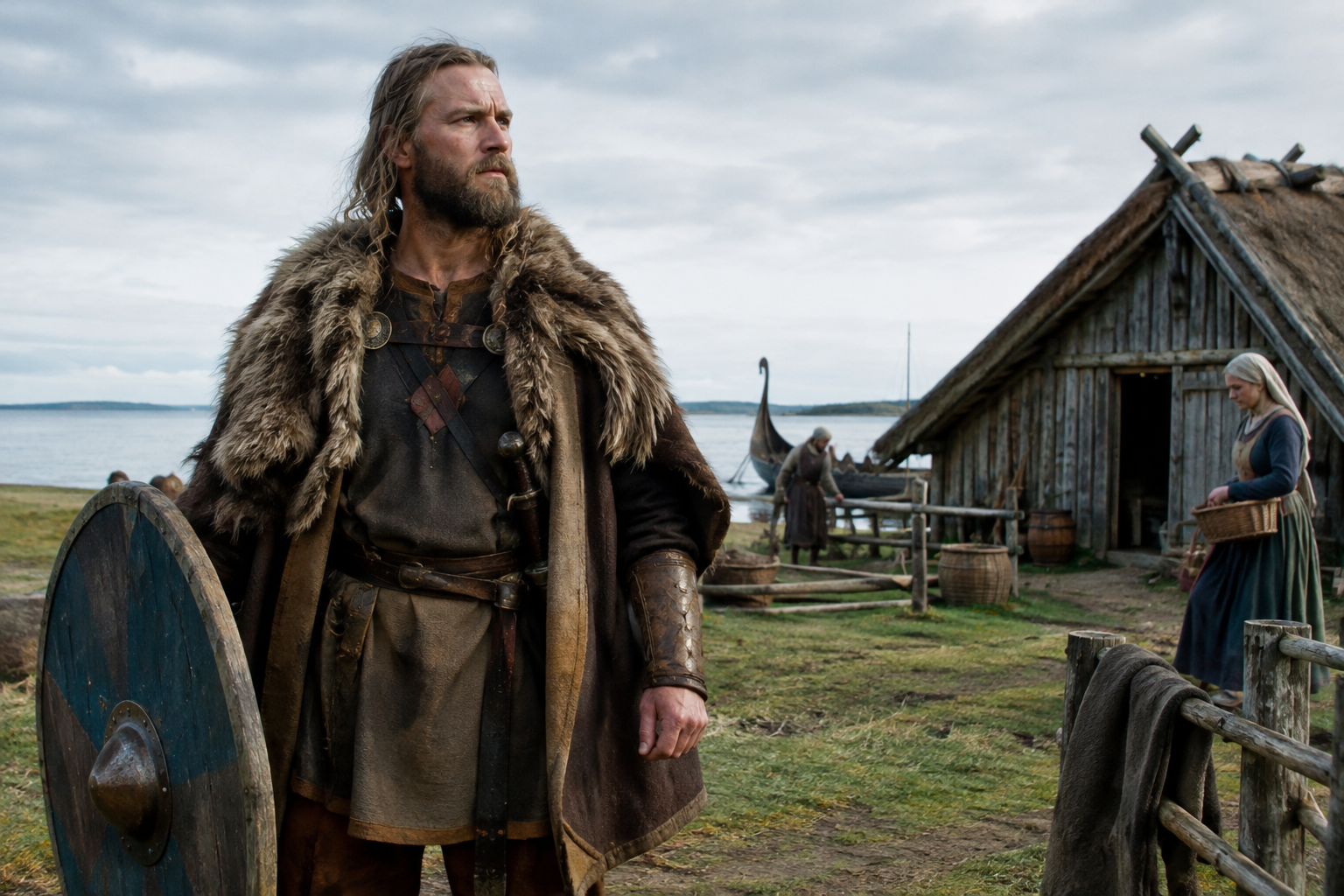
At Barse on Zealand, one Viking Age male identified as VK281 has been associated with the Y-DNA haplogroup I1a1b1a1c2a. The date given for him is around AD 950, which places him in the later Viking Age, when Denmark stood at the center of a busy North Sea world of farms, ships, tribute, trade, raiding, and royal consolidation. With only a single ancient individual securely in view here, the interest lies not in a grand dynasty but in something more grounded: a paternal line appearing in a real man from Viking Age Sealand, in one of the most important regions of early medieval Scandinavia.
That matters because Y-DNA follows one direct paternal line only: father to son across many generations. It does not describe a person's whole ancestry, language, status, or identity by itself. But when a branch like I1a1b1a1c2a turns up in a dated archaeological individual such as VK281, it gives that lineage a firm place in the human landscape of Viking Age Denmark.
Zealand was no peripheral backwater in the 10th century. It was one of the major islands of the Danish realm, tied into the political and maritime sphere that linked Scania, Funen, Jutland, the Baltic, and the North Sea. A man buried or otherwise represented there around AD 950 belonged to a world that was already deeply connected, and increasingly shaped by emerging kingship, Christian influence, and long-distance movement.
That is the proper historical frame for VK281. We should be careful not to turn one Y-chromosome result into a saga hero or a tribal mascot. Still, the association of VK281 with I1a1b1a1c2a places this paternal branch within a documented Scandinavian setting at a time when Danish men and women were participating in some of the best-known movements of the early medieval north.
An ancient DNA study of Viking Age populations, available at https://www.biorxiv.org/content/10.1101/703405v1, helped establish just how varied and wide-ranging this world was. That wider research context is important even when we focus on a single sample, because it reminds us that Viking Age Scandinavia was never genetically or socially uniform.
The broader Y-DNA haplogroup I1 is strongly associated with northern Europe, especially Scandinavia, in both modern and ancient discussions of paternal ancestry. But the article haplogroup here is not simply I1 in general. It is the much narrower branch I1a1b1a1c2a, and that distinction matters.
A narrow subclade represents a later twig on a much larger paternal tree. It may reflect a more specific cluster of male-line descent within the broader Scandinavian and Germanic-speaking world, but that does not mean we can automatically assign to it every pattern ever observed for I1 as a whole. With the evidence provided here, the safe statement is that this branch is represented by a Viking Age man from Barse in Denmark, not that it defines all Danes, all Vikings, or all later descendants in regions touched by Scandinavian expansion.
That modesty is not a weakness. In archaeology, a precise claim securely tied to a place and period is far more valuable than a sweeping one. VK281 gives I1a1b1a1c2a a concrete archaeological anchor: late Viking Age Zealand.
Readers sometimes assume that only a great cemetery or a royal tomb can tell us anything significant. In fact, a single well-dated individual can be remarkably useful when the place and period are historically important. Denmark in the 10th century was just such a place. This was the era of Harald Bluetooth and the famous runic monuments at Jelling; the era when Christianity advanced unevenly; the era when Danish power mattered in England, along the Baltic, and across the northern seas.
VK281 need not have been a king, a warrior chieftain, or an emigrant to matter. Most paternal lines survive not through legend but through ordinary men living in households, working land, joining crews, marrying, inheriting, and passing on sons. A lineage found in Viking Age Sealand could have remained local for generations, or it could have fed into the wider movement of people around the North Sea rim.
That larger pattern is worth keeping in mind when thinking about paternal ancestry from Denmark, southern Sweden, Norway, the Danelaw, Normandy, or the western islands. Not every later bearer of a related branch descends from one Viking migrant, and not every Viking migrant carried I1. But the Barse sample shows this branch in exactly the sort of region from which many later northern European male lines expanded.
There is also a local Danish story here. Zealand had already seen profound population and cultural change long before the Viking Age. By the 10th century, people in Barse were living atop thousands of years of settlement history: Mesolithic foragers, Neolithic farmers, Bronze Age communities, Iron Age societies, and the layered transformations of the Roman and post-Roman north.
So although VK281 is a Viking Age individual, his paternal line was part of a landscape with very deep roots. That does not mean I1a1b1a1c2a can simply be projected unchanged into every earlier period. Rather, it means that Viking Age Denmark was the outcome of long regional histories, not a population conjured out of nowhere by the word "Viking."
For that longer Danish background, it helps to remember how much earlier prehistory shaped the population map of Scandinavia. The transition from foraging to farming, later Bronze and Iron Age developments, and continuing contact across the Baltic all formed the setting into which Viking Age male lines were embedded.
If you carry I1a1b1a1c2a today, the most responsible historical comparison from the evidence here is not to a particular king or saga family, but to the mobile and regionally rooted male population of Viking Age Denmark. Sealand was ideally placed for that. Men from this island sat near the sea routes leading west toward England, south toward the Slavic coast and Frankish lands, and east into the Baltic.
That does not prove that VK281 himself travelled abroad. Archaeology is often maddening in that way: it gives us one clear point, then leaves the rest in shadow. But the point itself is valuable. A paternal branch linked to late Viking Age Denmark belongs, at the very least, to the demographic world that produced traders, settlers, raiders, craftsmen, farmers, and sailors across the northern European seaways.
That broader Scandinavian maritime setting also helps explain why later descendants of northern paternal lines can appear far from Denmark itself. Movement in the Viking Age was not a rare exception. It was one of the normal facts of life in the North Sea and Baltic worlds.
The strongest evidence for I1a1b1a1c2a in this case is refreshingly solid and simple: a Viking Age male, VK281, from Barse, Zealand, Denmark, dated to about AD 950. That places this paternal line within the heartland of late Viking Age Denmark, in a region central to the making of the medieval Scandinavian world. For someone researching this haplogroup today, the clearest takeaway is not a fantasy pedigree, but a real connection to the male-line population of Viking Age southern Scandinavia.






Comments