Haplogroup I1a1a1b5a1a1
– 5 min read


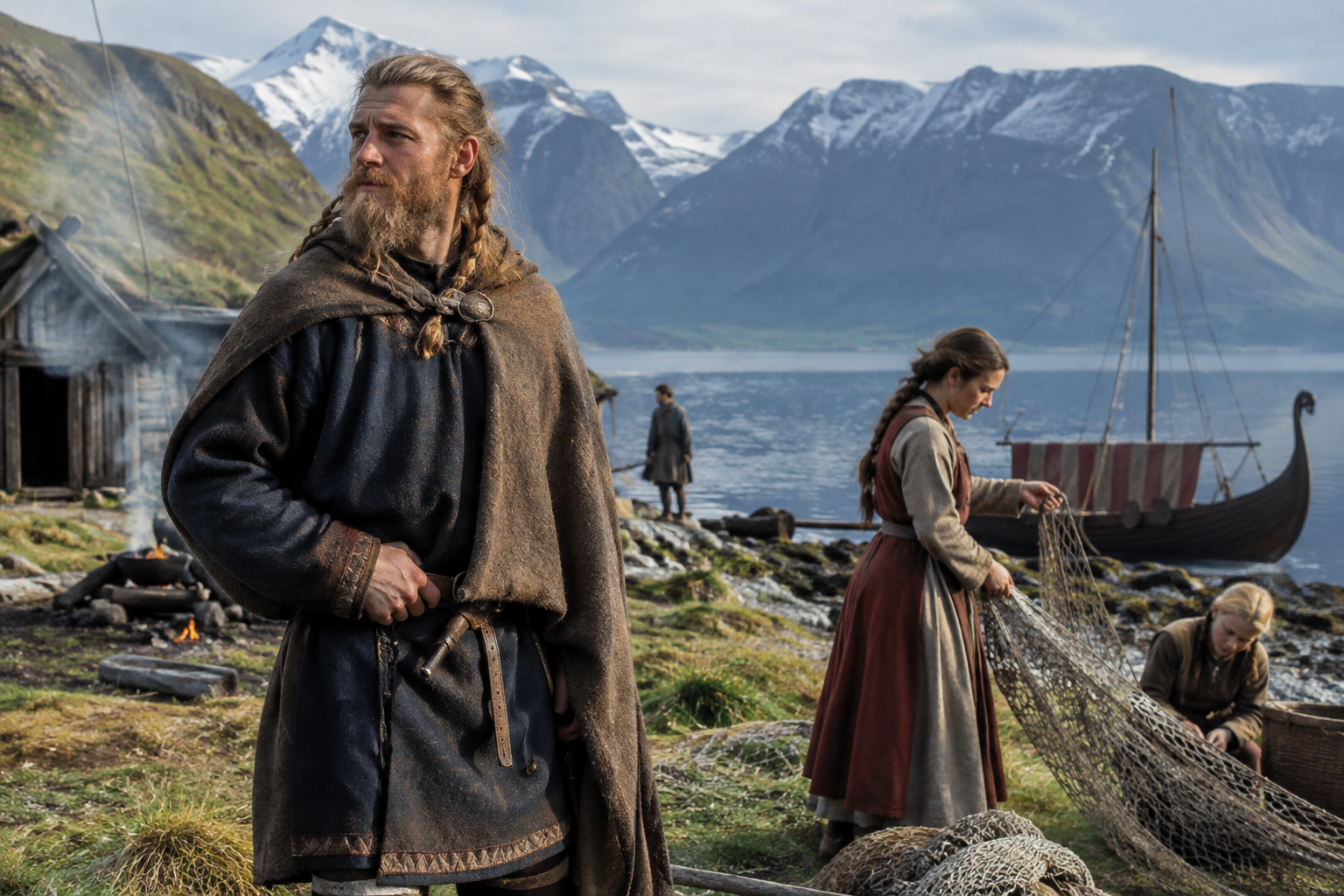
In northern Norway, at Viking Age Nordland, one ancient man stands out in the record simply as VK388, dated to around AD 750. That is a small scrap of evidence by itself: a place, a period, a sample ID, and a paternal line reported here as I1a1a1b5a1a1. But even a single result can be revealing when the setting is this specific. Nordland was not some remote historical cul-de-sac. In the late 8th century it sat within the maritime world that linked the Norwegian coast by sea, trade, raiding, kinship, and seasonal movement.
That matters because haplogroup I1, the broader paternal family to which I1a1a1b5a1a1 belongs, is one of the lineages most closely associated with later Scandinavian male lines. A very narrow subclade like I1a1a1b5a1a1 is something else again: not a label for a people, language, or culture, but a much finer branch within that larger tree. In other words, VK388 does not represent "the Vikings" in any grand, singular sense. He represents one direct paternal line carried by one man living on the northern Norwegian coast at the dawn of the Viking Age.
AD 750 is an arresting date. It falls right on the threshold of the period conventionally called Viking, just before Scandinavian expansion becomes loud in the written record of western Europe. For Nordland, however, the sea had always been the main road. Coastal Norway was stitched together by boat long before monasteries in Britain began noticing northern raiders.
So the importance of VK388 is not that he proves a dramatic migration by himself, but that he anchors this branch in a real Viking Age landscape. A man with the haplogroup I1a1a1b5a1a1, or at least a paternal line associated with that branch, was present in northern Norway in the 8th century. That is exactly the sort of finding that helps transform a modern haplogroup from an abstract code into a historically situated lineage.
A large ancient DNA study of Viking Age populations, circulated as research on Viking Age genomics, helped show just how varied Scandinavian communities could be. The wider lesson is important here: even in recognizably Norse settings, ancestry was not uniform, and Y-DNA was only one strand in a much broader biological and social picture.
Because the label I1a1a1b5a1a1 is so specific, it is worth pausing over scale. Y-DNA traces one line only: father to son to son across many generations. That makes it powerful for studying paternal continuity, but it does not describe a person's whole ancestry. A man in Viking Age Nordland could carry an I1-derived Y chromosome while also having maternal and other ancestral lines from many different places around the North Atlantic and Baltic worlds.
That distinction is especially important in the Viking Age. Archaeology and genomics alike show movement, mixing, fosterage, alliance, and migration across Scandinavia and beyond. A narrow branch like I1a1a1b5a1a1 should therefore be treated as a clue to paternal history, not as a shortcut to ethnicity or identity.
Still, narrow branches are exactly how deep time becomes family history. The broader haplogroup I1 has a long northern European story, but a subclade such as I1a1a1b5a1a1 narrows the question considerably. Instead of asking where a huge continental lineage once spread, we can ask where one much more particular male line turns up in securely dated human remains. For this article, that confirmed foothold is Nordland around AD 750.
Modern maps can mislead us. Northern Norway looks peripheral only if one thinks like a land-bound bureaucrat. In the early medieval north, coasts were connectors. Boats moved people, goods, stories, and probably marriage networks faster than mountain travel ever could.
This is why a Nordland sample is historically suggestive even without a lavish grave report attached to it. A paternal line found there may have been rooted locally for generations, or it may have arrived by coastal movement from elsewhere in Scandinavia. The evidence we have does not let us decide that neatly for VK388, and one should resist the temptation to over-tell the story. But it certainly places this lineage inside a world of maritime mobility rather than on some frozen fringe.
That bigger Scandinavian context is worth keeping in mind when reading northern finds. The spread of language, social customs, and lineages did not happen all at once or in lockstep. If you want the wider linguistic and genomic background to the Germanic-speaking world from which Viking Age Norway emerged, this companion piece is useful:
Germanic languages and genomics
Readers sometimes expect ancient DNA to deliver great heaps of evidence for every branch, but that is not how the field works. Some lineages are illuminated by royal tombs or large cemeteries; others first appear as a solitary, well-placed data point. VK388 belongs to that second category. Sparse evidence is still evidence, provided we handle it carefully.
The value of a single ancient match is that it gives a minimum historical anchor. By AD 750, a paternal line linked here with I1a1a1b5a1a1 was present in Nordland. That does not tell us where the branch first formed, how common it was, or whether VK388 left many descendants. But it does tell us that this lineage belonged within the living male population of Viking Age coastal Norway.
That, in turn, helps modern testers think historically. If your own paternal line falls under this branch, the most responsible takeaway is not a cinematic claim about a specific raider or chieftain. It is something subtler and more interesting: your direct male line fits into the documented population of Scandinavian north-coastal society at the beginning of the Viking Age.
Although this article rests on one featured individual, that individual makes sense against a broader northern pattern visible in archaeology and ancient genomics. Scandinavia was never genetically static. Long before the Viking Age, the region had seen repeated population shifts and mixtures. By the 1st millennium AD, communities in Norway, Sweden, and Denmark were heirs to that long prehistory, while also participating in fresh movements across the Baltic and North Atlantic.
That is why it is dangerous to read an exact subclade backward as if it were unchanged through every earlier age. The parent haplogroup I1 has deep roots in northern Europe, but the branch name in this article is far narrower and later in genealogical scale. Ancient DNA lets us say that its bearers were part of Viking Age Scandinavia; it does not license a fantasy of uninterrupted, perfectly traceable identity stretching unchanged into prehistory.
For northern Europe more generally, MyTrueAncestry has also explored how post-Iron Age and early medieval communities were formed through continuity and change rather than simple replacement.
The strongest thing we can say about I1a1a1b5a1a1 from the evidence here is also the most useful: this paternal branch is tied to a real man, VK388, living in Viking Age Nordland, Norway, around AD 750. That places the lineage firmly within the northern Scandinavian world just as seaborne Norse history was beginning to leave clearer marks in archaeology and written memory. For anyone researching this haplogroup today, that is not a mythic claim of heroic descent. It is something better: a documented foothold in the lived history of Viking Age Norway.





Comments