Haplogroup I1a10a

– 6 min read


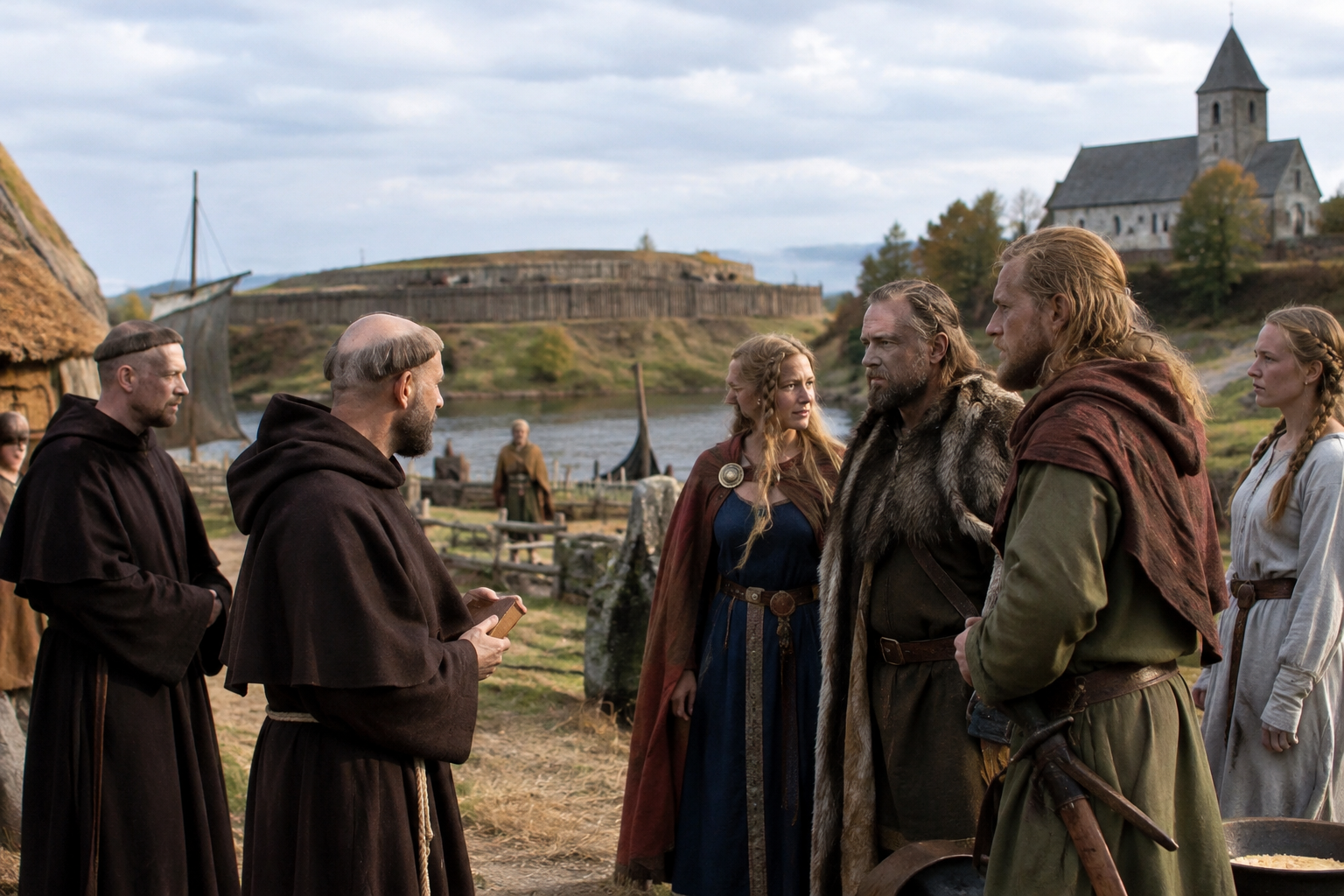
Some Y-chromosome lineages appear in history with a bang: kings, conquerors, famous tombs, the usual parade of banners. Others emerge more quietly, from a Swedish fortified settlement, a Danish cemetery, a friary in medieval England. Haplogroup I1a10a belongs to that second kind of story, and in some ways that makes it more interesting. It is not simply the story of one dynasty or one nation. It is a northern European paternal line glimpsed across centuries in real communities, from late antique Scandinavia to Viking Age towns and finally into medieval England.
As always with Y-DNA, a note of caution matters. A Y-haplogroup traces only one narrow line of ancestry: father to father to father, back through time. It does not describe a person's whole ancestry, culture, language, or identity. Still, paternal lineages can be historically revealing. They help us see where male lines persisted, where they moved, and how the map of human settlement was shaped not just by armies and kings but by families, households, and local communities.
I1a10a is a branch within the wider I1 family, a Y-chromosome lineage long associated with northern Europe, especially Scandinavia. For a subclade this specific, it is important not to lazily borrow the whole history of the broader parent haplogroup and pretend it all belongs neatly to one tiny twig of the tree. What we can say, from the evidence supplied here, is that I1a10a sits firmly in a Scandinavian and North Sea world.
The ancient samples connected with this haplogroup cluster in Sweden and Denmark before appearing later in England. That pattern fits well with the broad historical importance of the Baltic and North Sea as corridors of movement. These waters did not divide people so much as connect them. Traders, raiders, settlers, clerics, mercenaries, and craftspeople moved through them for centuries. A paternal line found in late antique Oland, Viking Age Sigtuna, Jutland, and Trelleborg, and then in medieval England, is exactly the sort of pattern that makes archaeogenetics so useful: it turns old historical generalities into testable, human-scale evidence.
The earliest sample in this small sequence is snb013, from Pre-Vendel Age Oland Sandby Borg Sweden, dated to 475 AD. Sandby Borg is one of those sites that reminds us the past was not tidy. It was a fortified settlement on Oland, and its archaeological fame rests on violence and abrupt catastrophe. A lineage found there places I1a10a in the Scandinavian world before the classic Viking Age began, in a period when the Baltic was already politically tense, regionally connected, and socially stratified.
From there the trail continues into the Viking Age proper. CGG106823, from Viking Age Trelleborg Kingdom of Denmark, dated to 975 AD, carries the story into the age of ring fortresses and royal consolidation. Trelleborg is not merely a Danish place-name; it evokes state formation, military organization, and the tightening grip of kingship in Scandinavia. A paternal lineage present there belongs to a world in which movement across the North Sea was becoming systematic as well as opportunistic.
Then comes CGG100510, from Viking Age Jutland Denmark Vor Frue Kirkegard Aalborg, dated to 1000 AD, and grt060, from Viking Age St. Gertrud Sigtuna Sweden, dated to 1050 AD. These are especially useful because they hint at two different Scandinavian settings: Jutland, looking west and south through Denmark's maritime networks, and Sigtuna, one of early medieval Sweden's key urban and royal centers. Together they suggest that this paternal line was not confined to one isolated district. It moved, or at least persisted, across more than one important Scandinavian region.
None of this proves that every carrier of I1a10a was a Viking in the pop-cultural sense, helmet and all. But it does place the lineage in populations living through the centuries when Scandinavian mobility transformed Britain, Ireland, the North Atlantic, and parts of continental Europe.
The most striking later sample in the set is ATP_PSN_709, from Medieval England Augustinian Friars, dated to 1290 AD. By then, of course, we are far beyond the first Viking raids. England had absorbed centuries of migration, settlement, intermarriage, conquest, and religious change. A Scandinavian-rooted paternal line appearing in medieval England is not surprising; what matters is that we can now point to an actual individual in an identifiable context.
An Augustinian friary is a long way, socially and symbolically, from a Viking fortress. That contrast is the point. Paternal lineages do not carry fixed occupations or identities with them. The same line can pass from men living in fortified Scandinavian communities to men in Christian institutional settings in medieval England. Genetics here helps us see continuity where written history usually prefers dramatic breaks.
It also warns us against simplistic storytelling. A medieval English man with this Y-line is not "really Scandinavian" in some exclusive sense. By 1290 AD, any such lineage could have been in England for generations. What ancient DNA shows is the durability of one paternal branch across different political worlds, not a frozen ethnic label.
This is where the medieval landscape becomes especially evocative. The supplied noble connection is House Barnard, linked with Barnard Castle in County Durham. The castle began as a Norman fortress built around 1095 by Guy de Balliol above the River Tees. Later it passed to the Beauchamp family, and still later to Richard III, through his mother Cecily Neville and the great northern estates. Over time it was rebuilt in stone, stood over a thriving market town, and eventually suffered siege and heavy damage in the Civil War before declining into ruin.
Now, one must be careful here. A historical association between this haplogroup article and House Barnard does not prove that the Barnards, Balliols, Beauchamps, or Nevilles were themselves carriers of I1a10a. Castles are not DNA tests, and noble pedigrees are not the same thing as verified paternal haplogroups. But Barnard Castle gives us something just as valuable: geography and historical setting.
The castle stands in northern England, a region profoundly shaped by the long aftermath of Scandinavian settlement as well as Norman lordship. By the time Barnard Castle was dominating the Tees valley, the north had already experienced centuries of movement around the North Sea. If a paternal lineage such as I1a10a appears in medieval England, this is exactly the sort of region where its deeper context makes sense: a zone of conquest, lordship, trade, and cultural layering rather than a neat ethnic frontier.
There is also a pleasing irony in the sequence. The haplogroup's supplied ancient samples point us to Scandinavian worlds of forts, towns, and burial grounds. Barnard Castle, though Norman in foundation, represents another northern stronghold in another age, presiding over a landscape where older paternal histories had long since been folded into medieval society.
The value of I1a10a is not that it hands us a fairy tale about one heroic ancestor. It does something better. It gives us a plausible chain of context: late antique Sweden at Sandby Borg, Viking Age Denmark at Trelleborg and Aalborg, Viking Age Sweden at Sigtuna, and medieval England in an Augustinian setting. That is a serious historical arc. It suggests persistence of a paternal line within the northern European world linked by the Baltic and North Sea.
It also shows why ancient DNA and traditional history work best together. Archaeology gives us burials, fortifications, settlements, and chronology. Written history gives us castles, noble houses, and political change. Genetics adds another layer, revealing that some paternal lines survived all the noise of history and can still be spotted centuries apart. But survival of a lineage is not proof of direct descent from any particular ancient individual or noble family. It is evidence of connection in the broader, more interesting historical sense: continuity across place, time, and changing identities.
If this part of the medieval north interests you, Barnard Castle's story also sits close to the worlds of other great families in the region, and readers may enjoy the nearby context of the House of Beauchamp and the House of Neville, both of which help flesh out the aristocratic landscape around the castle.
If you carry a northern European paternal line, a haplogroup like I1a10a can open a remarkable historical window, from Scandinavian settlements to medieval England and the world of castles like Barnard. MyTrueAncestry lets you compare your DNA with ancient individuals and past populations, offering clues that can deepen family history without pretending to prove exact descent from a king, friar, or warrior.
Upload your DNA and see whether your results connect you with ancient samples like snb013, CGG106823, CGG100510, grt060, or ATP_PSN_709, and with the wider human story behind them.






Comments