Haplogroup GHIJK

– 5 min read


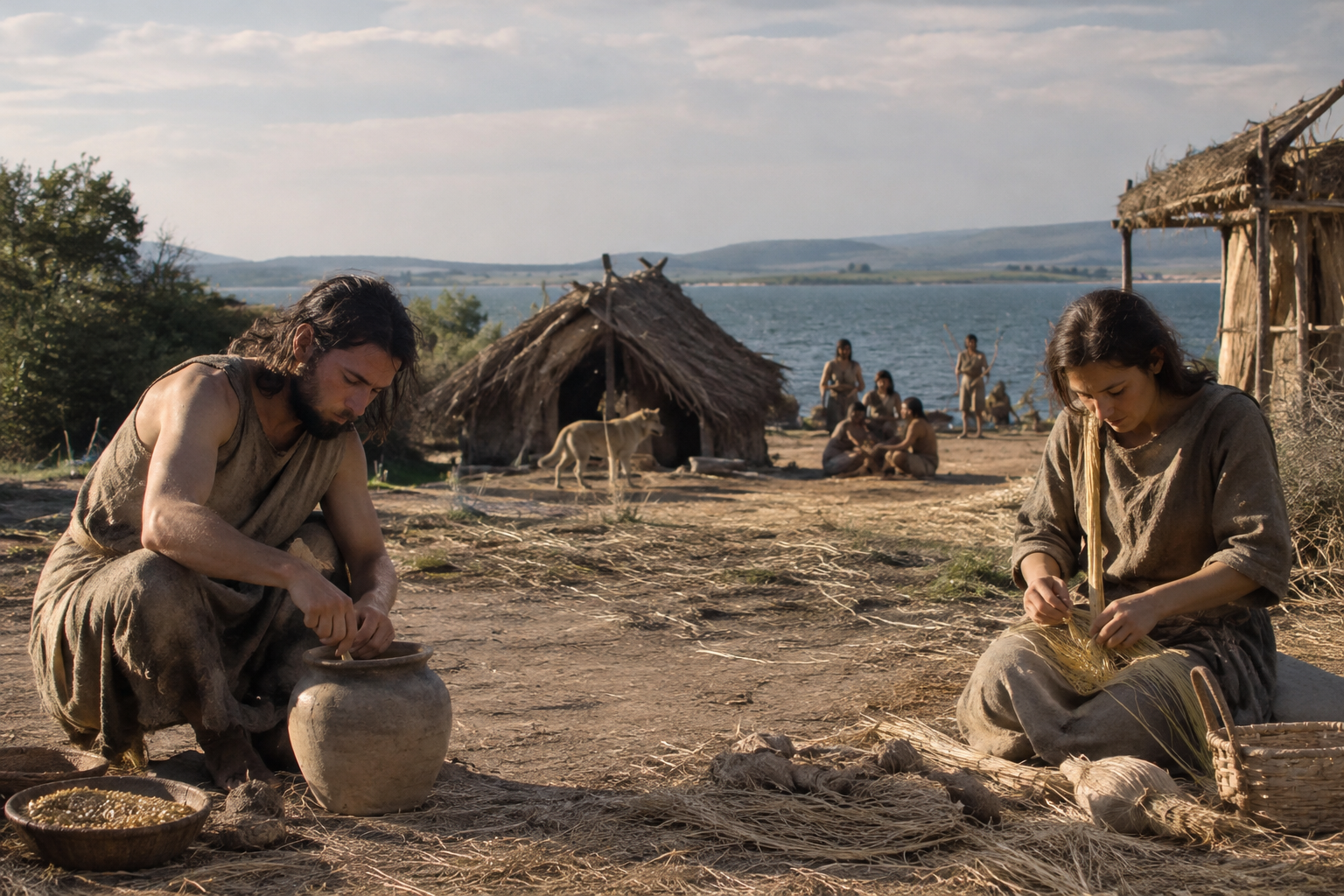
The older of the two ancient men linked here comes from Vasilevka in Ukraine, dated to around 8705 BC and identified as NEO496. That date places him deep in the Mesolithic world of post-Ice Age hunter-gatherers, long before farming reshaped Europe and long before any kingdom, clan, or written people-name could claim him. Yet even in such remote prehistory, a Y-chromosome assignment matters, because it lets us place one direct paternal line inside the enormous branching tree of human male descent: in this case, within haplogroup GHIJK.
That needs saying carefully. GHIJK is not a recent family signature or a neat ethnic label. It is a very broad ancestral trunk in the Y-chromosome tree, far older than almost any historical identity a reader might recognise. Still, broad trunks are exactly what make some ancient samples so interesting. They show how far back the paternal record can stretch, and how archaeologists and geneticists sometimes catch only a high-level branch rather than a later, more familiar subclade.
Vasilevka sits in the wider North Pontic zone, the great grassland-and-river interface north of the Black Sea. For prehistorians, this region is not just a corridor on a map. It was one of the important meeting grounds of postglacial Eurasia, where hunter-gatherer groups adapted to changing coastlines, river systems, and animal resources after the last Ice Age.
Sample NEO496, dated to around 8705 BC, belongs to that very early horizon. At this distance in time, the striking thing is not that we can pin down a modern-style lineage identity, but that a male line can be placed at all in so ancient an individual. A Y-DNA result at the level of GHIJK tells us that the paternal signal survives, but only at a broad level. That is a reminder of how ancient-DNA evidence often works in the earliest periods: it gives us a real placement, but not always a fine-grained one.
The larger archaeological importance of the region has become clearer through recent ancient-DNA work on the North Pontic area, where researchers have been tracing population structure and change across the long stretch from foragers to early farming communities. A broad study of these populations can be found in research on genomic ancestry and migrations in the North Pontic region, which helps situate finds like Vasilevka within a much wider prehistoric landscape.
For anyone carrying a much later downstream branch, this sort of sample is not a neat genealogical ancestor in the family-tree sense. Rather, it is evidence that the deep paternal stock from which later branches emerged was already present among very early communities north of the Black Sea. That is a different, and in some ways more profound, historical point.
There is a temptation, when reading Y-DNA results, to focus only on the most terminal branch: the smallest, latest, most genealogically marketable label. But archaeology often works with rougher edges. Some ancient male samples preserve enough Y-chromosome information for a broad placement but not enough for a modern-looking fine resolution. That does not make them unimportant.
With haplogroup GHIJK, we are looking at one of the major ancestral divisions from which many later Eurasian and global paternal lineages ultimately derive. In practical terms, that means an ancient assignment to GHIJK does not tell us that two men belonged to the same recent paternal clan. What it can do is mark the presence of a very ancient paternal framework in a given place and period.
This is especially relevant in articles like this one, because the two listed samples are separated by more than five millennia and come from different archaeological settings. Their value lies less in proving direct continuity from one man to the other than in showing how the surviving record can catch extremely old Y-chromosome structure across very different worlds.
The second individual, IKI032, comes from Ikiztepe in Black Sea Anatolia and is dated to around 3300 BC. By then, the human world had changed dramatically. We are no longer in the mobile forager landscapes of the early Holocene. Fourth-millennium BC Anatolia was a patchwork of settled communities, regional exchange networks, and growing social complexity.
Ikiztepe is an important site precisely because it sits in the Black Sea zone of Anatolia rather than in the more often discussed heartlands of central or western Anatolian prehistory. That matters. The Black Sea coast was not an isolated fringe; it was a connected region, tied into wider movements of people and materials while still keeping its own local archaeological character.
Sample IKI032 is reported here under the article haplogroup GHIJK. As with the Vasilevka man, the careful reading is that we are dealing with a broad paternal placement unless a narrower subclade is explicitly demonstrated. That broadness is not a weakness so much as a clue to the scale of the branch involved. It tells us that the paternal history reaching into Black Sea Anatolia was part of a much deeper human inheritance than later historical labels would suggest.
An ancient DNA study examining populations from Anatolia and surrounding regions in deep time is available at this research on the genetic history of ancient Anatolian and nearby populations. Even where a paper is broader than one site, such work helps frame Ikiztepe as part of a long regional story rather than a lonely dot on the map.
Placed side by side, NEO496 and IKI032 are intriguing because they sit on opposite shores of a larger Black Sea world. One is from the Mesolithic north of the sea, the other from later Anatolia to the south. That invites, quite naturally, thoughts of corridors, contacts, and long-term population history around the Pontic zone.
But one must not over-polish the evidence. A shared assignment at the level of GHIJK does not mean these two men belonged to a recent common lineage in any historically useful sense. GHIJK is too old and too broad for that. What the pairing does show is that this ancient paternal framework appears in very different settings across the wider Black Sea sphere, from early forager Ukraine to a later settled Anatolian context.
That pattern fits a broader truth about prehistoric Eurasia: the regions around the Black Sea were repeatedly shaped by movement, contact, and local survival. Some of those movements were dramatic; many were slow and cumulative. Ancient DNA is powerful here not because it hands us a simple migration arrow, but because it lets us compare paternal traces across landscapes that archaeology already knew were deeply connected.
If your own result points to GHIJK, the first useful thing to understand is scale. This is an ancient upper branch, not a tidy recent surname cluster. Y-DNA traces one direct paternal line only, and in this case the label reaches far back into prehistory. That makes it less specific in genealogical terms, but very revealing in evolutionary and archaeological ones.
The two ancient men here show that such a broad paternal branch can appear in very early postglacial Europe and in later prehistoric Anatolia. They do not prove a single uninterrupted local dynasty, nor do they identify an ethnicity. What they offer is something subtler: evidence that the deep paternal background behind many later lineages was already spread across important prehistoric worlds around the Black Sea.
For MyTrueAncestry readers, that is perhaps the most interesting lesson. Some haplogroups connect you not to one famous house or one neatly bounded people, but to a level of ancestry older than either - older than farming in one case, older than written history in both. GHIJK belongs to that deep layer of the human past, where archaeology and genetics meet at their most elemental.
The value of haplogroup GHIJK in ancient DNA is not that it names a recent tribe or a medieval pedigree. Its value is that it anchors a paternal line in very deep time. From Vasilevka in Mesolithic Ukraine to Ikiztepe in 4th-millennium BC Anatolia, the evidence points to an old and widely distributed paternal background in the wider Black Sea world. For anyone exploring this branch today, the story is less about prestige and more about antiquity: a direct male line that disappears into the earliest recoverable chapters of Eurasian prehistory.






Comments