Haplogroup G2a3

– 5 min read


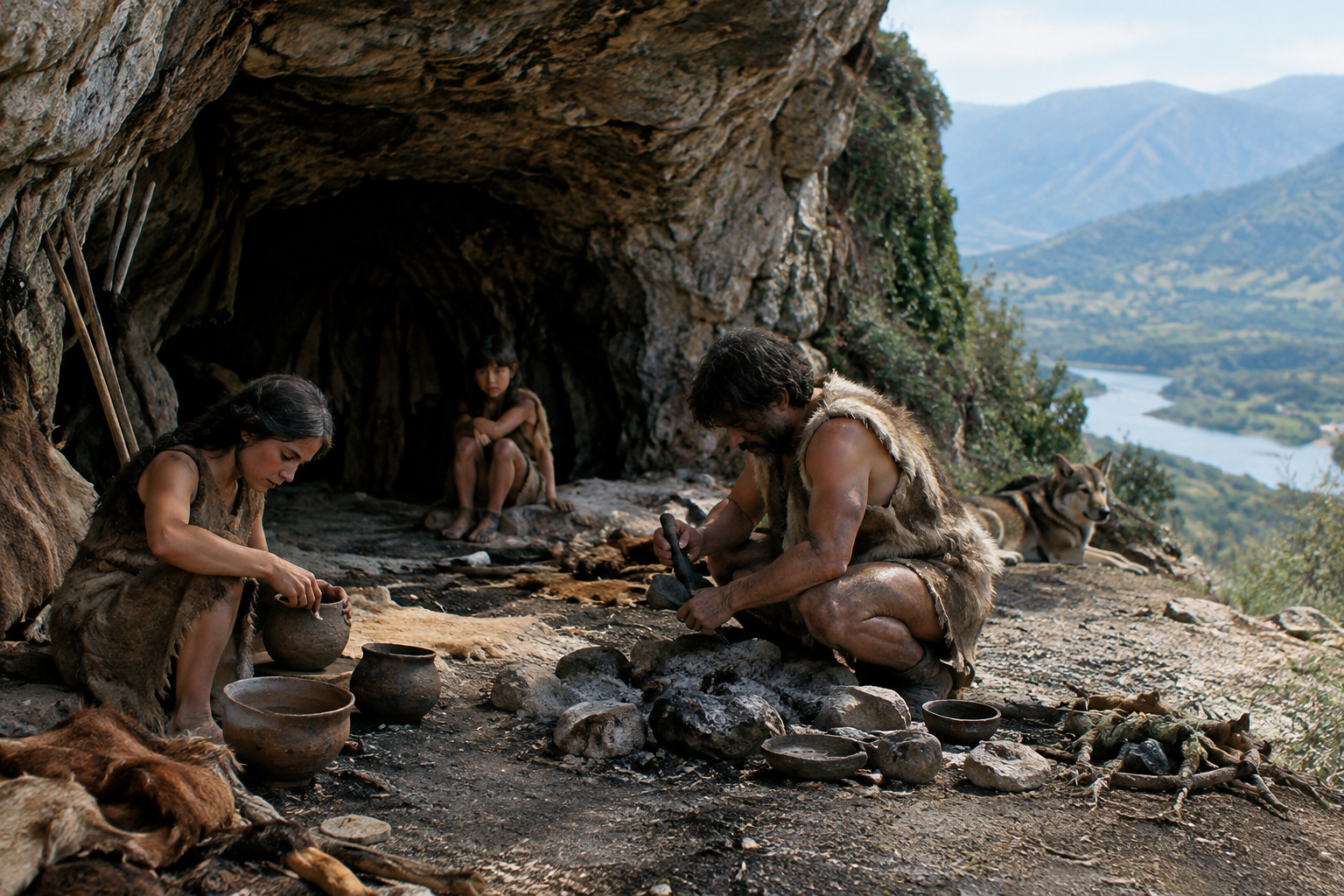
At Grottina dei Covoloni del Broion, a cave site in northern Italy, one Copper Age man labeled BRC001 offers a small but very telling clue about the deep history of Y-DNA haplogroup G2a3. His date, around 2934 BC, places him in a world of early farming communities, cave use, and local traditions that belonged neither to the first pioneers of the Neolithic nor yet to the fully transformed societies of the Bronze Age. That matters, because G2a3 sits inside a wider Y-chromosome family, G2a, long associated with the spread of early farmers into Europe.
One ancient man does not stand for all of Copper Age Italy, of course. Y-DNA traces only a direct paternal line, not a person's whole ancestry. But BRC001 is still valuable because he anchors G2a3 in a real archaeological landscape: late prehistoric northern Italy, where caves, farming, mobility, and population change all met in complicated ways.
The site name matters here. Grottina dei Covoloni del Broion is not a grand palace or an imperial cemetery, but a cave context in Italy, and that is precisely why it is interesting. Caves in later prehistory were often more than mere shelters. They could be reused over long spans of time and sometimes formed part of funerary or ritual landscapes, which means an individual from such a place can open a window onto local cultural practice as well as ancestry.
For BRC001, the key point is the reported association with haplogroup G2a3. In broad terms, this places his paternal line within one of the best-known early European farming haplogroups. Across much of Neolithic Europe, branches of G2a appear frequently in ancient DNA, especially among populations descended largely from the first agriculturalists who moved westward from Anatolia through the Balkans and into the Mediterranean and central Europe. By the Copper Age, however, the picture had already become more mixed. Some regions preserved substantial continuity from earlier farming populations; others show stronger signals of new incoming ancestry and changing male lineages.
An ancient DNA study of prehistoric Italy and surrounding regions, published in Current Biology, helped clarify just how dynamic these later prehistoric populations could be. Even without forcing BRC001 into a larger story than the evidence allows, his lineage fits an important pattern: some paternal lines rooted in Europe's early farming horizon were still present in Italy well into the 3rd millennium BC.
It is worth being careful with the label. G2a3 is not the same thing as all of haplogroup G, nor even all of G2a. The wider parent lineage has a long and complicated history stretching across western Eurasia, with particularly strong importance in early European farming populations. The narrower branch in this article is one part of that bigger family tree.
That distinction sounds technical, but it matters historically. It would be easy, and wrong, to say that every man with G2a3 must descend from the very first farmers in exactly the same way, or that this branch marks a single people, language, or culture. Archaeology does not work like that, and neither does genetics. What the evidence does suggest is more modest and more interesting: some paternal lines connected to the older Neolithic world remained in use through later periods, even as populations changed around them.
In other words, G2a3 is best approached as a surviving thread rather than a complete historical identity. A branch like this can persist through many cultural shifts. A man buried in Copper Age Italy may carry a paternal line with deeper Neolithic roots while living in a society already transformed by new technologies, exchange networks, and regional mixture.
To understand why BRC001 matters, we need the setting. Northern Italy in the later 4th and 3rd millennia BC was not isolated. It was a contact zone between the Italian peninsula, the Alpine world, and the wider networks of Copper Age Europe. Farming had long since taken hold, but communities were still changing: socially, materially, and genetically.
This is one reason Italian prehistoric DNA is so useful. Italy often preserves traces of continuity that can be harder to see elsewhere, while also showing the impact of broader continental developments. Some regions held onto lineages associated with earlier farmer populations longer than one might expect if one imagined prehistory as a clean sequence of replacements. BRC001's G2a3 signal belongs in that slower, messier story.
And there is something properly archaeological about this. We are not dealing with an abstract migration arrow on a map, but with a person from a cave site, at a specific time, in a region where old and new patterns overlapped. The paternal line survives, but the world around it is already changing.
Haplogroup G2a has become almost emblematic in archaeogenetics for Europe's early farmers. It turns up repeatedly in Neolithic contexts from the Balkans westward, which is why later survivals are so intriguing. They remind us that paternal history is not simply erased each time a new ancestry component appears in the genome-wide record.
Italy is especially revealing because it sits between Mediterranean and continental routes. The first farmers reached the peninsula early, and later prehistoric Italy remained regionally diverse. Some communities may have preserved local paternal continuity even while absorbing ancestry from neighboring populations. Others may have seen stronger turnover. The presence of G2a3 in a Copper Age Italian individual suggests that at least some of these older male lines endured well after the first Neolithic expansion.
That does not make G2a3 uniquely Italian, nor does it mean every modern bearer of G2a3 has a specifically Copper Age Italian paternal origin. But it does show that northern Italy was one of the places where this branch, or a reported association with it, was present in the later prehistoric record.
There is also a methodological point hiding in this single sample. Ancient DNA is often most powerful when combined with the texture of archaeology: not just dates and haplogroups, but site type, landscape, and local practice. A cave burial or cave-associated human remain is not interchangeable with a cemetery grave on an open plain. The setting shapes the questions we ask.
In this case, the cave context at Grottina dei Covoloni del Broion places G2a3 within a very old Mediterranean and Alpine habit of using caves as meaningful places. That does not tell us BRC001's social rank, kin group, or precise role in his community; the evidence supplied here is too limited for that. But it does prevent the lineage from floating free of history. He was not merely a data point. He belonged to a real community making local choices about where the dead were placed and remembered.
If your paternal line falls under G2a3, BRC001 offers a plausible ancient echo rather than a neat personal pedigree. The most defensible takeaway is that this branch belongs to a wider paternal tradition deeply involved in Europe's farming past, and that one reported example appears in Copper Age northern Italy around 2934 BC. That is already quite a lot: not a legend, not a dynasty, but a documented human presence in a recognizably prehistoric Italian setting.
For family historians, that means G2a3 may point toward very old connections with the Neolithic and post-Neolithic populations of Europe, especially in regions where early farming lineages persisted. The strength of the evidence lies in its modesty. One cave, one man, one paternal line - and from that, a glimpse of how ancient continuity can survive inside a changing world.






Comments