Haplogroup G2a2b2b1a1
– 5 min read


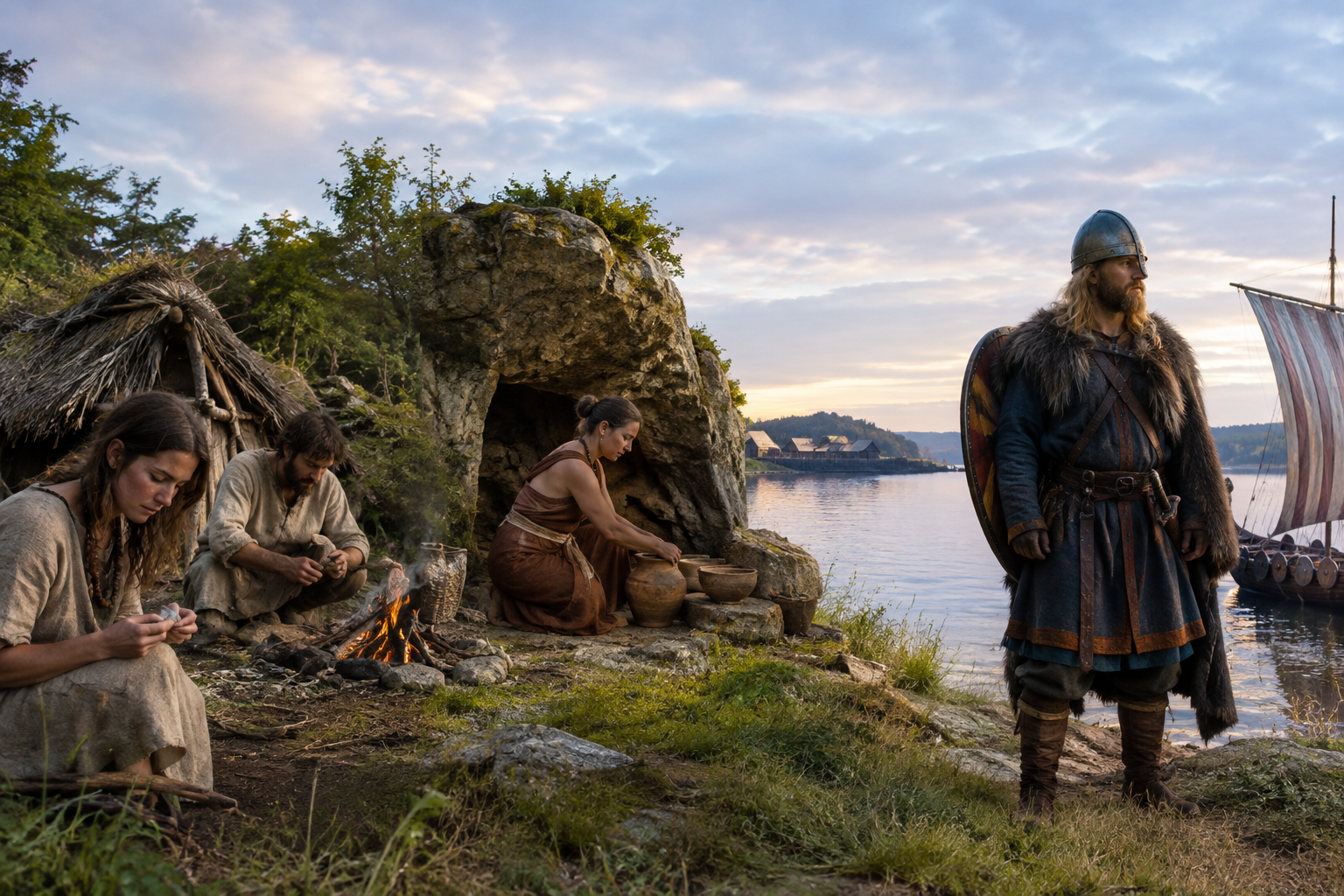
In Viking Age Sigtuna, one of Sweden's earliest towns, a man dated to around AD 955 appears in the ancient DNA record as sample grt035. That is already an arresting setting: Sigtuna was not an isolated farmstead but a place of minting, trade, Christianity, political theatre, and movement across the Baltic world. The reported appearance here of Y-DNA haplogroup G2a2b2b1a1 matters because it places this paternal line in a very recognisable urban Scandinavian context, far removed in time and culture from the early farming worlds where G lineages are so often discussed.
Yet the interesting part is not that one Viking Age man carried this lineage. It is that the same branch is also reported in much earlier individuals from Copper Age Italy and late Neolithic France. Taken together, these finds suggest that G2a2b2b1a1 belongs to one of those paternal histories that do not stay neatly inside a single people, kingdom, or language. It is a Y-chromosome line, tracing only one direct paternal thread, but that single thread can still illuminate a remarkably long archaeological span.
Sigtuna is a superb place to begin because it belongs to a period when Scandinavian towns were becoming denser, more connected, and more politically charged. A man such as grt035, dated to about AD 955, lived in a world of exchange routes linking Lake Malaren to the Baltic, eastern trade networks, and the wider Viking sphere. A paternal lineage found here does not tell us his language, occupation, or complete ancestry, but it does anchor G2a2b2b1a1 in a historically vivid milieu.
That is worth pausing over. Popular imagination often treats Viking Age Scandinavia as if it were genetically simple and overwhelmingly homogeneous. Ancient DNA keeps spoiling that tidy picture. Urban and proto-urban places especially could gather lineages with deeper roots elsewhere in Europe, whether through long-term local continuity, migration, marriage, slavery, trade, or generations of earlier mobility. A broad genomic study of the Viking world helped underline just how varied these populations could be across regions and sites, even when they shared a recognisable Norse cultural horizon in major ancient DNA research on the Viking Age.
So the Sigtuna evidence does not make G2a2b2b1a1 a "Viking haplogroup" in any exclusive sense. What it does show is that this paternal branch was present in a Scandinavian town at the very moment when royal authority, trade, and Christianisation were reshaping the north.
Much earlier evidence comes from northern Italy, where sample BRC013 is reported from Grottina dei Covoloni del Broion and dated to around 3000 BC. Now we are in a completely different world: not towns with coinage and kings, but late prehistoric communities living in the long aftermath of the first farming expansions into Europe.
The cave context matters in itself. Caves in later prehistory were not simply empty holes in the landscape; they could become places of burial, storage, ritual attention, and repeated visitation. Even without inventing details about one specific interment, the site name tells us we are dealing with a setting that belongs to that intimate, layered archaeology so typical of parts of Copper Age Europe.
For haplogroup G lineages more broadly, this is the sort of time depth that feels archaeologically plausible. G2a and its descendant branches are strongly associated in ancient DNA with many of Europe's early farming populations, especially those whose ancestry ultimately derived from Anatolian and southeastern European Neolithic expansions. That does not mean every later G subclade can be mapped neatly onto one migration event. But a Copper Age Italian occurrence like BRC013 fits the larger pattern of long persistence and local survival of G paternal lines well after farming had become established.
The third key sample, PEI2, comes from Villedubert in France and is dated to around 2780 BC. This places G2a2b2b1a1, or at least a reported association with this branch, in late Neolithic western Europe. If the Italian sample hints at continuity within a long-established farming zone, the French sample shows that this paternal line was not confined to the Italian peninsula.
France in the later Neolithic was a patchwork of regional traditions, burial practices, and changing community structures. Ancient DNA studies there have repeatedly shown that the story was not one of simple replacement or one-way movement. Farmer ancestry, lingering forager ancestry, and local demographic shifts all interacted in different ways from region to region. A study focused on Neolithic population change in France has shown just how dynamic these communities could be in research on Neolithic population turnover in the Paris Basin.
That broader context helps make sense of why a lineage like G2a2b2b1a1 can turn up in western Europe before the Bronze Age and then appear again, much later, in medieval Scandinavia. The paternal line did not need to remain numerous everywhere to remain historically consequential. It only needed sons, and then more sons, across many centuries of social change.
With a label as specific as G2a2b2b1a1, caution is essential. The wider haplogroup G2a has a substantial ancient European record, especially among early farmers, but that does not license us to assign every fine-grained descendant branch the same exact birthplace, date, or route. The supplied ancient samples show reported occurrences in France, Italy, and Sweden across a span of nearly four millennia. That is strong evidence for longevity and geographical spread, not for a single tidy migration map.
It is also important not to confuse archaeological identity with paternal descent. The man from Sigtuna participated in a Viking Age urban society; BRC013 belonged to Copper Age Italy; PEI2 belonged to a late Neolithic French setting. Sharing a paternal branch across those cases does not erase the enormous differences in language, belief, diet, technology, and political life between them. What the Y-chromosome records is narrower and, in its own way, more stubborn: one male line surviving through repeated cultural transformations.
If there is one part of this small sample set that deserves emphasis, it is the jump from Neolithic and Copper Age contexts into Viking Age Scandinavia. That is not because such movement must reflect one dramatic migration from the Mediterranean northward. Quite the opposite: the long gap warns against simplistic storytelling. The Scandinavian occurrence may represent local survival of an old European lineage, mobility during the Bronze or Iron Ages, movement within the Roman and post-Roman world, or more than one episode altogether.
But archaeologically, it is a splendid reminder that medieval northern Europe was built upon very old population layers. By the 10th century, men in towns like Sigtuna carried paternal histories older than the town, older than the kingdom, older than the Viking Age itself. A branch linked in the public imagination to early European farmers could still be present in a society of traders, missionaries, craftsmen, and warriors on the threshold of the Scandinavian Middle Ages.
For someone exploring haplogroup G2a2b2b1a1 today, the most responsible conclusion is also the most interesting one: this is a paternal line with documented ancient appearances in late prehistoric western Europe and in Viking Age Sweden. That does not promise descent from any named ruler or one famous migrating tribe. It does suggest that your direct paternal line may belong to a very old European story, one that began appearing in farming societies long before written history and continued, quietly but successfully, into the medieval north.
Comments