Haplogroup G2a2b2a1a1b1a1a2a1a1b2
– 5 min read


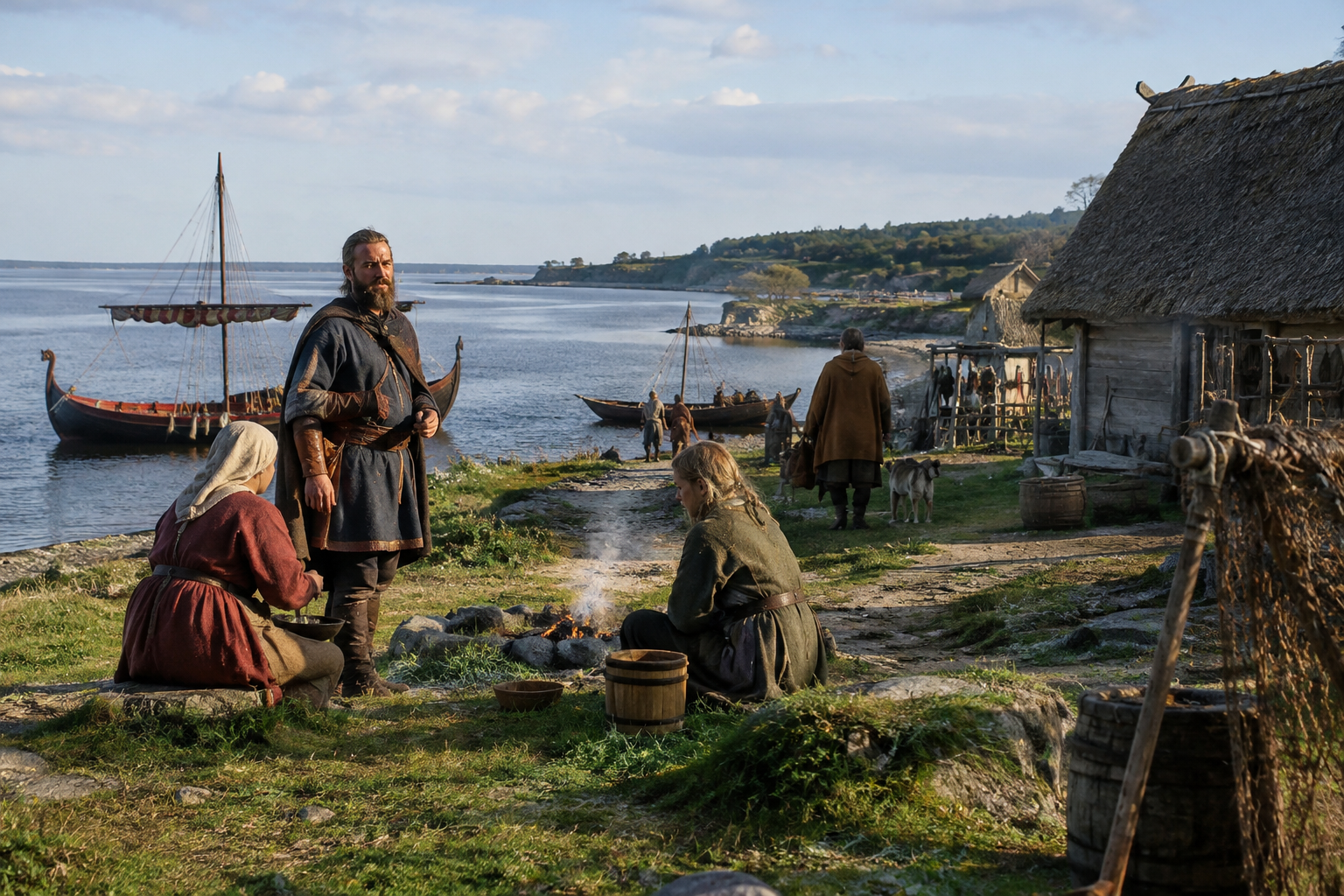
At Kopparsvik on Gotland, one Viking Age burial has given this very specific Y-chromosome branch a firm archaeological foothold. The individual known as VK479, dated to around AD 975, links the haplogroup G2a2b2a1a1b1a1a2a1a1b2 to a real person from the late Viking world of the Baltic, not just to a string of letters on a modern test result.
That matters because Gotland was no backwater. It sat in the middle of Baltic exchange, a place of merchants, sailors, craftsmen, and travellers moving between Scandinavia, the eastern Baltic, and river routes leading deep into eastern Europe. When a rare paternal line turns up here in an ancient individual, it tells us less about a single "people" than about how mixed, mobile, and unexpectedly varied Viking Age communities could be.
Kopparsvik, near Visby on Gotland, belongs to a landscape already famous for its long and complicated human past. By the late 10th century AD, when VK479 lived, Gotland had been woven into trade networks that connected the island to Sweden, the wider Norse world, and the commercial circuits of the Baltic and beyond. A paternal lineage found here therefore has to be read in a maritime context: movement was normal, and ancestry could arrive by many routes.
For that reason, the value of VK479 is not that he can be turned into a mascot for all Vikings. Quite the opposite. He shows that even within a recognisably Viking Age Scandinavian setting, paternal ancestry could be quite diverse. Y-DNA traces one direct male line only; it does not define a person's whole ancestry, language, or identity. But it can illuminate one thread in the much denser fabric of the past.
This exact branch, G2a2b2a1a1b1a1a2a1a1b2, is an extremely narrow terminal lineage within the much broader haplogroup G. That broader family has deep importance in Eurasian prehistory, especially in discussions of early farming populations, the Caucasus, and parts of Neolithic Europe. But one must be careful here: the long terminal branch seen in a Viking Age sample is not identical to the whole ancient story of haplogroup G.
In practice, what VK479 gives us is a late historical appearance of a branch nested inside that older paternal family. The broad parent haplogroup has a long prehistoric career, but this exact subclade should not be casually projected backward into every Neolithic or Bronze Age case of G. Ancient DNA often forces that sort of discipline on us. It insists that lineages survive, split, contract, and reappear in places where older historical stereotypes would not necessarily expect them.
A genetic study of Viking Age populations, available as research on ancient Scandinavian and Baltic-era genomes, helped establish just how heterogeneous these communities could be. Even without turning every sample into a life story, the cumulative effect is clear: the Viking world was connected enough to contain lineages with quite different deeper histories.
People often imagine Viking Age Scandinavia in blunt ethnic blocks, as though the entire region were genetically uniform and neatly bounded. Archaeology has been challenging that picture for years, and ancient DNA has made the challenge sharper. Islands like Gotland were hubs. Goods, styles, and probably people moved through them constantly. In that setting, a lineage such as G2a2b2a1a1b1a1a2a1a1b2 is not an anomaly to be explained away but part of the evidence for a complicated human landscape.
That does not mean we can identify VK479 as an immigrant, a merchant from a named distant land, or the descendant of a particular earlier population. The evidence supplied here does not support that sort of precision. What it does support is a more modest and more interesting point: by about AD 975, this paternal branch was present on Gotland in a society tied to far-reaching Baltic and Scandinavian networks.
Gotland is especially good at revealing such complexity because the island has produced genetic evidence from very different periods. Those earlier and later datasets show that the island was not frozen in one ancestral state. It changed repeatedly, while still preserving local continuities in some lines and importing novelty in others.
There is a further twist here. Gotland already occupies an important place in discussions of prehistoric population change, especially in the interplay between foragers, early farmers, and later communities around the Baltic. Several MyTrueAncestry pieces on the island's earlier DNA record underline how much demographic layering occurred there long before the Viking Age. That broader backdrop makes a late Viking G-lineage all the more suggestive, because it fits an island with a long habit of absorbing, reshaping, and transmitting ancestry.
Still, one should resist the temptation to draw a straight line from a Neolithic G-bearing farmer somewhere in Europe to VK479 in AD 975. That would be more tidy than truthful. Thousands of years separate those worlds. Branches divide, local male lines disappear, and other lines rise by chance, kin structure, and historical circumstance. The right lesson is not uninterrupted sameness, but long-term survival of some paternal families through many cultural transformations.
The wider Scandinavian picture also supports caution. Viking Age communities included people with varied ancestries and biographies. Some were locally rooted; some or their recent forebears were mobile. Some lineages that look unusual today may have been unremarkable in particular harbour towns, trading settlements, or islands then.
Because VK479 lived in a Norse-speaking environment, it is tempting to equate his paternal line with language. But language and Y-DNA are not the same thing. A man carrying G2a2b2a1a1b1a1a2a1a1b2 on Gotland could have spoken the language of his community regardless of where that paternal branch had been centuries earlier. Historical languages often spread through social dominance, trade, and cultural prestige rather than by one male lineage alone.
That is why the best use of this sample is not to claim that haplogroup G "was Viking" in some essential sense. The useful claim is narrower: this branch was present in a Viking Age setting on Gotland, within a society participating in the wider Scandinavian world. For readers interested in how genetics and language spread can overlap without being identical, that is exactly the sort of case that keeps archaeogenetics honest.
Germanic Languages and Genomics
If your paternal ancestry falls under G2a2b2a1a1b1a1a2a1a1b2, VK479 offers one clear and grounded historical glimpse: a bearer of this branch was living on Viking Age Gotland around AD 975, in one of the Baltic's most connected societies. That does not prove descent from this individual, nor does it reduce your ancestry to a single island or culture. But it does place your line, at least in one documented case, inside the busy human traffic of the late Viking Baltic - where Scandinavian life was shaped as much by contact and exchange as by isolation.






Comments