Haplogroup G2a2b2a1a1b

– 7 min read


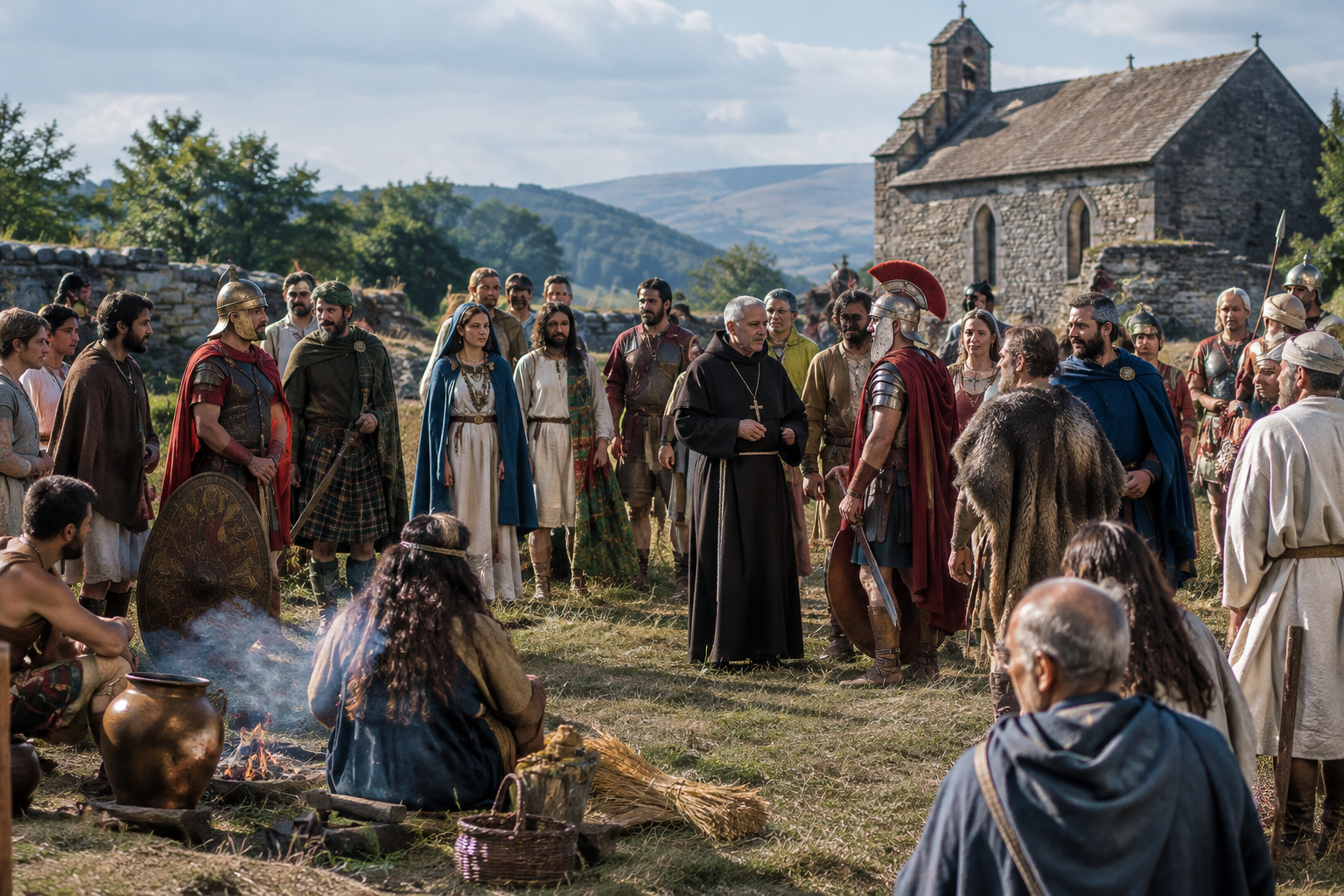
Some Y-DNA haplogroups announce themselves with a flourish: they turn up in famous royal tombs, or in one tightly defined region, or under the label of one well-known archaeological culture. G2a2b2a1a1b is more intriguing than that. It appears, from the evidence supplied here, in a broad sweep of European and Mediterranean contexts: Copper Age Alpine communities, Iron Age Celtic elites, Roman and post-Roman burials, early medieval England, and even a soldier from Napoleon's Grand Armee. That is precisely what makes it historically interesting. It is not the story of one people, but of a paternal line moving through many worlds.
As ever with Y-DNA, a note of caution is essential. A Y-haplogroup tracks only one narrow line of ancestry: your father's father's father, and so on. It does not describe your whole ancestry, your culture, your language, or your identity. Nor does the appearance of the same haplogroup in two people prove close kinship. But when ancient DNA places related paternal branches across centuries and landscapes, it gives us something wonderfully concrete: a way of following one thread through the tangled business of European history.
G2a is widely known in ancient DNA research as one of the important paternal lineages found among early farming populations in Europe. For a more specific branch such as G2a2b2a1a1b, however, we must be careful not to dump the whole history of broad G2a straight onto this narrower subclade. What we can say from the supplied evidence is that branches of this lineage were present very early in continental Europe and remained visible over an impressively long timespan.
Some of the earliest clues come from Neolithic and Copper Age contexts. The Late Neolithic Brienzersee Switzerland sample SX11, dated to 4410 BC, and Neolithic France sample GRG052, dated to 3500 BC, suggest that related paternal lines were already established west of the Alps in deep prehistory. Then the Alpine zone begins to look especially important. Copper Age and Bronze Age northern Italian sites supply a remarkable run of individuals: South Tyrol Ora/Auer 3058_13_115_1 from 2700 BC, Trento Romagnano samples ROM308 and ROM309 from 2488 BC, Paludei di Volanoo PAL01 from 2148 BC, Nogarole NOG201 from 2182 BC and NOG302 from 1705 BC, and later NOG301 from 1481 BC. This is not proof of one unbroken dynasty of fathers and sons, of course. But it does point to a long-lived paternal presence in the Alpine world.
That matters because the Alps were never an isolated backwater. They were corridors: for herders, metalworkers, traders, migrants, and later armies. A lineage that persisted there could radiate north into central Europe, south into Italy, and west toward France and Iberia.
If the Alpine evidence gives us depth, the Iron Age gives us drama. Several of the most striking samples belong to high-status Celtic settings in what is now southern Germany. MBG016 comes from the Elite Celtic Burial at Magdalenenberg, Villingen-Schweningen, dated to 530 BC. HOC003 and HOC003b come from Elite Celtic burials at Eberdingen-Hochdorf Biegel, dated to 515 BC. These are not anonymous scraps from the margins. They come from the world of princely burials, feasting elites, and the politically charged landscape of early Celtic Europe.
And the pattern does not stop there. Related samples appear across an Iron Age map that stretches from France to Bohemia to Hungary to Britain: BUCH48-1 from a Gallic context at Bucheres in France, WET429 from Wettolsheim in Alsace, ERS83-2 among the Nemetes in Erstein Alsace, I17314 from an Iron Age warrior in Prague, I25508 from Vas County in Hungary, I18181 and I18526 from Iron Age Celtic Hungary, I20588 from Oxfordshire, I19587 from North Yorkshire, and I12772 from Harlyn Bay in Cornwall.
One should not make the elementary mistake of saying "this was the Celtic haplogroup." Iron Age Celtic-speaking societies were genetically varied, as ancient DNA repeatedly shows. But the recurrence of this paternal line in elite burials and broad Iron Age networks does suggest that branches of G2a2b2a1a1b, or closely related upstream lines, were woven into the communities that linked central Europe with Gaul and Britain. That fits a world of mobility rather than ethnic purity: aristocratic exchange, warrior movement, trade routes, and regional continuity mixed together.
Then the map widens again. In Italy, the lineage appears in Etruscan and pre-Roman contexts such as R10363 from Villanovan-period Tarquinii, dated to 750 BC, TAQ006 from Etruscan Tarquinii, dated to 400 BC, and CAM003 from Iron Age Campiglia dei Foci in Siena, dated to 655 BC. Sicily adds another pair: I17432, an ancient citizen of the Greek colony at Himera from 550 BC, and I7219, an Ancient Greek warrior from the First Sicilian War, dated to 480 BC. There is also the Carthaginian sample I24208 from Kerkouane Tunisia Pantelleria, dated to 470 BC, and the Bronze Age Spain sample CDM002 from Camino del Molino Murcia Caravaca, dated to 2460 BC.
What does this mean? Not that one branch belonged neatly to Greeks, Etruscans, Carthaginians, or Iberians. Rather, it shows that the paternal line was present in the Mediterranean's mixed human traffic. Colonies, ports, war, commerce, and intermarriage all created opportunities for such lineages to move and persist in very different cultural settings.
The Roman and late Roman samples make that point even more firmly. BBC004 and BBC034 from Imperial Roman Croatia Karlovac Pannonia Savia, both dated to 275 AD, I33890 from Late Imperial Roman Croatia Hvar Radosevic Palace, dated to 400 AD, and R3685 from Late Roman Era Velic in Croatia, dated to 442 AD, place this paternal heritage inside provinces tied together by roads, military service, taxation, and migration. R11552 and R11560 from the Marxberg Necropolis at Sarrebourg in France, dated to 400 AD and 413 AD, show similar continuity in frontier regions where "Roman" and "barbarian" are far blurrier categories than older history books liked to admit.
Read Roman Hispania's DNA Legacy
One of the pleasures of this haplogroup is that it does not vanish with Rome. It carries on into the unsettled centuries that followed. OBM011 from the Thuringii tribe in German Obermoellern, dated to 500 AD, Bal_149 from post-Roman Pannonia at Balatonszemes, dated to 475 AD, and 2427 from Dark Ages Italy South Tyrol Malles Burgusio Santo Stefano, dated to 450 AD, all suggest that related paternal lines survived the political collapse and rearrangement of late antiquity.
In England, BMN016 from Anglo Saxon early medieval Norfolk Barnham Market, dated to 600 AD, and ATP_PSN_502 from Medieval England Augustinian Friars, dated to 1226 AD, show the lineage in very different social worlds: one in the age of early kingdoms and migration-era settlement, the other in a fully Christian medieval landscape of towns, churches, and religious orders. Further north, KPN011 from post-Viking era St Clemen in Zealand, dated to 1100 AD, and VK39 from Viking Age Skara Varnhem Sweden, dated to 1050 AD, add Scandinavian evidence. Even YYY085B, a soldier of Napoleon's Grande Armee from the Vilnius mass grave dated to 1812 AD, reminds us that paternal lineages do not stop at the Middle Ages; they roll onward into modern history.
This is exactly where genetics and written history complement one another. A genealogy may run for a few centuries if you are lucky, and for longer only among the grandest families. Ancient DNA, by contrast, shows that paternal branches can persist through entirely different political orders: tribal confederacies, Roman provinces, monastic communities, royal states, and modern armies.
The noble associations supplied for this haplogroup belong not to prehistory but to the carefully staged world of monarchy. In England, Hampton Court Palace stands as one of the great theatres of royal memory. Begun in the early 1500s by Cardinal Thomas Wolsey and surrendered to Henry VIII in 1528, it became a setting for Tudor ceremony, feasting, household politics, and dynastic anxiety. Later, William III and Mary II refashioned much of it in Baroque style through Christopher Wren. Hampton Court is useful here not as genetic proof of anything, but as a reminder that later ruling houses built monuments that made lineage visible and unforgettable.
Something similar is true of El Escorial near Madrid, the vast monastery-palace begun by Philip II in the 1560s. It was royal residence, library, monastery, political center, and mausoleum: a building designed to embody Habsburg power, piety, and imperial order. If Hampton Court is dynastic theatre on the Thames, El Escorial is dynastic geometry in stone.
We should be careful. The association of a noble house with this haplogroup does not prove that every branch of English royalty or every Spanish Habsburg carried G2a2b2a1a1b. Nor do these palaces provide genetic evidence in themselves. But they do preserve the later historical landscapes in which paternal descent mattered intensely: inheritance, succession, legitimacy, burial, and memory. In that sense, they are the architectural cousins of the ancient burial mound and princely grave.
Read About the House of Habsburg
G2a2b2a1a1b is a fine example of why haplogroup history is so absorbing when handled carefully. The evidence here suggests a paternal line with deep roots in prehistoric Europe, especially visible in Alpine and central European contexts, later turning up in Iron Age Celtic elites, Mediterranean societies, Roman provincial populations, post-Roman communities, medieval England and Scandinavia, and even early modern warfare. That is not a tale of one tribe marching intact across millennia. It is something more historically real: survival, adaptation, movement, and mixture.
For MyTrueAncestry users, that is the excitement. A haplogroup does not hand you a ready-made identity card from the past. What it offers is a historically grounded clue. If your paternal line falls near G2a2b2a1a1b, you may be looking at connections to some of the same broad worlds seen in samples like MBG016, HOC003, 3058_13_115_1, TAQ006, BMN016, or ATP_PSN_502. Not descent from those men personally, but a place in the same long and complicated human story.
If you want to explore how your DNA compares with ancient individuals, archaeological cultures, and historical populations, MyTrueAncestry can help you place your results in that wider past. You may discover links to ancient Alpine communities, Iron Age Europe, Roman-era mobility, or medieval populations - fascinating context for your ancestry, even when it does not prove direct descent from any named dynasty or noble house.






Comments