Haplogroup G2a2b2a1a1a1

– 5 min read


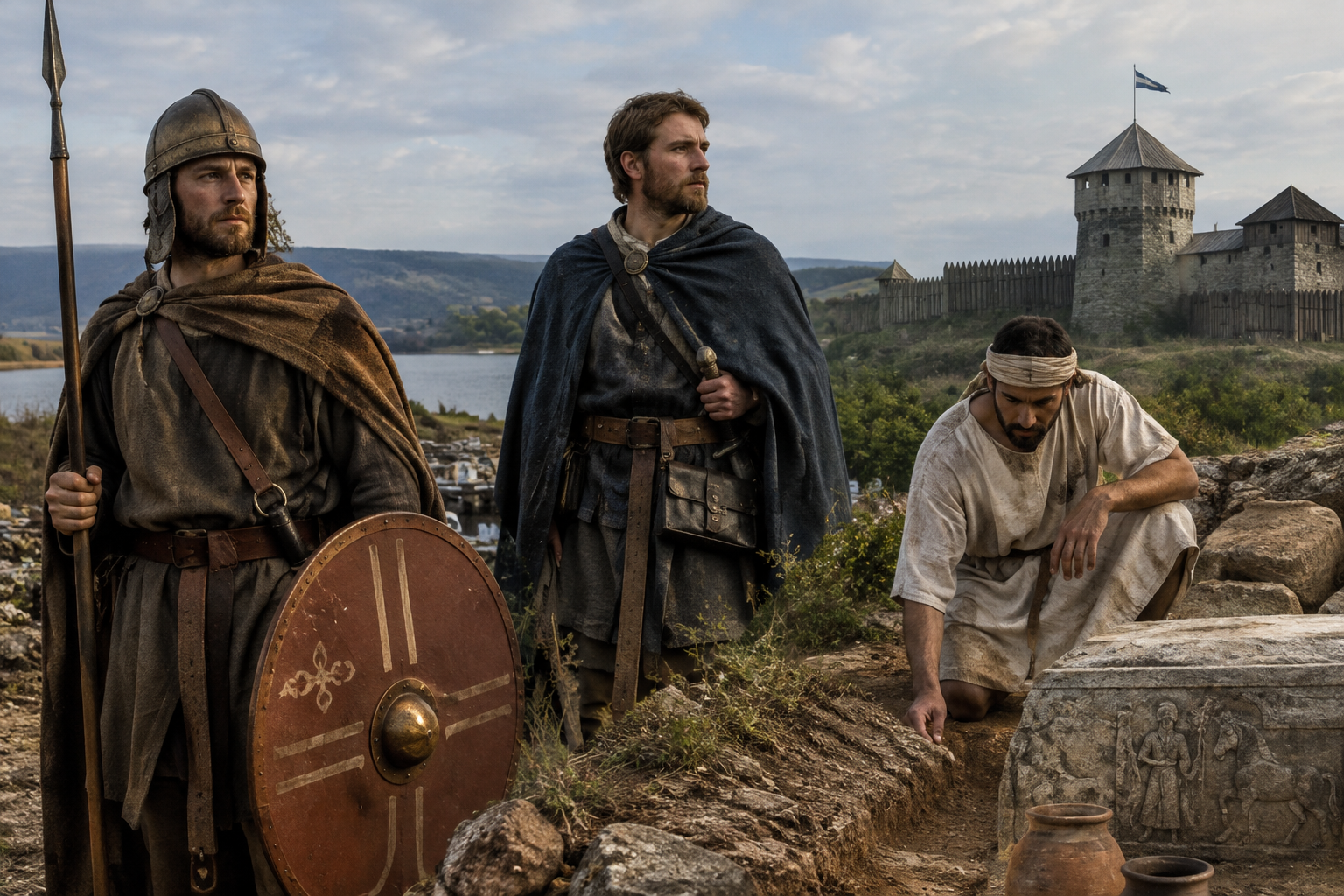
One of the clearest glimpses of Y-DNA haplogroup G2a2b2a1a1a1 in the ancient record comes from western Hungary, in the post-Roman landscape around Scarbantia, where sample HMU058 is dated to about AD 525. This was a frontier world after the end of Roman imperial rule in the West: old provincial structures had not simply vanished, but were being reworked by new political powers, new local alliances, and new communities buried in places that sat between Roman habit and so-called Barbaricum.
That is what makes this lineage interesting. Rather than appearing in one single, tidy cultural box, G2a2b2a1a1a1 turns up here in settings that stretch from Iron Age Anatolia to post-Roman Pannonia and then into medieval Scandinavia. Y-DNA follows only one direct paternal line, not a person's whole ancestry, but even that narrow line can illuminate something important: some male lineages persisted through very different worlds without belonging neatly to one empire, one language, or one people.
Sample HMU058, from the Hegyko area near Scarbantia in Hungary, belongs to a region that became especially important in ancient DNA work because it captures the messy centuries after Rome. Pannonia had once been a Roman province, but by the early sixth century it was a contact zone shaped by the remains of imperial administration, incoming groups, and local continuity. The archaeology of such cemeteries often resists simple labels, and that is exactly the point.
A genetic study of this post-Roman population has helped show how varied communities in the Little Hungarian Plain could be, with individuals reflecting different backgrounds and different forms of local integration rather than one uniform "barbarian" population. In that setting, HMU058's association with the article's branch matters because it places this paternal line in a historically mixed borderland at a time when identities were being rebuilt after Rome, not in a sealed-off ethnic enclave. For readers wanting the wider context of these burials, MyTrueAncestry has covered it here:
The most careful way to read HMU058 is not as proof of a migration route all by itself, but as evidence that a G-lineage branch associated here with G2a2b2a1a1a1 was present in a population living through the political unmaking of Roman Europe. If your paternal line belongs to this haplogroup, that is already a useful clue: its documented ancient appearances are compatible with long-term survival in settled agricultural and urban-adjacent societies as well as in later mixed frontier communities.
The oldest sample in this small group is I20224, from the Samantas Necropolis at Yatagan in Anatolia, dated to about 615 BC and placed in the era of the Lydian Kingdom. That is an arresting context. We are not dealing here with a medieval transplant or a late antique frontier alone, but with western Anatolia in the first millennium BC, in a landscape of kingdoms, sanctuaries, trade, and deep local continuities.
Research published on ancient populations of the broader Mediterranean and Near Eastern-connected world has repeatedly shown that Anatolia was not a peripheral backdrop to European history, but one of its great engines of movement and mixture. The presence of a lineage associated with G2a2b2a1a1a1 in a Lydian-period burial fits that larger picture well. It does not mean that every later bearer of the haplogroup came directly from Lydia, but it does remind us that western Anatolia was one plausible reservoir for paternal diversity long before the Roman and medieval periods.
This is also where the wider history of haplogroup G becomes useful, if handled carefully. Broadly speaking, many branches of G are deeply tied to the Near East, the Caucasus, and the first farming expansions into Europe. But the article's branch, G2a2b2a1a1a1, is a much narrower twig on that larger tree. The Yatagan sample is important because it gives this specific article a grounded ancient point in Anatolia rather than leaving readers with only a generic parent-haplogroup story. For a wider look at how Anatolian-linked ancestry moved into later Mediterranean worlds, see:
One should also note the limitation. We have a necropolis name, an approximate date, and a kingdom-level cultural frame, but not a warrant to invent language, status, or family role for I20224. The interest lies in the secure minimum: this paternal branch, or a very closely related reported association, appears in western Anatolia centuries before the Roman frontier sample from Hungary.
The third supplied example, mbv131, comes from Vasterhus in Sweden and is dated to about AD 1313. Vasterhus is significant because medieval Scandinavian churchyard cemeteries offer a very different kind of evidence from Iron Age kingdoms or post-Roman frontier zones. They show lineages not in moments of imperial collapse, but inside stable Christian burial landscapes shaped by parish life, inheritance, and local community structure.
An ancient DNA project focused on medieval Swedish multiple burials and kinship has highlighted how useful such cemeteries can be for understanding social relations as well as biological ones, even when every individual does not become historically famous. In that context, mbv131 tells us that the paternal history of this branch did not end in the Mediterranean or the Danube basin. By the early fourteenth century, a lineage associated here with G2a2b2a1a1a1 had a documented presence in Sweden.
That does not make the lineage "Swedish" in origin, nor does it require a dramatic migration tale attached to one man. Medieval Scandinavia was connected to the Baltic, to Christian Europe, and to older Viking Age and post-Viking mobility networks. A line appearing there could have arrived much earlier, spread through ordinary marriage and descent, or persisted through small-scale local founder effects. The value of mbv131 is that it widens the map while keeping the evidence concrete. Readers interested in how genetics is illuminating medieval burials in Sweden may also like:
Three samples are not a dynasty, and they are certainly not a population census. Still, they form a striking sequence: I20224 in Lydian Anatolia around 615 BC, HMU058 in post-Roman Hungary around AD 525, and mbv131 in medieval Sweden around AD 1313. The line appears in places that were all connected, at different times, to wider systems of exchange, empire, and movement.
That matters because haplogroup discussions are often flattened into crude origin stories. In reality, a paternal lineage can persist for many centuries while the men carrying it shift languages, religions, political loyalties, and social identities. The Anatolian sample sits in an Iron Age kingdom; the Hungarian sample in a post-imperial frontier; the Swedish sample in a Christian medieval setting. Same paternal thread, utterly different historical worlds.
There is also a broader archaeological lesson here. The old habit of matching one haplogroup to one people is a poor guide to the past. The evidence around G2a2b2a1a1a1 is more interesting than that: it hints at longevity, survivorship, and insertion into very different local histories. For another example of how mixed and mobile communities could be in late antique eastern Europe, compare:
What makes G2a2b2a1a1a1 memorable is not abundance, but contrast. Its current ancient trail, based on the samples here, links an Iron Age Anatolian necropolis, a sixth-century burial ground in the former Roman Danube world, and a medieval Swedish cemetery. That is a respectable historical span for any paternal line, and it sits comfortably with what archaeogenetics keeps teaching us: Europe and the Near East were tied together by repeated episodes of movement, settlement, and local continuity rather than one simple population replacement after another.
For someone researching this haplogroup today, the responsible takeaway is quite specific. Your direct paternal line may connect you to a branch with documented ancient appearances in Anatolia and later Europe, including a post-Roman frontier context and medieval Scandinavia. That does not hand you a royal pedigree or a single ethnic label. What it does offer is something better grounded in evidence: a paternal lineage that was already traveling through major historical landscapes long before modern surnames ever appeared.

Comments