Haplogroup G2a2b2a1a1
– 5 min read


At Kerkouane on the Tunisian coast, one ancient male identified as I24208 lived around 470 BC in the world of Carthage. That alone would be interesting enough: a Punic settlement tied to Mediterranean trade, North African history, and the long shadow of Phoenician expansion. But his reported Y-DNA association with G2a2b2a1a1 makes him more interesting still, because this is not the sort of lineage people usually imagine when they think about Carthaginian identity.
The point is not that one Y-chromosome tells us who the Carthaginians "were." Y-DNA tracks just one direct paternal line among thousands of ancestors. But when the same branch turns up in very different settings - a Late Neolithic individual in Switzerland, an Early Bronze Age man in Hungary, and then a Punic-era individual in Tunisia - it gives us a wonderfully concrete reminder of how old Mediterranean and European paternal strands could persist through enormous cultural change.
Kerkouane is one of those sites that forces us to drop simplistic ideas about ancient populations. Carthaginian and Punic communities were not sealed ethnic boxes. They sat inside trading networks that linked North Africa to Sicily, Sardinia, Iberia, and beyond. So when a male individual from this setting, I24208, is associated with G2a2b2a1a1, the real historical value lies in the mixture it implies: a Punic-period life carrying a paternal line with much deeper prehistoric roots.
That broader picture fits the growing lesson of ancient DNA work on Punic and island Mediterranean populations: these were connected, mobile, and varied communities rather than biologically uniform colonies. A recent ancient DNA study touching this western Mediterranean world is here, and it helps frame why a lineage like G2a2b2a1a1 appearing in a Carthaginian context should not surprise us.
In historical terms, this is rather delicious. Carthage is often presented in schoolbook fashion as the great "other" of Rome, yet the genetics of Punic-era burials increasingly show a society shaped by circulation and contact. A haplogroup like G2a2b2a1a1, seen here in North Africa, belongs in that story of layered ancestry rather than any tidy tale of a single founding people reproducing in isolation.
The earliest sample in this set is SX11 from Brienzersee, Switzerland, dated to about 4410 BC in the Late Neolithic. That date matters. Haplogroup G, in its broader forms, is well known in discussions of early and middle Neolithic farmers across Europe, and this Swiss individual provides the oldest clear point in this article's chain of evidence.
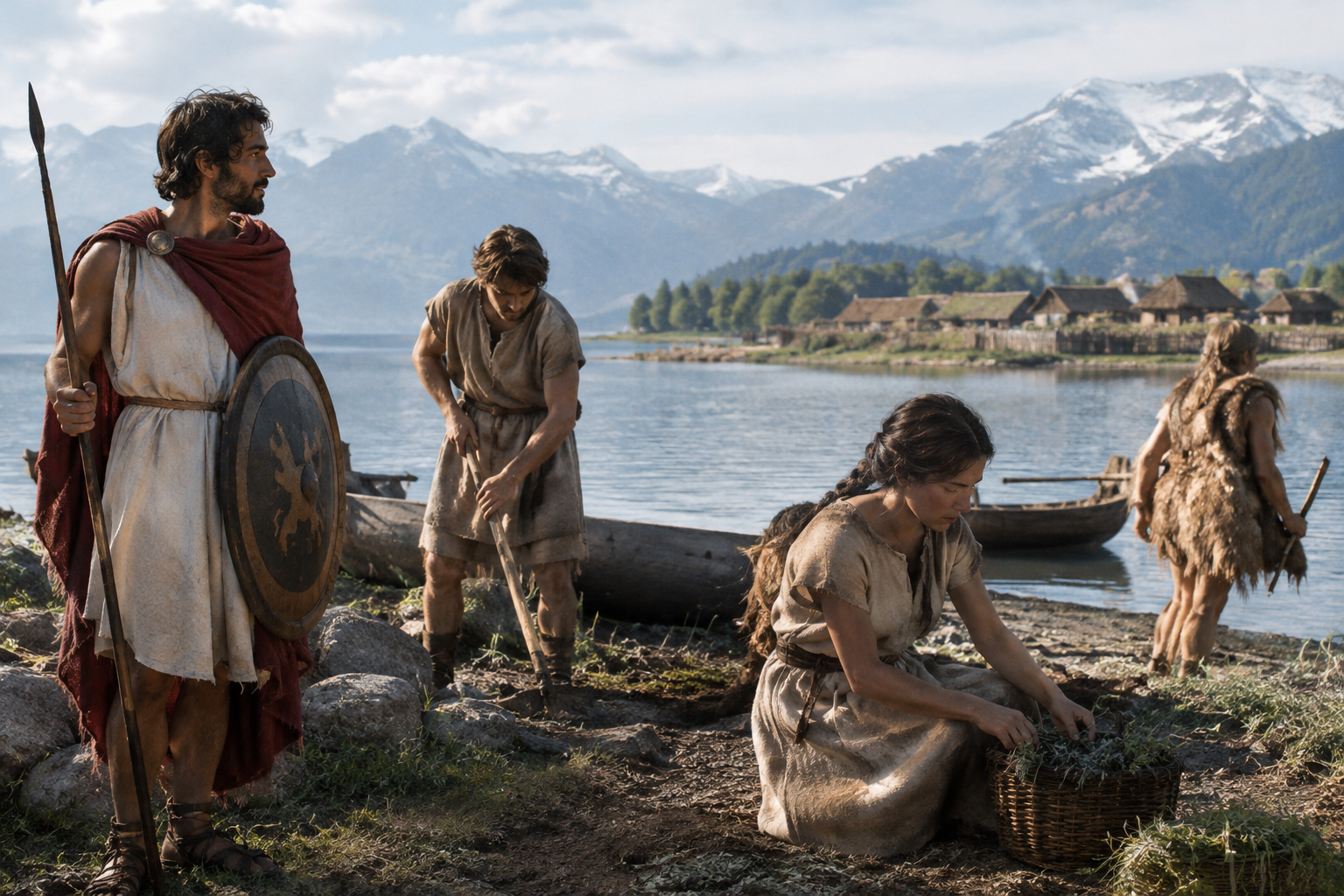
Now, one must be careful here. It would be wrong to say that G2a2b2a1a1 "belongs" to all Neolithic farmers, or that every later man with this branch descended from this exact Swiss community. But SX11 does place this paternal line in the farming world of prehistoric central Europe, a landscape of lakeshores, villages, and long-settled agricultural lifeways.
That deep Neolithic presence is important because it helps explain why later appearances of the lineage need not signal some dramatic migration each time. Sometimes a lineage survives locally, or regionally, through centuries of change in language, material culture, and political allegiance. If you want wider context for how farming ancestry transformed Europe, MyTrueAncestry has a useful overview in The Neolithic Expansion.
The next stop is I2367 from Budakalasz-Luppa Csarda, Hungary, dated to around 2100 BC in the Early Bronze Age. This is a different historical world altogether from Late Neolithic Switzerland. By the early 2nd millennium BC, the Carpathian Basin was tied into wide networks of exchange, shifting burial customs, and populations that had already lived through the upheavals of the later Copper and Bronze Ages.
What makes I2367 valuable in this small cluster is precisely that middle position. It shows G2a2b2a1a1 not only in an early farming horizon, but also in a later Bronze Age setting after Europe had already experienced major demographic changes. In other words, this paternal line did not simply vanish with the end of the Neolithic; it persisted into a far more mixed and dynamic age.
A landmark ancient DNA study on prehistoric Eurasia and the transformations around this period is here. Even without forcing any single sample into a grand migration tale, the wider lesson is useful: Bronze Age Europe was not a clean replacement of one lineage by another. Some earlier paternal strands continued, sometimes quietly, beneath the louder genetic and archaeological headlines.
Ancient DNA in the Carpathian Basin
Taken together, SX11, I2367, and I24208 do not form a pedigree. They are not evidence of one family moving from Switzerland to Hungary to Tunisia over four thousand years. That would be nonsense. What they do show is something subtler and, in truth, more historically satisfying: G2a2b2a1a1 appears in very different societies that succeeded one another across prehistoric and historic Europe and the Mediterranean.
That matters because haplogroups are often flattened into slogans. People hear that a lineage is "Neolithic" or "Mediterranean" and start treating it like a tribal badge. The archaeology here resists that. At Brienzersee, the lineage sits in a Late Neolithic setting; at Budakalasz-Luppa Csarda, it survives into the Bronze Age Carpathian world; at Kerkouane, it appears in a Punic context tied to North Africa and maritime exchange. Same paternal branch, radically different cultural lives.
There is also a useful geographical point. These sites lie across a broad arc from Alpine central Europe to the Carpathian Basin and the central Mediterranean. That does not define the total range of the haplogroup, but it does suggest that this branch was part of long-lived male ancestry within zones repeatedly connected by movement, commerce, and settlement.
If there is a theme to G2a2b2a1a1 in the evidence here, it is not conquest or sudden expansion but endurance. This branch turns up in moments when archaeologists often talk about transformation: the establishment of farming worlds, the social changes of the Bronze Age, and the cosmopolitan realities of Punic North Africa. Yet the lineage itself seems to persist through those changes rather than belonging neatly to only one of them.
That is why this haplogroup can be so intriguing for paternal ancestry research. It hints that some male lines passed through Europe's and the Mediterranean's great transitions not as headline-makers, but as survivors. For another example of how ancient genetics complicates easy regional labels, see Paleogenomics of Ancient Italian Islands, where island histories also turn out to be far more connected than they first appear.
On the evidence here, G2a2b2a1a1 is best understood as a paternal line with deep roots in prehistoric Europe and a later presence in the wider Mediterranean world. The most distinctive thing about it is not a claim to one people, one kingdom, or one migration, but its appearance across very different archaeological settings over a very long span of time. If this is your Y-DNA line, the strongest historical suggestion is that your direct paternal ancestry may connect to one of those old and persistent male strands that remained in circulation from the Neolithic into later Mediterranean history.






Comments