Haplogroup G2a2b1a1b1b

– 5 min read


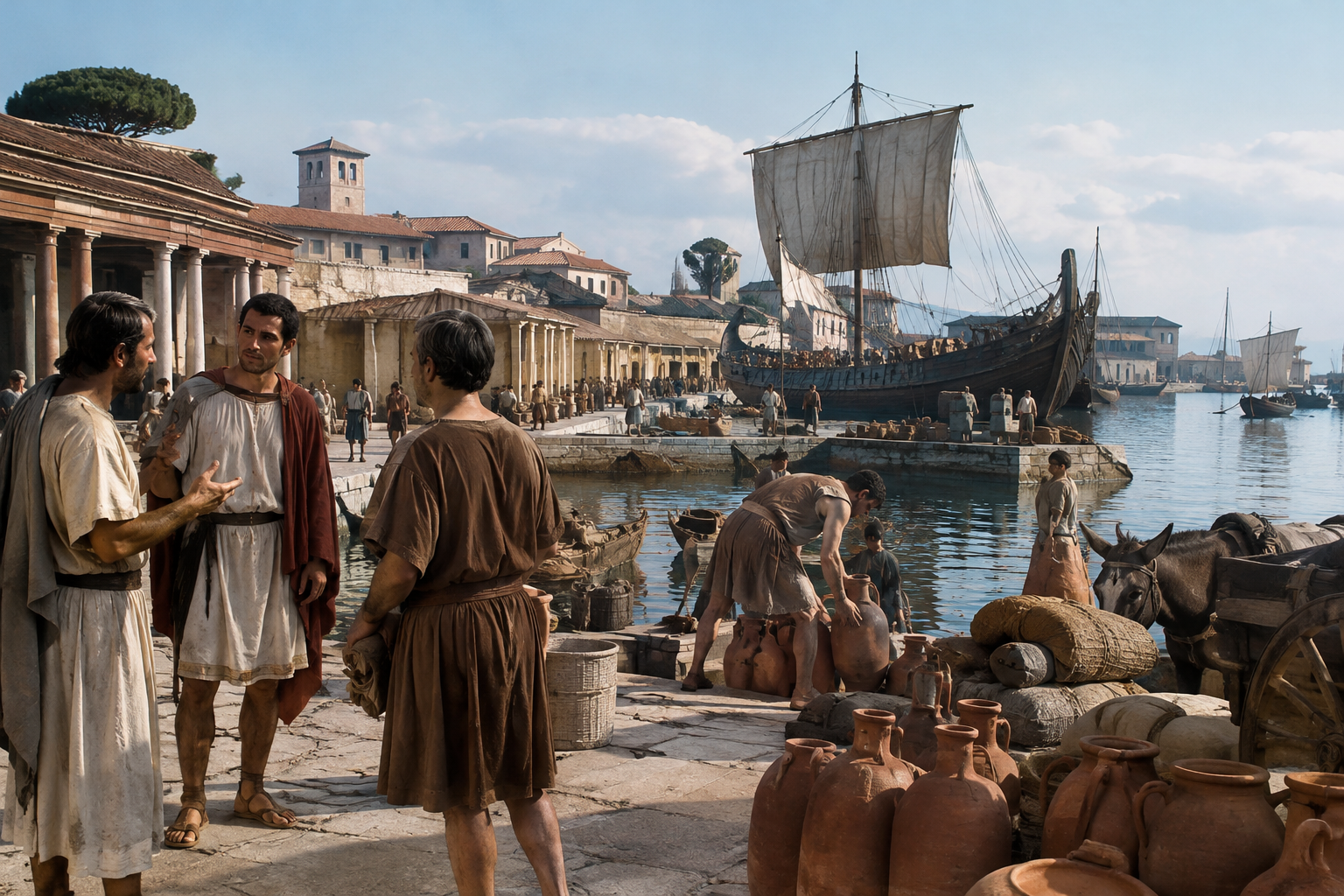
At Isola Sacra, the great cemetery serving the port of Ostia near Rome, one man dated to around AD 200 has been reported with the Y-DNA haplogroup G2a2b1a1b1b. He is known in the ancient DNA record as R11119. That may sound like a dry laboratory label, but the setting is anything but dry: this was one of the busiest maritime landscapes in the Roman world, a place where merchants, sailors, dockworkers, freedpeople, and families passed through the empire's front door.
That makes R11119 interesting straight away. A paternal lineage such as G2a2b1a1b1b traces one direct male line only, not a whole person's ancestry, but finding it in Imperial Rome's port environment places this branch inside one of antiquity's most cosmopolitan human crossroads. The question is not whether one haplogroup can explain Rome. It cannot. The question is what one well-placed individual can show about how old paternal lines survived and circulated in a world built on mobility.
Isola Sacra lay between Ostia and Portus, in the zone where river, sea, warehouses, roads, and cemeteries all met. It is the sort of site archaeologists love because it brings together ordinary life and imperial scale. The dead buried there belonged to a port society tied to Rome's food supply, trade, transport, and constant movement of people around the Mediterranean.
So when a lineage like G2a2b1a1b1b appears here in sample R11119, the result matters less as a badge of ethnic identity than as evidence of presence in a mixed urban setting. Roman ports did not neatly sort people into simple ancestral boxes. They gathered lineages with very different deeper histories and placed them into shared neighborhoods, workplaces, and burial grounds.
An ancient DNA study examining Roman-period populations, including material relevant to this wider setting, can be found here: https://www.biorxiv.org/content/10.1101/2022.05.15.491973v1.full. Even without forcing more precision than the present evidence allows, the broad lesson is clear enough: port communities in Roman Italy were biologically and culturally varied, and paternal lines like this one were part of that diversity.
The wider haplogroup G is an old West Eurasian paternal lineage with a long archaeological record. In European prehistory, branches of G are especially familiar from early farming contexts. That does not mean every later G lineage should be read as a simple survival of the first farmers, nor does it mean that this exact branch moved along one tidy route from Neolithic village to Roman grave.
Still, the broader background is useful. G lineages were deeply involved in the demographic changes that accompanied the spread of agriculture into Europe. Over the millennia, some branches dwindled, others persisted locally, and others were absorbed into later societies shaped by Bronze Age mobility, Iron Age networks, and imperial urbanization. By the time we reach R11119 at Isola Sacra, we are looking at a paternal line with very old roots appearing in a thoroughly historical world.
That is often the fascination of Y-DNA. The branch name looks technical, but behind it sits a very human fact: some direct paternal lines can remain traceable across enormous spans of time, even though the societies carrying them have changed almost beyond recognition.
Ostia and Portus were not provincial backwaters. They were engines of connection. Grain from North Africa, goods from the eastern Mediterranean, people from Italy's interior, administrators, laborers, traders, and migrants all passed through. The cemeteries around them therefore matter enormously for ancient DNA, because they let us test what Roman connectivity looked like in actual bodies rather than in literary stereotypes.
In that sense, R11119 is valuable precisely because he is not a king and not an invented historical hero. He comes from the kind of place where the empire functioned day by day. A man carrying G2a2b1a1b1b at Isola Sacra tells us that this paternal branch belonged within the social reality of imperial Italy, not just in some remote prehistoric chapter.
It also helps correct a common misunderstanding. Roman Italy was not genetically static before, during, or after empire. The peninsula had already absorbed layers of ancestry and cultural influence long before Augustus, and Roman rule intensified rather than created mobility. One reason port cemeteries are so revealing is that they capture this mixing without pretending everyone there had the same origin story.
For many readers, haplogroup G immediately calls to mind Europe's first farmers, and that association is reasonable at the level of the wider haplogroup. Across Neolithic Europe, G-lineages appear again and again in early agricultural communities. But the historical importance of R11119 lies in showing how misleading it would be to stop the story there.
By about AD 200, nobody at Ostia was living in a Neolithic world. They lived with masonry tombs, imperial administration, shipping schedules, taxes, legal identities, and a vast urban market. Yet within that Roman framework, a paternal line belonging to the broader G family was still present. That is exactly how population history usually works: not as replacement by a single new people, but as survival, mixture, and reorganization over long periods.
If you are interested in the deeper farming background that made lineages like wider G so important in European prehistory, MyTrueAncestry has a useful overview here:
That larger prehistoric framework should be handled carefully, though. The exact subclade in this article is G2a2b1a1b1b, and without a fuller chain of securely discussed intermediate ancient examples, it would be wrong to assign to it every movement ever proposed for haplogroup G as a whole. The safe historical point is narrower and stronger: a branch within this old paternal family appears in an Imperial Roman burial from the port zone of Ostia.
Ancient DNA has made one thing wonderfully plain: terms like "Roman," "local," "migrant," or even "Italian" do not map neatly onto a single biological profile. At a site like Isola Sacra, the archaeological context is Roman, the date is Imperial, the geography is central Italian, and the people buried there could still have very mixed family histories across only a few generations.
That makes lineages like G2a2b1a1b1b historically useful because they resist lazy storytelling. They do not allow us to say, "this was the Roman haplogroup," because there was no such thing. Nor do they let us conjure a one-step migration tale from a distant homeland into a specific grave. What they do show is that an old paternal line had become part of the human landscape of Rome's port society.
Related work on Roman and post-Roman Italy keeps reinforcing this picture of layered continuity mixed with mobility. For a neighboring line of inquiry on ancient Italian populations across changing periods, see:
If your Y-DNA falls under G2a2b1a1b1b, R11119 offers something modest but real: a documented appearance of this paternal branch in the Roman port world at Isola Sacra around AD 200. That does not make every modern carrier "Roman," and it certainly does not provide a direct family tree back to Ostia. But it does place your direct paternal line within a historically vivid setting where Mediterranean mobility, local continuity, and imperial life all met.
In other words, this haplogroup is not only a prehistoric curiosity. In the case of R11119, it belonged to a man living in the working, burying, trading world of imperial Rome's harbor zone. That is a fine reminder that deep ancestry did not disappear when history began; it kept walking through streets, loading ships, raising families, and leaving traces in cemeteries.






Comments